Tag: Ring Cycle

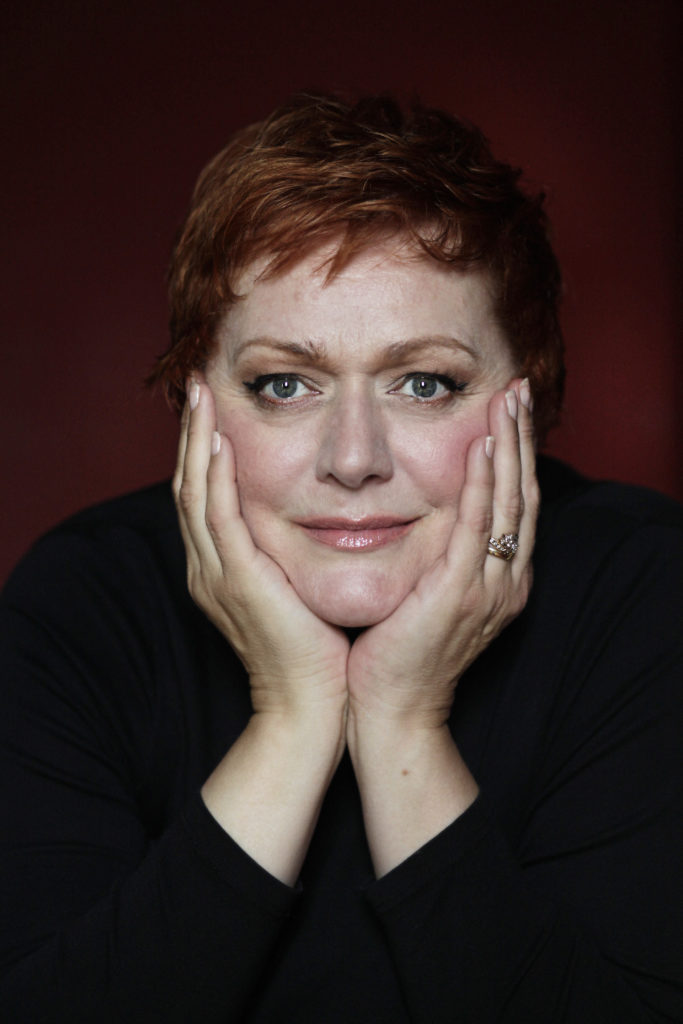
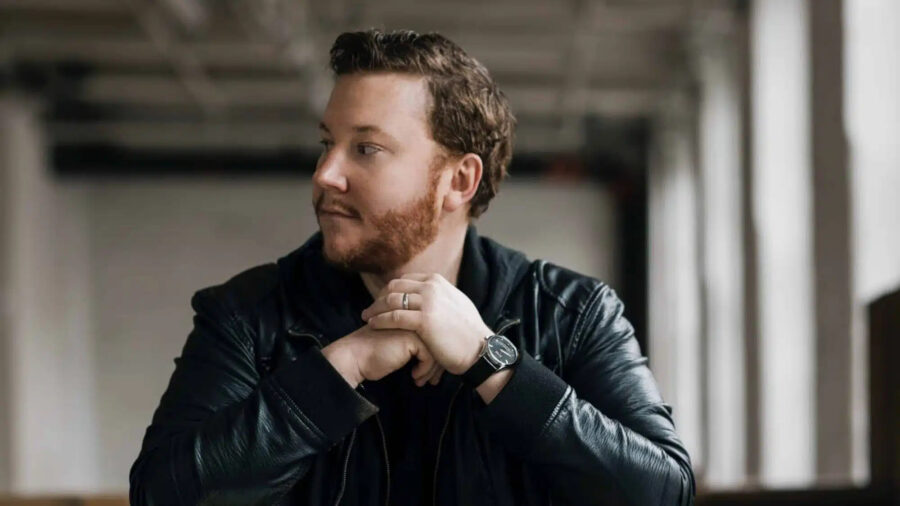
Nicholas Brownlee, portrait, profile, opera, bass-baritone, singer

Nicholas Brownlee: On Opera, Emotions, & Being “A Whole And Total Person”

Nicholas Brownlee smiles when asked if he has any summer plans.

“Not really,” comes the response, “but I think I know every inch of track between Munich and Bayreuth.”

The American bass-baritone has been singing non-stop, or so it seems, for over a decade. This past season has been especially focused on the work of Richard Wagner, starting last autumn at Bayerische Staatsoper in Munich with a highly acclaimed production of Das Rheingold directed by Tobias Kratzer, with Brownlee singing the role of Wotan, King of the Gods. The production was revived this past July for the company’s annual summer opera festival. This summer he returned to the Bayreuth Festival, following his debut there last summer, as Donner in a revival of Das Rheingold, directed by Valentin Schwartz and conducted by Simone Young. Between rehearsals for the two revivals, Brownlee clocked up a lot of mileage with Deutsche Bahn.

The journey for a “classic-American boy” from Alabama, as you’ll read, has been longer, if also deeply rewarding. Winner of the 2025 Richard Tucker prize, Brownlee’s journey has been characterized by a nose-to-the-grindstone approach, one that has never been at the expense of intelligent singing and a colourful, rich sound. The bass-baritone, who was awarded first-prize in the Hans Gabor Belvedere Singing Competition (2016), the Zarzuela prize at Operalia (2016), and was a winner in the Metropolitan Opera National Council Auditions (2015), got his start studying at the University of South Alabama before getting his Master of Music degree from Rice University. From the 2014-2015 to 2016-2017 seasons, Brownlee was a member of the LA Opera Young Artist program; he also appeared with the International Vocal Arts Institute in Tel Aviv, was part of the inaugural Young Artist Vocal Academy with Houston Grand Opera; spent a summer in Beijing with I Sing Beijing, and was part of the ensemble of Badisches Staatstheater Karlsruhe, where he performed a range of works by Handel, Massenet, Gounod, Offenbach, Mozart, and Verdi, and others. The 2020-2021 season saw him join the ensemble of Oper Frankfurt, where he has been based ever since. There, Brownlee has added the music of Verdi, Mozart, Strauss, Szymanowski, Bizet, Bartók, Giordano, Stravinsky, and a great many more to his repertoire.

He has since performed with Wiener Staatsoper, Opernhaus Zürich , Irish National Opera, Teatro dell’Opera di Roma, Teatro de São Carlos (Lisbon), The Metropolitan Opera, LA Opera, The Dallas Opera, Santa Fe Opera, Atlanta Opera, and Bard SummerScape,  expanding his musical palette to include the work of Erich Korngold (Das Wunder der Heliane, 2019) as well as contemporary composers like Jake Heggie (Moby Dick, 2015) and Unsuk Chin, whose Alice in Wonderland was presented in 2015 in concert with the Los Angeles Philharmonic and conductor Susanna Mälkki. He has also performed with the Houston Symphony Orchestra, Orchestre Symphonique de Montréal, the Prague Philharmonia Orchestra, and Orchestra Sinfonica Siciliana; next season sees him give concert performances with the Houston Symphony (Tristan und Isolde) and the orchestra of the Gran Teatre del Liceu (Mahler’s Eighth Symphony).

Whether in-concert or onstage in opera, Brownlee is never less than fascinating. In 2024 he gave a particularly zesty portrayal of Don Pizarro in a unique production (by Andriy Zholdak) of Beethoven’s Fidelio at Dutch National Opera, in which he was made to resemble high fashion honcho Karl Lagerfeld. One definitely isn’t supposed to root for the bad guy in Beethoven’s paean to freedom and fidelity… and yet. Something similar could be said for his Wotan in the Bayerische Staatsoper production of Das Rheingold – though Wotan is less villainous, as Wagner fans will know, than he is ruthlessly ambitious. Brownlee placed emphasis on the “ruthless” part, offering a multifaceted portrayal of the Valhalla god, by turns playful, brutal, seductive, highly selfish and deeply driven – human.

We discussed that and more last month, at the almost-end of what had been a very busy, Wagner-heavy season. Along with Wotan in Munich in October (and again in July), early February saw Brownlee sing the same role for his house debut with Opéra national de Paris (directed by Calixto Bieito) and Oper Leipzig, in a revival of  Rosamunde Gilmore’s 2013 staging. From there, Brownlee performed as the doomed title character in Der fliegende Holländer (The Flying Dutchman) at Palau de les Arts Reina Sofía (Valencia), Teatro Regio di Torino, and Bayerische Staatsoper. He sang the role of Amfortas (Parsifal) with Oper Frankfurt and in a concert presentation with Cēsis Art Festival and the Latvian National Symphony Orchestra. Recently in Bayreuth, Brownlee stepped in at the last minute for the singing role of Hans Sachs in Die Meistersinger von Nürnberg. His 2025-2026 season opens with a role debut as Balstrode in Peter Grimes in Frankfurt (opposite tenor Allan Clayton in the lead) before travelling to Hong Kong to sing Amonasro in Aida; his hectic future also includes a performance of Jochanaan in Salome with Lyric Opera Chicago, a turn as the Dutchman opposite Asmik Grigorian’s Senta in Bayreuth, and of course, a return to Wotan with Die Walküre with Bayerische Staatsoper, both next summer. One suspects the Munich-Bayreuth line is going to be especially well-used.

Brownlee’s impressive vocalism, with its oaken shades and bronzed ringing top, joins seamlessly with an effortlessly magnetic stage presence and thoughtful artistry – and comes minus any divo attitude. The “charismatic and charming” description by The New York Times (from a review in 2015) is not inaccurate; offstage however, the bass-baritone’s charisma is powered by a refreshing lack of pretension or putting-on of any artiste-style airs. He is a star, make no mistake, but he wants to make sure audiences don’t just hear him, but feel him, and his musicality especially, with all the earth of sonic experience viscerally moving between fingers and toes. This isn’t singing from the heavens so much as from rolling around in that very earth, while, to borrow from Wilde, gazing at the stars. That’s the magic of Nicholas Brownlee as person and performer, onstage and off.

Over a lunch of salad and mineral water, and on the very day of the Munich Rheingold revival, Brownlee spent a good hour-plus musing on singers of all genres (he is a big Roy Orbison fan), the realities of German ensemble life, the importance of embracing his background (including creature comforts), living with (and as) Wotan, and why all opera essentially revolves around four basic human emotions.

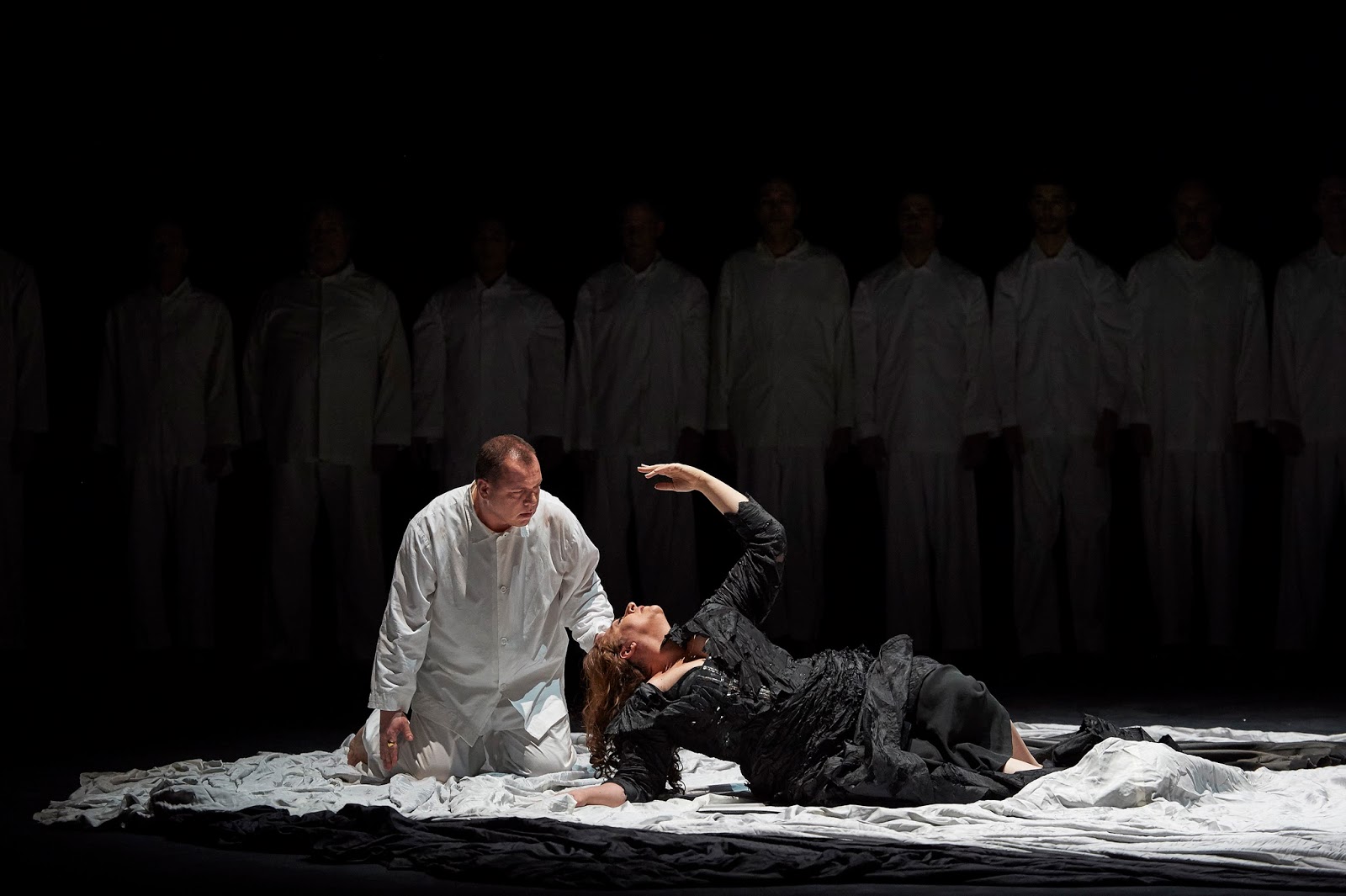
Nicholas Brownlee, opera, stage, bass-baritone, Der fliegende Holländer, Wagner, Bayerische Staatsoper, performance

Nicholas Brownlee in the title role of Der fliegende Holländer, Bayerische Staatsoper, 25 March 2025. Photo ©Geoffroy Schied

Early Inspirations

Some singers have a clear idea of what they want to do – “When I first heard Aida, I knew I had to be Aida,” or “When I first heard Traviata, I knew I had to be Violetta” – was it the case for you with the music of Wagner, or was it a more circuitous route?

For me opera was, and continues to be, a very interesting journey. I have no classical music in my family at all, although I originally wanted to be a conductor; that’s how I fell in love with music. I had a high school teacher who introduced me to big symphonies and gave me a full music education in a public high school in Alabama, which was and is rare. And so I went to school to be a conductor and pianist. And it wasn’t until I was in the first opera I ever saw that I really thought about singing.

Which opera were you in at the beginning?

I was in the chorus of La traviata with the Mobile Opera. They still exist and I’m on the board there now. I then fell head over heels in love with opera through them.

Was there a big “a-ha!” moment – “Wow, I can sing this stuff!” – or was it more gradual?

I was always singing and performing in my household – Elvis Presley; Conway Twitty; old-school country music. I think it makes you a balanced performer to know that work. And I think when you look at singers like Tom Jones and Elvis and Roy Orbison, all those guys, they’re just beautiful, I mean… wow, they are just really good singers! They sing in tune; they sing unfixed post; they project – it’s all really good stuff. So with all that music at home, I would also sing and perform. In college I had a professor who was already sort of pushing me to sing; when I would have my exams, he would say, “You have a voice, and it’s operatic; I can hear it in your speaking voice.” I was 19 years old. So then I changed my focus to include voice in my major, and I started taking voice lessons. That was 16 or 17 years ago or so now, and there have been a lot of steps, but it’s been incredible.

Opera for me was the first thing I ever truly felt comfortable in, really. I grew up your very classic-American boy; I played American football and baseball and golf. I didn’t really know I felt uncomfortable then – I felt perfectly comfortable, in a way – but then I got around opera singers and various other artists in rehearsal rooms, and all my dark jokes were met with smiles. It was like, “Ah, welcome to the craziness!” That was when I felt the most comfortable, and I knew that I’d found a home.

Honest Friends = Good Friends

How does that sense of community translate to your experiences now? Doing opera productions, one forms this little club, and then when the run ends, so does the club – I would imagine that’s tough.

Well, it’s gotten easier. It is tough when you’re beginning because you’re young, you’re right out of school, and school is such an insular community. Then you go into your young artist program, and you’re all together like we were in LA for two years, having every meal together; in a way there are very frat-like vibes in a young artist program, because we’re all in it together… but then, all of a sudden, you are a freelance artist.

And those first few years, you’re working, sometimes with people in similar age ranges, and you realize people may take different paths: teaching, coaching, management. So you learn that every gig is different people, but each time you’re creating a bond. Maybe you have a show romance with someone or you think you’re best friends and you trade numbers. You’re like, “I found it! I found my best friend!” – and then it’s just gone. And then you go away and you don’t have time to figure it all out and real life kicks in. It’s so hard to get to this level – the amount of, not just talent, but luck it takes, the stress, the energy, the training, everything… it’s a lot. There are so many things you are forced to deal with. You end up working with some of the same people also, so there are little mini-reunions twice or sometimes three times a year, and that’s really important. From that, you start to forge actual friendships with roots and depth – and that, for me, has been a huge change.

Has that depth affected your performance practices?

I’ve been in the ensemble for five years in Frankfurt. The way we use our ensemble is so special. For instance, we’ll do a full Salome, and it’s everybody in the ensemble. We do a full Ring Cycle; it’s everybody from the ensemble. So you’re singing with some of your real best friends – like, all of our kids play together in real life. We have a lot of life there together and you get to do opera with them also, and so there’s a real safety, but more than that; there’s this ability to like feel like you can take chances that you wouldn’t normally take when you’re a guest in a place – because that trust is already there, it’s established. And, to be quite frank with you, it’s good to have friends who are close enough to sometimes say, “Well, that didn’t work, that thing you were trying to do.”

It works the other way also. Right before we went out and did a twelve-show run of Macbeth, I saw a friend of mine and they said, “I’m going to do it this way tonight” – and later it was like, “Bro, you gotta do that every night!”. There’s a beautiful, natural camaraderie amongst the singers, something that can be really hard to find.

Camaraderie, Comforts, & Life Between Plans

How do you negotiate life as an American in Europe?

It’s hard. I think you know I’ve lived here for nine years now. I was first in Karlsruhe for four years, then in Frankfurt now for five years. I think, like anywhere, you just have to find your people – you have to find your way of living. For instance, in the first four years my wife (mezzo-soprano Jennifer Feinstein) and I were here we went full-European: no car; lived in the heart of the city; walked everywhere – rain, snow, didn’t matter. It was really difficult. And then when we moved to Frankfurt, my wife and I were both like, “Look, if we’re going to really lean into here, why don’t we at least have some of the comforts from home?”

So we still live centrally, but further out. We bought a car we go grocery shopping with; we buy in bulk. We bought a big, American-style refrigerator with ice on the door. We bought screens for the windows. You have to find your creature comforts, these little things that, for better or worse, we grew up with, culturally. You cannot help where you’re born; you cannot help or change what is your homeland. And so, you adjust and you acclimate as much as you can – and then enjoy your creature comforts.

I would imagine that actually helps you on stage, knowing you have that kind of predictability at home.

Yes, and understanding that decision fatigue is a real thing also. It’s really hard to know, as a person living in a foreign place, exactly what you want initially, and how you want your life to look on a literal day-to-day basis – especially as an artist. I mean, as artists we are always looking at the big picture in this zoomed-out way, but the details matter, like “Wow, this person is probably a little dehydrated; he needs a coffee” – it’s just that simple sometimes.

Nicholas Brownlee, Sean Panikkar, Lucie Thies, Bayerische Staatsoper, Das Rheingold, Wotan, Valhalla, Tobias Kratzer, opera, Wagner

Film still from Tobias Kratzer’s production of Das Rheingold for Bayerische Staatsoper. (L-R) Sean Panikkar as Loge, Nicholas Brownlee as Wotan, Lucie Thies (Bavarian State Opera extras). Photo © Manuel Braun, Jonas Dahl, Janic Bebi

Does Wotan want a coffee, then?

Yes! I mean, the question as to whether Wotan’s actually a human or a god or whatever… sometimes people are just people, and the answer is very simple. And I think that that’s the thing that gets us through day-to-day life. I think that it’s taken me a long time to come back around to this idea; I was raised very blue-collar, and then I got to college and I met a variety of different people, and I wound up getting a little too lofty for my britches, I would say, a little too heady and a little too looking-down-at-my-past culture and how I was raised – and now, I’ve come right back around. I think that that’s being a whole and total person. I think that’s what people mean by being worldly.

The ability to sit in a cafe in Paris and argue about philosophy until 2am is really nice, and really fun, and boy do I love that kind of thing, but I also love when I get invited by a nonna for an incredible meal that involves four ingredients – that is life; that is experience. It’s easy to fall into thinking opera’s this big, flowery thing, but, I say this all the time, I really am just screaming into a black void…

… with great precision and beauty.

That’s true, but I’m also doing it because I want to display the four base emotions of human life and try to shed a little bit of light on them. In order to do that, I say some of the most lofty things, especially singing Wagner – it’s the most poetic German you’ve ever heard in your life. Yes, we can break down the chords and we can talk about how gorgeous the music is and all of it, yes – but really, for me, what there highlights the four most basic human emotions: love; anger; sadness; the fourth one is complicated, maybe something like saudade, longing, sehnsucht. And I think that that’s what opera is. It’s trying to capture those four base emotions. Of course we can discuss its incredible power at various levels: the scary power of the church in Tosca; the power of economic hardship in Bohéme; Wotan’s testing and exercising his own divine power in The Ring. These stories aren’t distant; they’re very real.

With this Wotan I’m singing in Munich, I think of it like Elon Musk when he was 31 years old and had just sold PayPal; you can listen to interviews from that time and hear that he was walking along that line of power and how to use it. Wotan in Rheingold feels like somebody I might know, somebody who was young and made it big and is walking this line now. I mean, imagine you have the keys to the city, to every single city, the secrets of many, infinite knowledge, any male or female wants to be next to you – or more – all the time; how is that shit not going to corrupt you? Of course it will. Having that kind of a life is not the way life is really meant to be – it’s weird. The way this production ends really underlines that.

So what do you think has this experience taught you overall?

Some of my colleagues will say to me after a performance, “Look, you have this life, it’s a good life; whatever you do, Nick, hold onto it.” As much as Wagner is great, Bayreuth is great, Munich is great, it’s all very great – it’s important to have a life outside of opera. I think it’s really imperative. You can easily forget that life happens outside the opera house each and every day; you zoom in, and then you zone out. My wife is a big planner and I’m very spontaneous, and we’ll talk about meeting in the middle, but we always say in the end: life is really between the plans. Life is now.

Top photo: Fay Fox
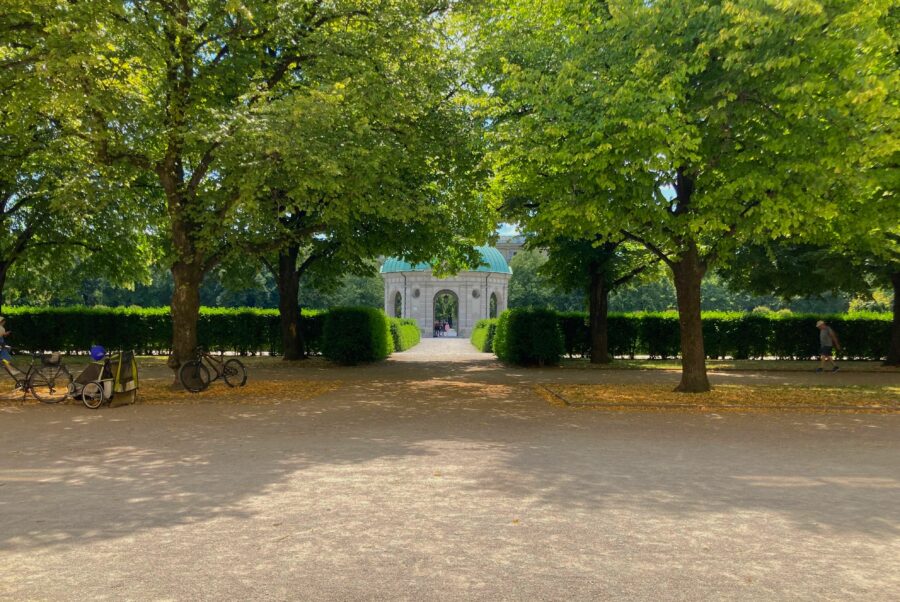
trees, nature, path

Reading List: Summer 2025

Voila, a varied list of meaty music morsels, here for your weekend heatwave reading perusal:

Money, Honey

Arts organizations everywhere are facing funding shortfalls, with American outlets especially feeling the pinch. The New Yorker published an article in late April outlining the realities particularly related to funding drops from philanthropic organizations; writer Helen Shaw quotes various members of said philanthropic outlets who state that funding should not be forever, for anyone. Niegel Smith, artistic director of The Flea Theater in New York, is blunt: “Since the nonprofit theatre movement solidified in the nineteen-fifties, we have faced government shifting, but not this kind of foundation retrenchment. When I entered the field, the sense was that you could work and prove yourself and then your company would win enduring support from the pool of foundations. That’s no longer the case.” (“The Show Can’t Go On”, The New Yorker, April 24, 2025)

A new article by The Globe & Mail‘s Josh O’Kane sheds light on a pay-for-play situation within the Canadian classical world. The Toronto Symphony Orchestra is allowing a wealthy amateur conductor to lead a performance of Mahler’s Second Symphony this coming week. The amount the individual paid the orchestra for the opportunity was not disclosed, but some TSO musicians (all of whom asked to remain anonymous) are unhappy. Interestingly, it was only last September that the orchestra received a $15 Million gift from the Barrett Family Foundation, the largest in the orchestra’s 102-year history. (“Amateur conductor pays Toronto Symphony Orchestra to lead Mahler performance, shocking some musicians“, The Globe and Mail, June 20, 2025)

What’s the relationship between location and innovation? A short rundown in Concerti explores various German opera companies who, facing needed renovations at their home bases, have moved to alternate locales, and found new methods and modes of both presentation and programming. The report is a little dismissive of Komische Oper Berlin — moving from Behrenstraße to “polite bourgeois Charlottenburg” (specifically the Schiller Theatre) has hardly dampened the company’s embrace of innovation. Large-scale presentations like Henze’s The Raft of Medusa (staged at an old hangar at Templehof Airport in 2023) and the upcoming Jesus Christ Superstar (at the same venue this autumn) might never been done so ambitiously, nay programmed at all, were it not for the renovations that forced the company from their longtime home. Still, this is good food for thought, especially at a time when dwindling resources may necessitate more creative approaches. (“Ungeahnte Impulse“, Concerti, June 13, 2025)

Humans First

Sir Simon Rattle received the 2025 Ernst von Siemens Prize in mid-May in Munich. The conductor is using the €250,000 prize to form a new period ensemble within the Bavarian Radio Symphony Orchestra (BRSO).  In a comprehensive interview with BR Klassik’s Bernhard Neuhoff done earlier this month, the conductor (who is also the subject of a new documentary) reflects on his career and its changes and challenges. One quote (translated) particularly stood out: “You will need all experiences, because if there is only music, what’s the point? We have to be human beings first, and musicians second.” (This nicely echoes something Lucas Debargue said to me in early 2020.) The conductor is set to lead the BRSO in a new production of Don Giovanni at Festival D’Aix, and he’ll also be on the podium for a concert with the orchestra in mid-July (still in France), one featuring the music of Ligeti, Wagner, and Bruckner. (“So Hat Musik Sein Leben Verändert“, BR Klassik, June 6th, 2025)

A new column by Lynn Gardner in The Stage explores survey results of British theatregoers, and makes an obvious if important observation: “For those of us for whom theatregoing is a habit, we often forget that for many people a night at the theatre is a special night out.” (“Matching expectation to experience in theatre is getting harder“, The Stage, June 16, 2025) Gardner’s musings on the intersection of expectations and artistry brought to mind an interview in Van Musik between music writer Arno Lücker and author, film critic, and podcast host Wolfgang M. Schmitt, in which Schmitt shares how his classical passion came about, and what he thinks of companies targeting young audiences. (The title of the piece – which translates to “Classical music institutions are on the wrong track if they declare their older audiences to be a problem”–  should be a tip-off.) Schmitt’s insights are fascinating: “Fewer and fewer people – and this is my cultural pessimism, which I feel is completely justified – are prepared to break away from social media in order to concentrate on something for an hour or two. If you are not willing to muster this ability to concentrate, then you will never be able to open yourself up to the realm of classical music.” (“Die Klassik-Institutionen sind auf einem ganz falschen Weg, wenn sie ihr altes Publikum zum Problem erklären“, Van Muzik, February 19, 2025)

The Devil Inside

Earlier this month BBC Music published an interesting little survey of the so-called “devil in music”, the tritone – known better (to some of us anyway) as the augmented fourth or diminished fifth, depending on the musical context. Creepy and essentially unresolved in sound, the chord was avoided throughout much Medieval and early Baroque writing. Steve Wright references a number of famous examples where the easily-identifiable chord is used: the writing for Don Pizarro in Fidelio; Debussy’s Prélude à l’après-midi d’un faune and La Damoiselle élue; Camille Saint-Saëns’ Danse Macabre; Sibelius’s Fourth Symphony; Bernstein’s West Side Story. Of course my personal favourite is its use as part of the famous Tristan chord. (“The ‘devil in music’: the musical trick once thought so dangerous that it was banned outright“, BBC Music, June 3, 2025.)

Demons (or more traditionally, daimons) are part-and-parcel of many folk legends and stories, though as a symbol they are heavily linked with Christianity and its concepts of sin, temptation, possession, and damnation. Aeon takes a fascinating look at their history, wisely (refreshingly) noting that “(t)he demons of the Christian Bible were none other than the daimons of paganism demoted, that is, the lesser divinities of the Greco-Roman religion superseded by Christianity after Rome’s conversion to Christianity in the 4th century CE.” (This brings to mind Waldemar Januszczak‘s excellent series on the (so-called) Dark Ages, in which he carefully links various Christian rituals, symbols, and depictions to ancient counterparts.) Writer and professor David Gordon White does something similar here, noting that “(f)or the monks of medieval Catholicism, the organisation of the demonic host replicated its own hierarchy” – an idea strongly reflected in the opera world. As well as being a reflection of repressive regimes, though, their influence is also often code for unleashed sexuality (The Devils of Loudun) or overheated fantasy (The Fiery Angel) or even simply awful people (Don Giovanni, and not only the main character, who indeed exits the work surrounded by said figures). White also examines Buddhist and Hindu traditions as well as the connection between language and myth. (“Demonology“, Aeon, May 12, 2025)

Is singing a crime? (I can hear some of you tittering.) It once was, at least in 16th century Geneva, when Protestant reformers led by John Calvin attempted to stamp out what they termed “illicit singing.” JSTOR‘s Livia Gershon quotes a 2015 paper by musicologist Melinda Latour examining song (and singing) in the town during that period – the role of Calvinism in shaping (dampening?) cultural life. Between 1542 and 1552, over one hundred people were tried in the civic-religious court for singing and/or performing works perceived by authorities as dance music – songs with sexy content, or anything dance-related (which, in turn, might lead to sex, which was a big no-no). As Gershon notes, “singing was considered a form of enticement to more serious offenses.” (“When Singing Was A Crime“, JSTOR Daily, May 9, 2025)

Reality As It Is

Dutch National Opera’s new staging of Boris Godunov (by Kirill Serebrennikov) will be broadcast on Mezzo TV on July 13th. Tomasz Konieczny sings the lead and Vasily Petrenko is in the pit. The production takes a very plus-ça-change approach to its subject matter, perhaps reflecting the house arrest experience of its director less than a decade ago, but more directly his attitude toward the current state of things in his homeland. “I believe in taking conscious, thought-through decisions, in trying to grasp and understand the reality as it is,” he recently told The Guardian’s Shaun Walker. Boris Godunov runs at Dutch National Opera (DNO) through the end of June; the run is sold out. (“‘It’s about self-destruction’: director Serebrennikov on his bleak operatic vision of Russia“, The Guardian, June 16, 2025)

Relatedly: the DNO Academy (DNOA) teamed up with Masters students at Leiden University for an Honours practicum called “Politics, Opera, & Philosophy”. Over the past few months, 25 students from a variety of programmes studied various aspects of the opera world; they attended a dress rehearsal, examined music and texts, and heard lectures from a variety of figures working directly in the industry, including conductors, directors, and dramaturgs, and *gasp* critics. (I like this.) Tim Meijers, who lectures in philosophy at Leiden University, worked with Paul McNamara, the artistic director of DNOA, to create a class that dove straight into issues (including outdated racial depictions) that clash with contemporary sensibilities and awareness: “Sometimes it’s super problematic, but then you go and listen to the music and think: wow! Do you just throw the whole thing in the trash?” The class concluded with a final concert of arias, duets, and scenes from well-known works. (“This course brings opera into the classroom: ‘Many themes are still relevant today’“, Leiden University, June 13, 2025)

Still with politics (and theatre): Globe Theater Berlin has partnered with Eastern European troupe Urban Theater for Krieg. Macht. Frieden (?) (War. Power.  Peace (?) ) , a contemporary take on Shakespeare’s Henry V and complemented by texts from both Machiavelli and Hannah Arendt. (Urban Theater’s repertoire itself includes the intriguing-sounding Richter’s Fairytale, a meditation on the life and work of pianist Sviatoslav Richter.) Krieg. Macht. Frieden (?) opened Globe Theater Berlin’s summer season recently and runs through mid-September.

RIP Pierre Audi

Michael Quinn wrote an excellent obituary of Pierre Audi in The Stage following the director’s untimely passing in May. Rupert Goold, current artistic director of the influential Almeida Theatre, called Audi’s tenure “the purest expression of values that remain central to the Almeida to this day – experimentalism, internationalism, integrity, playfulness and, above all, a celebration of new artists.” In opera, Audi’s many accomplishments included the first Ring Cycle ever to be staged in the Netherlands; it was led by Hartmut Haenchen, with whom he worked extensively – and intensively. The conductor penned a thoughtful tribute on his Facebook page: “Es ging immer um die Sache und nicht die Person.” (“It was always about the cause and not the person.”)

The Ring Cycle one of many feathers in Audi’s cap over his three decades with Netherlands Opera, a company that went on to be renamed Dutch National Opera (DNO) during his tenure. Audi also helmed the British premiere of Verdi’s Jerusalem (for Opera North) in 1990. His artistic passion fully embrace new works as much as old, and he premiered a number of ambitious pieces including Thebans (by Julian Anderson and Frank McGuinness) in 2014 for English National Opera, and Innocence (by Kaija Saariaho) in 2021 and Picture a Day Like This (by George Benjamin and Martin Crimp) in 2023, both for Festival D’Aix, where he had served as director since 2018; three years earlier he had been named artistic director of New York’s Park Armoury. Pierre Audi passed away suddenly in Beijing in early May at the age of 67. (Pierre Audi Obituary, The Stage, May 12, 2025)

Thank you Mr. Burrell and Mr. Brendel

Colorado Public Radio published a very good obituary of legendary American bassist Charles (“Charlie”) Burrell. Profiled in a segment on Denver television news last year, Burrell said of classical music that “I didn’t pick it up; it picked me up.” Burrell became entranced with classical via a performance of Tchaikovsky’s Fourth Symphony, led by Pierre Monteux. Long considered “the Jackie Robinson of the classical world”, Burrell’s many accomplishments included working with the Denver and San Francisco Symphony Orchestras, as well as being a professor at San Francisco Conservatory of Music. (Sidenote: Burrell would eventually be taken for lunch by Monteux himself.) A recipient of the Martin Luther King Jr. Humanitarian Award and member of the Colorado Music Hall of Fame, the musician also has an arts school named after him in the Denver area. Charles Burrell passed away earlier this week at the age of 104. (“Classical bass legend Charlie Burrell dies at 104“, Colorado Public Radio (CPR), June 17, 2025)

News of Alfred Brendel’s passing this week has led to a waterfall of touching tributes and remembrances. Martin Kettle writes in his obituary for The Guardian that “(i)n performance, he eschewed glitz.[…] That was the deal. It was the music, not his personality, that the audiences came to hear.” Brendel gave his first concert at the age of 17 in Graz, Austria; through the next six decades he focused on Austro-German repertoire, recording the Beethoven concertos and sonatas (twice);  all of Mozart’s piano concertos, and numerous works by Schumann, Brahms, Liszt, and Schubert. He accompanied singers in recital too, notably Dietrich Fischer-Dieskau with Winterreise. Brendel was also a poet, painter, and a teacher, and very supportive of other musicians (which is precisely how I encountered the pianist in Berlin years ago – at a performance by Martin Helmchen). Another pianist, Canadian Bruce Liu, wrote a simple, elegant post on his Facebook page: “You taught me how to find meaning between the notes.” Brendel passed away at his home in London; he was 94. (“A man of sense and wide sensibilities, Alfred Brendel was simply the pianist of pianists“, The Guardian, June 20, 2025)

Stay cool, readers – my heartfelt thanks for your continued support. More music and culture writing is coming soon (perhaps, maybe, I hope).

In the meantime: Remember the c-word.

Top photo: mine. Please do not reproduce without express written permission.
footsteps, snow, winter, nature, forest, scene

January 2025: Sounds, Remembrances, Reminders

“Die Zeit, die ist ein sonderbar Ding,” ponders Die Marschallin early in Strauss’s Der Rosenkavalier; indeed time and its passage are phenomena keenly felt by a great many these first four weeks of 2025. Time can sometimes pass too quickly, a cause for alarm (“Manchmal hör’ ich sie fliessen – unaufhaltsam”); time can also slow to a snail’s pace, a water’s drop, a faucet that only pours tepid. “Welcome to the 87th day of January!” one contact wryly wrote in a recent note. The experience of live art and music –opera – underlines the feeling of time speeding up, slowing down, or stopping altogether, whether through thoughtful engagement or immediacy, via sheer beauty and wonder, the use of escapism, or sometimes, rarely, all of these elements combined.

Few artists excelled that integration so clearly the way Otto Schenk did. The famed theatre artist passed away on January 9th at the age of 94. Schenk led and acted in numerous opera presentations throughout Europe and North America throughout the 1960s, 70s, 80s, and 90s, appearing in the annual “Jedermann” presentations in Salzburg and staging Wagner’s Ring Cycle with a literalist approach (including Viking-style regalia), a presentation remembered and revered by a great many. As writer Ed Pilkington noted in a 2009 article in The Guardian, “Met regulars have come to adore the production almost as much as the opera.” For many, that Ring Cycle was the absolute embodiment of Wagnerian Gesamtkunstwerk, and provided a memorable introduction to  – and resultant lifelong immersion in – Valhalla.

My mother, a diehard devotee of Italian opera, was one of those entranced fans, and she saw this production at The Met in 1990. (I was off seeing a very unusual off-Broadway production of Hamlet, natch.)

Schenk’s overall directorial oeuvre captured an epoch in opera that still largely colours mainstream perceptions of the art form, and I find it striking and quite profound that his passing came on the same day as what would have been opera impresario Rudolf Bing’s birthday (9 January). Bayerische Staatsoper in Munich hosted ten different Schenk productions, including his much-vaunted Das Rosenkavalier, last performed there in 2021. Dramaturg Malte Krasting has written a lovely tribute, describing Shenk as having “lived the theatre like no other.” (Zum Tod von Otto Schenk, Bayerische Staatsoper 10 January 2025) Wiener Staatsoper opened its online archive to the many productions Schenk did with them (L’elisir d’amore; Fidelio; Das Rosenkavalier; Andrea Chenier; Die Meistersinger von Nürnberg; Das Schlaue Füchslein; Die Fledermaus) – enjoy free access now until Friday (31 January).

A divisive new production of Die frau ohne Schatten opened at Deutsche Oper Berlin earlier this week. Featuring Clay Hilley and David Butt Philip sharing the role of The Emperor, Daniela Köhler as The Empress, Jordan Shanahan as Barak, Catherine Foster as Barak’s wife, and Marina Prudenskaya as The Nurse, Strauss’s heavily symbolic work (with libretto by Hugo von Hofmannsthal) feels, more and more through the passage of that old bugbear time, like some Rorschach Test of conscious and/or unconscious notions of sexual politics and the privilege therein (not unlike Don Giovanni) – though I wonder if that’s also what Strauss/Hofmannsthal might have actually intended.  FT‘s Shirley Apthorp criticized the lack of political stance and specifically the lack of feminist approach by director Tobias Kratzer, while Radio3‘s Andreas Göbel says Kratzer’s ignoring the fairytale elements renders his approach insufficient for the opera’s considerable (four-hour-plus) running time; Concerti‘s Roland H. Dippel writes that Kratzer’s direction smartly highlights “emotional details of characters caught up in their walls of conflict.” (Backstage Classical has a good collection of other reviews, complete with quotes and links.) Albrecht Selge offers a poetic analysis in VAN Musik, cleverly tying Berlin’s recent budget cuts (specifically to its opera houses) with thoughtful observations on the respective presentations of humour , hurt, and human warmth used in Kratzer’s presentation. (“Stofftier, aus dem die Träume sind“, VAN Musik, 28 January 2025) FroSch is conducted by outgoing General Music Director Donald Runnicles and runs through 11 February.

Morgiane, ou, Le Sultan d’Ispahan by 19th century composer Edmond Dédé is finally (finally!) receiving its world premiere early next month, courtesy of Opera Lafayette in partnership with OperaCréole . The work, considered to be the earliest surviving opera by a Black American composer, is based on the story of Ali Baba and the Forty Thieves; it will make its world premiere on Monday (3 February) at Lincoln Theatre in Washington before moving on to presentations in New York on Wednesday (at Rose Theater, Lincoln Center), and Maryland on Friday. Patrick Dupre Quigley, artistic director designate of the Washington-based Opera Lafayette (who is leading the work on its tour) commented earlier this week to San Francisco Classical Voice that the opera is “the most important piece of American music that no one has ever heard.” (“Bringing Morgiane, the first African American opera, back to life“, Katelyn Simone, San Francisco Classical Voice, 27 January 2025)

Still with streaming: Opera Vision recently hosted a broadcast of the 2000 opera Judith by Frano Parać from Croatian National Theatre. Based on the biblical tale of Judith and her murder of the general Holofernes in order to save her people, the new, recent Judith presentation marked the 500th anniversary of the death of Marko Marulić, considered the father of Croatian literature and author of Judita, the first literary epic in Croatian language published in 1521. The production was helmed by Snježana Banović with musical direction by Opera choirmaster Ivan Josip Skender; it can be streamed now through 17 July 2025.

Rundfunk Sinfonieorchester Berlin presented a programme of moving works to mark International Holocaust Remembrance Day on Monday (27 January); it included the premiere of a work by composer Berthold Tuercke. “Aus Geigen Stimmen” incorporated instruments from Violins of Hope, an historic collection comprised of stringed instruments whose owners were murdered in the Holocaust. The piece itself interweaves solos for the instruments with choral writing (performed by RIAS Kammerchor) and spoken texts that mix Yiddish songs, poetry, and first-person accounts from the time. Monday’s concert at the Philharmonie also featured Gideon Klein’s Partita for string orchestra, created in the Theresienstadt ghetto by Klein just nine days before his deportation to Auschwitz in the mid 1940s, and an orchestral arrangement of String Quartet No. 5 by Mieczysław Weinberg, who, at the time of the work’s composition in 1945, had no idea his family had been murdered at Treblinka. Amidst the darkness of this programme there is a ferocious and very palpable will to live laced deeply within each work. (“Violins of Hope: Konzert zum 80. Jahrestag der Befreiung des KZ Auschwitz“, Deutschlandfunk Kultur, 27 January 2025)

That sense of “Lebenswille” is also woven in Exile (Alpha Classics), a new album of works by (mostly) exiled composers released earlier this week. Featuring violinist Patricia Kopatchinskaja and cellist Thomas Kaufmann together with Camerata Bern, the thirteen-track album deftly mixes various sounds and cultures through stellar interpretations of works by Schnittke, Schubert, Ysaÿe, Andrzej Panufnik, and Ivan Wyschnegradsky that explore notions of distance, separation, identity, and isolation. Its opening track, “Kugikly for Violin and Ukrainian and Russian Panpipe” is both a dance (complete with zesty shouts) and a kind of a manic dirge, and, like the entire album, a needed symbol of hope.


What’s the connection between video games and opera?  The ties run deeper than one might assume; they were examined with fascinating clarity recently by writer/translator Angelica Frey at JSTOR. Using quotes from music writer Tim Summers’ intriguing “Opera Scenes in Video Games: Hitmen, Divas and Wagner’s Werewolves” (published in Cambridge Opera Journal in 2017) Frey traces the ties between the two forms back to 1994, when the game Final Fantasy VI revolved around a would-be abduction of an opera star (“Maria” – who could it be?). Using contemporary references, Frey writes that “In a way, both Assassin’s Creed and Hitman challenge the assumed highbrow status of opera and the assumed lowbrow status of gaming, suggesting a more complex and compatible negotiated relationship through their fusion in the game worlds.”  (“Why Are Video Games So Fond of Opera?”, Angelica Frey, JSTOR Daily 21 January 2025)

Still with JSTOR, a timely little bit of history examining the relationship between humour and fascism in mid-20th-century Italy. Wait, there’s a relationship at all? Why yes – and sometimes it isn’t very funny, or maybe it is, but not in that funny-haha way. As Livia Gershon notes, “Journalist Leo Longanesi is said to have invented the slogan “Mussolini is always right” as a joke only to have it adopted by the regime while Longanesi moved into creating Fascist propaganda.” Hmmm… plus ça change? (“Laughing With the Fascists“, Livia Gershon, JSTOR Daily, 3 January 2025).

Relatedly, and finally: the fascinating history of Carl von Ossietzky, an influential German journalist especially active in the early 1930s. He received the 1935 Nobel Peace Prize for reports that exposed the clandestine operations of the German government in violating the Treaty of Versailles with rearmament. Those exposes landed him in a concentration camp more than once and he endured torture – as well as carefully orchestrated tours for American press. Writer Kate McQueen traces the prison meeting between Ossietzsky and Hearst Press Group correspondent Hubert Renfro Knickerbocker in detail; she also outlines the related histories of his family and colleagues, the questions that surrounded his receiving the Nobel (the ceremony for which the Norwegian royal family chose not to attend), and his tragic death from tuberculosis after five years of imprisonment, in 1938. As McQueen notes, “Ossietzsky’s articles were those of an advocate for a fledgling democracy stretched to the breaking point by increasingly radical political factions. He didn’t want the young republic to die on his watch.” (“The Good Traitor: The Journalist Who The Nazis Could Not Silence“, Kate McQueen, The Atavist November 2024).

Until next month: take deep breaths in cold air, drink hot tea in silence, read poetry, and say the word “hoffnung” – out loud, to yourself; often.

David Trippett, musicologist, professor, Cambridge, classical, opera, British

David Trippett on Editing ‘Wagner in Context’: “You Have To Make The Object Of Your Study Move”

What’s the c-word? Regular readers and former students might know the answer. Likewise Cambridge University Press, whose In Context book series is dedicated to multifaceted explorations of law, literature, music, and ideas. The collection offers much more than life-and-times surveys by highlighting detailed and often surprising aspects of those lives and those times via deep dives on tangibles (money, partners, projects), intangibles (ideas, philosophies, lifestyles), socio-cultural trends, and, in the case of music, elements of composition, recording, and reception, as well as historic and contemporary interpretation and practice. Through an interconnected series of brief if in-depth essays, material is presented with thematic and chronological considerations, with each essay curated in order to illuminate its surrounding colleagues. The series is an indispensable resource for both fans and scholars, with its composers series exploring an array of famous names, including Puccini, Brahms, Mozart, Mahler, Stravinsky, Strauss and The Beatles.

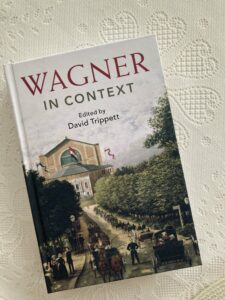
Wagner in Context (Cambridge University Press, 2024), released this past March, contains 42 essays by music scholars, writers, and other classical figures (including conductor Leon Botstein), all probing the life and legacy of composer Richard Wagner (1813-1883). Divided into six sections including geography, politics, people, performance, and reception, the book offers meaty dives on well-known topics (i.e. The Ring and its stagings through time), practicalities (money), realities (criticism), as well as pointed socio-cultural examinations (performing his work in Israel; Buddhism, video game music). The book’s release is particularly timely what with houses in Zürich and Berlin having presented complete Ring cycles recently, and those in Milan, Munich, and Paris (the latter featuring Ludovic Tézier as Wotan) starting in the 2024-2025 season. Amidst the contemporary online discourse – alarm that opera is in a state of crisis and/or “burn it all down” and/or “the old days were better” – actual interest in Wagner and his work would seem to be growing in leaps and bounds, even if audiences at historic houses like Bayreuth have grown shaky.

Musicologist David Trippett, Editor of Wagner in Context, has assembled a rich collection of essays, many of which speak to these communities and ongoing conundrums. Professor of Music at the University of Cambridge and a Fellow of Christ’s College, Trippett was also the guiding force behind the rediscovery, reconstruction, live presentation and recording of Franz Liszt’s lost opera Sardanapalo in Weimar in 2018. The author of Wagner’s Melodies (Cambridge University Press, 2013), he has also edited collected volumes on music and science as well as music in digital culture. His own essay for Wagner in Context (“Sentient Bodies”) is a thoughtful contextualization of the composer’s tonal language via its sensory effects, using historical and philosophical frameworks; Nietzsche’s infamous 1888 claim that “Wagner increases exhaustion” is its starting point. In the introduction Trippett offers a thorough examination of the meaning and role of context as related to the composer and his legacy, fusing old and new with immense confidence. He raises the reality of the Russian invasion of Ukraine (which occurred during the book’s editing process) and in noting the presence of the Wagner Group and the Mozart group writes that “these tatty battlefield personae beg the question of how reception contexts engineer and amplify such different moral valences, and what and what role is played by the signs and nodal gateways of modern media in their dissemination.” The connection to the immediate subject matter, and his overarching shadow on contemporary opera life, couldn’t be made clearer.

Still, I was curious as to the process of editing a book on one of classical music’s most (in)famous figures. In conversation, Trippett is involved, detailed, fascinating to speak with, his engagement warm and friendly. There’s always something new to learn about Wagner, and, as this conversation proves, lots more to talk about. The c-word is indeed a grand and wondrous thing.

The Selection Process

You have an array of distinguished contributors in this book, and I’m wondering how you chose them, and, relatedly, the way that the chapters and respective contributions are divided; did you approach people like Mark Berry and say, “I need you to write about revolutionary politics,” or Leon Botstein with “We need an article about America” ?

The first thing to say is that I think the quality of contributors is a vote of confidence in the field of Wagner studies. People want to write about Wagner and there is so much that changes with time – so when we listen to works, reread his writings, and see how the world has changed, the meaning of those works and those writings changes also. There is a perennial reinvention that takes place, and I think in looking at contributors I really was inspired by people whose work I admire. It really was a case of asking myself two questions. On the one hand, there was a sense of thinking, what does a book like this need? Wagner had so many interests and it would be impossible to chase them all down and try and do a serious scholarly dive into vegetarianism, or into his trouble with debt, or his attitude towards women; there isn’t space. These are short chapters; they have to be bite-sized, like a kind of elite tasting menu.

The other equally important question was, whose opinion do I want? Who would be really good to write about this? So to pick at random, the head of The National Archive for Wagner Studies in Bayreuth is a wonderful Wagner scholar, Sven Friedrich. I happen to know that before he moved to directing the Richard Wagner Museum in Bayreuth, the Jean Paul Museum, the Franz Liszt Museum, and the National Archive and Research Centre of the Richard-Wagner-Stiftung, Sven had a career in banking –  his training is in finance – so he knows a lot about the area of merchant banking and money. I suggested to him to look at the copyright and the royalty situation for Wagner (“Wagner’s Finances”), and to translate his findings into current figures, in order to really try to understand whether the myths and the easily-parroted opinions about Wagner are warranted; I was very lucky that he agreed.

And you mentioned Leon Botstein, who is such a learned and incredibly wide-ranging, talented musician and scholar. He is somebody who I would say can almost literally write about anything to do with music. But the notion of America was interesting because we know that Wagner, later on in his life, thought about emigrating. I wrote to Leon and I said, “There’s this thread we can pull out” and he had so many ideas about where to take (the topic) – in the end, there’s a very important set of sources that he brings to bear. He does a wonderful job of really positioning this ambivalent history in America to race relations with things like Parsifal, German immigration, and The Birth of a Nation. It really was amazing to chase down what is a very textured history that I think we don’t really receive in biographies of Wagner or in normal narratives that accompany performances in program notes and other material. This was an opportunity to find excellent, insightful people and to think harder than we might normally do about the kind of subjects that Wagner in the 2020s warrants in the world as we find it.

Did those subjects for Wagner in Context arise naturally, or did they arise out of the material that you received? Gundula Kreuzer already wrote about the technical side of Wagner’s stagings, and Mark Berry has his book (written with Nicholas Vazsonyi) on The Ring. Was it a grand plan or something more organic?

Like you, I’ve read all of this literature when it comes out, and I was guided by people who’ve made a very significant contribution. To ask, for instance, Katharine Ellis, to write about Paris – there’s almost nothing that Katharine doesn’t know about Paris and Wagner in the 19th century. Her work has developed, of course, and gone in many directions but she is a figure who is just a world authority in this area.

Likewise Gundula Kreuzer is an authority on the stage technology. In her case, because I felt the history of stage technology is just too big, there are three chapters that kind of fit together on that overall topic, so you’ve got Gundula’s history of staging (“Stage Technology), which pretty much goes up to the premiere of The Ring Cycle in 1876; then you’ve got Patrick Carnegy, who picks up the baton just after the premiere (“Historic Stagings: 1876-1976”) and looks at the history of the 20th century staging up to Chereau in 1976; after that there’s a wonderful chapter by Clemens Risi that really looks at performance traditions (“Regietheater in Performance”) and more exploratory and risque presentations; he’s written very thoughtfully about how, for instance, performers and performance psychology are affected by some of the very real challenges the directors throw at them, some really quite undignified visuals that we might think, “Gosh, that’s risqué” we maybe don’t stop to think about how it feels to be a performer, doing a dream role, but being told by a director to do X-Y-Z. And I think that there was a very interesting levelling of perspective there. I suppose if those three chapters are linked one could tack them on to “The Wagnerian Erotics Of Video Game Music” by Tim Summers.

I found that essay particularly fascinating, and very contemporary…

Yes, Summers is a wonderful scholar at Royal Holloway in London. That essay began life as something about internet memes and the way the themes and motifs from The Ring Cycle can bounce around the internet and be repurposed – how they acquire meanings in different video games. Lo and behold, he brings Schopenhauer into a reading of the game player who escapes themselves in the projections they experience within the game, and this becomes “The Wagnerian Erotics of Video Game Music” – it was quite unexpected, but incredibly unique and really insightful. So you can really look at the different configurations, I think.

“Flickering” And Editing

Different configurations, but they speak to something that you write in the introduction, that “the point about contexts is that they start to flicker with insight only when they run deeper than biography.” I thought of this with relation to the Summers essay while simultaneously considering how many might only know Wagner from cartoons or The Blues Brothers, how Wagner himself wasn’t interested in artsy silos – were these sorts of things “flickering” in your mind as editor? And why does do these “flickerings” matter in appreciating an artist like Wagner in 2024?

I think it’s a wonderful question. The way this was initially presented to me was as an opportunity to rethink the relationships between figures that we think we know quite well and some of the deeper history. As historians we’re always looking at the deeper history, but very often we don’t have the chance to write about it as the primary object because it’s only the background, so this is why at the end of that introduction I mention the metaphor that writer José Ortega y Gasset introduces when he’s talking about modernist art.

In 1925 he wrote a book called The Dehumanization of Art (Princeton University Press), and at one point in it he gives the example of looking through a window at a beautiful garden; you can focus on the garden and you can see the beautiful pictures, or you can see the colour used by Kandinsky or some of the textures in a sculpture – or you can look at the frame. You can zoom back and you can actually look at the window frame and see how it’s making the garden a picture. That drawing of attention to the medium was central to what Ortega was saying about modernist art.

For this question of context, I thought, well, that’s exactly what we can do now. We already study the “scene” – of literature from Spain or France or whatever, and we do put our favourite composers into that, but we never actually focus on the framing. So what this book does is give scholars and readers a chance to play with that lens of focus and zoom in on one thing or another and to really ask how Wagner fits into the world of finance, or into the literary culture of Spain, or media theory. There are lots of different elements at play. So yes, “flickering” is the right word because it’s that dynamic sense, a type of motion that is not fixed to where you actually are as a reader or scholar; you have to make the object of your study move, not just try to learn all the details about it as a sort of stone sculpture but make it real for the here and now.

book, read, reading, Wagner, Wagner in Context, Cambridge University, essays, musicology, history, David Trippett, context

Photo: mine.

How real did it become for you, particularly in light of your work on Liszt’s Sardanapalo? I would imagine that experience changed your own lens with Wagner.

Oh yes.The relationship between Wagner and Liszt has been problematised a little bit in recent years. At the beginning, Liszt had far more fame, wealth and status than Wagner did, but of course that changed. At the end of his life Liszt regarded himself as “Bayreuth’s poodle” – that’s his expression – that he was wheeled out for big events. He felt like he was being used. I think the challenge for historians is to think about, not only at a personal level, what it costs to have this changing relationship to Wagner, but to track the ways in which that was manifest with money. All of these things were there to be documented, but I think the broader question is: what should historians make of these artists now?

Wagner’s music has made him enormous and very widely performed; Liszt’s legacy as a composer remains restricted in a popular sphere, I think, to the keyboard works, and even then, only to a very small handful of keyboard works. We might flip the coin and say, “Well, what about Wagner’s keyboard works?” – because there are keyboard works by him. They were composed after Lohengrin and Tannhäuser. But we don’t talk about them; they’re not a main part of his legacy. I think the question of why we value some music and not others, and why that’s so unbalanced, is an interesting one. Joanne Cormac does a really great job in her essay (“Franz Liszt”) of bringing some of these larger historical options to the fore, and also the biases of our own historical narratives that tend to marginalize Liszt and bring Wagner ever more into the larger sphere.

This was what I was getting at regarding musical marginalizing: Sardanapalo seemed like an attempt at historical balance, among other things.

Well, when Liszt insisted on pursuing an Italian opera, Wagner advised him not to do it – he tried to give him a cast-off libretto and said, “Why don’t you set this to music?”. I think Liszt stuck to his guns and Wagner then said, “Well you should write something in German for Weimar and stop trying to be an Italian composer” – so while I don’t know what he would have said (to the Sardanapalo presentation) I do think your point is absolutely right, that Liszt had a musical talent, the likes of which is hard to imagine. He was so versatile and able to absorb so much from his surroundings. His work ethic was phenomenal if you look at the rate of production when it gets to Weimar. The opera that he spent on and off seven years really working to complete is a testament to his absolute fluency in not only a Bellini and Donizetti style, but the fact that he had absorbed aspects of the orchestrations for Tannhauser and Lohengrin. I think that kaleidoscopic imagination made itself known in an incredible ability to synthesize and draw together threads that seemingly don’t make sense, but actually sound great, and you’re right, it is very important, I think, to hear it. You can’t really understand it theoretically; you have to experience it.

David Trippett, musicologist, professor, Cambridge, classical, opera, British

Photo courtesy of David Trippett.

Sensory Relevance… ?

How do you see perceptions of Wagner evolving in the 21st century? What role can (or should) context play in presentation?

I think on the one hand there is a magnetic appeal to Wagner’s music. It is so rooted in what he called “Sinnlichkeit” – an appeal to the senses – that that alone, in the hands of a driven, skilled orchestra and wonderful singers, will create a spectacle and an artistic experience that will always be revelatory. It is not too hyperbolic to state that something like Tristan is a miracle of humanity; the job of performers and directors is to convey that value with the audiences.

I think the question to begin with is: how do we relate something that was composed in 1865? Or relate to The Ring Cycle, which premiered in 1876? How do we present it anew to an audience that can hear it on YouTube? Or that can get any parts of the score for free and are more likely to be involved in pop or any number of different new musical trends? The whole world has changed so much in such a short time – and on the one hand, Wagner’s style and language has an eternal appeal, but on the other hand there’s a very real question as to what one does to update and remain relevant in the here and now. There are many cases of directors not quite getting it right, of being too shocking; there’s the case of a production of Tannhauser in Germany (2013) which had to close after one performance because it was gratuitous in its references to the Holocaust – it didn’t have an organic relation to the opera – and many found it very upsetting.

Where does the word “relevant” fit then?

Well I think we do have to be relevant, but I think being relevant doesn’t mean always drawing on objects in the here and now. A whole genre of opera in the 1920s called Zeitoper was precisely meant to be relevant; they used all of the gadgetry of the times, like telephones and gramophones, and had contemporary themes and allusions to popular music, all aimed at making the art form accessible to audiences. For example, there’s an aria in Hindemith’s opera Neues vom Tage (1929), which praises hot water and gas, and was originally sung by a soprano wearing a flesh-tone suit in a bathtub. But this genre had a very short shelf life – it was relevant only for ten years. I think that is the problem of, you know, being “up-to-date” and being “relevant”; the more up-to-date you are, the sooner you become out-of-date. The challenge is to balance the music’s eternal appeal with things that matter in the here-and-now, and that is, I think, an issue to be solved by each director.

Top photo: Graham CopeKoga

Lecturing, Improvising, And Russian Piano Music: A Chat With Marina Frolova-Walker

piano, keys, keyboard, music, instrument, playing, hands, fingers, sound

Photo: mine. Please do not reproduce without permission.

Toward the end of her life my mother would chide me for what she perceived as prolonged screen time. “You are always at that damn computer,” she’d sigh, “but I suppose you have to think about your audience and what they’d like to read.” What with everyone spending longer and more concentrated time in front of screens amidst the current coronavirus crisis, the lines between education, entertainment, and enlightenment can be fraught indeed. As an educator and writer, I frequently have to balance my desire to share information with a deeply-held urge to entertain, and then be able to skillfully juggle the added ball of measured impact. Those of us whose work is largely based in or around the internet (i.e. writers, artists, musicians) are at the mercy of ever-changing algorithms; we want to have our work seen, but we want to keep our voices and ideas intact. Playing to the desired young audience many classical institutions now eagerly pursue should, I suppose, be a priority, but playing to such an audience is not easy when you are no longer young yourself, not comfortable changing the nature of your work (or its presentation), and have an innate awareness that it is not desirable (or very dignified) as an aging woman with highly specialist passions and specifically artsy tastes, to attempt to compete with young/cute/sexy/etc. And yet, to note one’s work being read, shared, engaged with, and sense it is having an impact – it is gratifying. To play to the algorithm, or not to play to the algorithm; this is the question.

This juggling act can become even more complex when it is one’s modus operandi to impart what you feel is vital information whilst providing a modicum of inspiration which might (possibly, hopefully) encourage independent exploration, on and off the screen. Gresham College has been able to do all of these things, with incredible style and success, specifically through its Russian Piano Masterpieces series, featuring Professor Frolova-Walker and pianist Peter Donohoe. Introduced in September 2020, the series consists of what can only be described as lecture-conversation-concerts – in-depth, one-hour explorations of the history, structure, harmonics, and socio-economic-creative contexts of composers and their respective (if oftentimes linked) outputs. Frolova-Walker specializes in Russian music of the 19th and 20th centuries, and has published, lectured and had her work broadcast on BBC Radio 3; along with being Professor of Music History and Director of Studies in Music at Clare College, Cambridge, she is a Fellow of the British Academy. In 2015, she was recognized for her work in musicology and awarded the Edward Dent Medal by the Royal Musical Association. Peter Donohoe, CBE, is a celebrated international pianist who, since his winning the 1982 Tchaikovsky Competition in Moscow, has worked with a range of conductors, including Yevgeny Svetlanov, Gustavo Dudamel, and Sir Simon Rattle. He has appeared at the BBC Proms no less than twenty-two times, and is steeped in the music of the composers who are featured in the series, though he also has vast experience with the music of Tchaikovsky, whose music Frolova-Walker had also wanted to include as part of the series, as she explains below.

The wonderfully easy rapport between Frolova-Walker and Donohoe – their mix of playfulness, intelligence, insight, experience, and genuine love of the material – makes the series a special event amidst pandemic gloom, and their impressive viewing numbers seem to confirm this. Algorithm or not, the series has hit a nerve with numerous classical-loving, culturally starving viewers; newcomers and old hands alike have been tuning in faithfully these past six months and interacting with good-humoured ease, judging (if one dares) from the comments shared and exchanged during live broadcasts. Indeed Frolova-Walker and Donohue do have their sizeable and frequently overlapping fan bases, but it’s heartening to note the embrace with which those fans have greeted a virtual presentation, and just how welcoming the community has been to newcomers. It was something of a thrill to chat recently for thirty minutes with Professor Frolova-Walker, whose work and style I have long admired, and to discuss not only the series itself, but wider ideas about classical music’s youth appeal (or not), how and why fashion intersects with events (or not), and the steep digital learning curve experienced by educators and artists alike over the past twelve months. The next presentation in Russian Piano Masterpieces is scheduled for Thursday, March 25th (at 6pm GMT), and explores the music of Sergei Prokofiev; the following presentation (the final one in the series) is on May 20th, about Dmitri Shostakovich.

How and why did this series come about?

Good question! When I applied to Gresham College I secretly was hoping I could get Peter to collaborate with me. Gresham College has been so proactive in using a different venue they don’t usually use, because we needed a piano. About a year ago we found out they managed to secure it, and I was absolutely delighted because it’s such a wonderful venue, everything is there; of course we couldn’t imagine how it would turn out, because it was planned as a live event, always. It was *never* supposed to be online. I mean, the online presence of Gresham College lectures was always an afterthought – it’s not the main thing, so you shouldn’t imagine we planned it as an online series at all – but emotionally it started with this great feeling of despair that we could only get 15 people. The next time we couldn’t get anyone, and then we got used to it. Now we’re just grateful for the opportunity, even if it’s in an empty hall! Really, it’s been a learning curve.

I would imagine part of that curve has involved upping technological skills, as has been the case with so many in the classical world.

I’m not sure I can claim anything in that field, really! The big moment was when, a year ago exactly, I was told I would have to do my other course, my Diaghilev lecture series, online; that was really… I was in complete panic, because basically I’m a person who draws energy from the audience. About 50% of my energy comes from the audience, from improvising in front of an audience, and in seeing their reactions. And suddenly, to not have this energy… I thought, “I can’t do this; I can’t write out text and read it. That isn’t me. I can’t do it properly!” So that was I think the worst, the steepest learning curve. It was primitive what I used – I just recorded myself and it was edited by someone else, but I had to actually speak to the camera and still have it be lively.

Marina Frolova-Walker, Professor, Gresham College, lecture, musicology, portrait, Russian

Photo via Gresham College

I find you very engaging – knowledgeable, passionate, with a really good understanding of pace and structure; I wonder if that’s because you have an artist’s understanding of the role of audience already.

It’s just something that was given to me. I think it’s one of the few gifts that I *was* given. Really, it’s not a gift of speaking coherently at all! But there’s something about connecting with an audience, which I was able to do since I was 19. I did my first lecture at that age, at a college in Moscow, and there were these students completely bored; they were basically forced into this room, it was their cultural program, they had to be there, and I was talking about Bach, and something just clicked at a certain moment, and they seemed to be really enjoying it so it was an opening. And I realized, “I want to do this” – but I don’t know what I do or how. It is just something I suppose I am predisposed to doing. And I’m sure I could learn to do it better, but I wouldn’t know how.

There has been a learning curve for everyone; my own output has been transformed and I’ve had to learn to release the need to know the immediate impact of my work on others.

It has been difficult, doing a series of undergrad lectures in an empty room, and there’s no connection! The previous year I was doing them so much better because I had the power of the audience. But what can you do?

Nothing. But it’s so hard sometimes…

It is!

… but things like your series help. How did you choose these composers and which pieces of music to feature in each segment?

When I was choosing which six to feature, it was very difficult because I had at least seven I wanted, but because I knew I’d be working with Peter, I looked at what he’d recorded and would play or remember, to bring it back to mind. One that is missing is Tchaikovsky; I would’ve loved to have had the music of Tchaikovsky as well, because Peter has a wonderful recording of his Grand Sonata and it’s a very I think undervalued work – people think it’s very loud and goes on forever, and I think it’s wonderful! So yes, Tchaikovsky had to fall off, but generally you know, I had some ideas of stories I could tell about some particular works, but then very often Peter would say, “Well let’s do this instead” and though it’s not what I planned it works perfectly, because there is no audience, and it’s not a concert. So it makes more sense to break things up, I think, and show different pieces in different ways.

Part of that method involves you and Peter trading various moments; how do you and Peter decide on these trade-offs in speaking, or do you just wing it?

I think you can guess!

I want you to tell me.

I think he believes in improvisation as much as I do, and you do, probably.

I do.

Right. So there is a certain amount of preplanning, but I think the interesting thing about this, and my thought behind it was, I’ve always known the way musicologists talk about music is very different from the way performers talk about it; I discovered that very early on when I travelled with a quartet. I was supposed to give a lecture about Shostakovich’s 8th Quartet and then they’d play it; on the train (with quartet members) I was telling them my ideas and they were like, “Wow, we would’ve never thought of it in this way!” and some of them I know, like other performers, find some of these things weird. So I’m kind of… I know that some of the things musicologists say about music are completely opaque, and possibly the other way around is true as well, so these are two different approaches, and my idea was to see whether they can go together and whether people in the audience can gain a third thing which might emerge. As to what is working or not, it is not for me to judge.

Peter Donohue, pianist, performer, artist, music, classical

Photo via Gresham College

So musicologists, performers, and audience are in this interesting triangulation of musical reception and experience within the context of live experience specifically; where do you see the role of online presentation?

My idea, my vision for it, is that in principle (the series) can grab the attention of someone who is not into piano music, who is not into music at all, who doesn’t read notation or know many things about this, that they would get something out of it, maybe very different things from what what you could get out of it, or what my students would get out of it, or my colleagues would get out of it. Ideally I would like that *everyone* will get something out of it, and that’s why I think also, this series is so multilayered; those who, say, want to do a project on Shostakovich’s piano music, can watch it and stop and look at the slides, and get much more out of those slides than during the lecture itself, and download the transcript – which of course is not really the actual transcript, because I wrote it before the lecture, but it has references on things we cover. There is depth in it, and depth in varied slides. I don’t have time to address everything when we’re presenting it live, and especially when it’s an improvised performance, but I am secure the content is there, and if somebody wants to get at it in a deeper way, they’d be able to.

Do you imagine your potential audience and write to that, or… ?

You get a little bit of feedback on things, not ever, of course, as you would like, but you get a bit, and I know that some of my former students for example who work in schools, show it to their pupils, who are A-level music students. I know there are music lovers who tune in, but there are also people who are just into Gresham College lectures overall – because Gresham College lectures are amazing. I started getting into them as well, for instance, I listened to a lecture on bell-ringing and mathematical patterns, and about 25 minutes into it I was completely lost, the mathematics side stopped making sense, it was too complicated – but I could still enjoy what I got out of it. It’s still valuable as an experience. My attitude to everything, basically, is it’s better to have a part of something and not be a purist, instead of having the attitude of, “I don’t understand this at all; I won’t bother getting into it.” I think it’s the same with classical music. When you first listen to a Wagner opera you get about 5% of it, then after 30 listenings you get maybe 20% of it; I think this is very important for people who want to get into classical and feel it’s too forbidding. It’s a reminder not to be too hard on themselves.

Having things laid out clearly, with intelligence and confidence, and letting people use their imaginations as well, is a good way to introduce the classical idiom overall, I have found.

Yes, I think it’s good too – I mean, notation is such a hot topic right now, but it’s why I use it. I think even for people who’ve never seen it before, it’s like a diagram: you understand it when (the piece) goes up and when it goes down, and that’s all you need to know. The time goes like this, you have these two axes like that; just from those elements, you can get quite a lot. You can see how many notes there are, how fast it goes – roughly – so with this very basic knowledge you can get quite a lot of comprehension, just by looking at two bars of music, even if you don’t know what it sounds like.

That’s just it, and then having the immediate experience of hearing Peter play what might be shown too...

It’s amazing. I think the last lecture we did Peter sight-read a piece just straight off the screen – the whole piece! It was so funny!

When I spoke to John Daszak about singing reductions he mentioned working with Peter on the Das Lied Von Der Erde piano reduction and how he found it louder than the full orchestration, and Peter’s playing in particular to be very full-on.

People who would have been in the room to actually hear the sound… it’s *astounding*. What a loss not to hear him live. Our little group from Gresham College has been obviously privy to this, and myself, and you realize this kind of piano playing is completely on a different level; there’s nothing in common between how I play the piano and how Peter plays the piano, it’s just a different thing. First of all the range of sound, the range of pianissimo to fortissimo is six times bigger – he can be very loud but he can be very quiet too – and also the control is amazing, I don’t know to what extent… we are in the hands of the technical team, so many things can go wrong, but really, the live-ness can never be replaced.

I hear your lectures and all I want to do is hear these pieces live.

That’s nice to hear! Maybe we’ll have a CD sale at the last lecture. There’s a tiny bit of hope that by the 20th of May we’ll have an audience, but we’re not worried about this now, we’ve gotten used to it the way one gets used to chronic illness or chronic pain, but it’s not something you want to necessarily have permanently. When the restrictions are lifted I think, people will realize what they were missing.

Some, but it’s different for everybody.

I think you know this well, that what we need to realize is that there are different generations who have very different relationships with online. My son, for example, was born online and he lives online, and to him, it’s different, so I’m sure, he would enjoy things in the real world, so to speak. His attitude to online things is *very* different, and for that young audience I think the idea of a short video or something that is not actually a full-scale lecture but a short video, really well done and well presented, professionally done, expensively done, is the best possible teaching aid. And I think he would prefer those things to reading books, to having live lectures, I have a suspicion that young people think very differently about these things.

But then when you get them in the concert hall or opera house they are quite shocked at what they’re hearing –in a good way, but shocked nonetheless. “What do you mean it’s not amplified?!” etc…

Oh, it’s amazing, yes! But here we get into the ritualistic side of it, and also I found out by talking to him, for example, what would prevent him from coming into the Royal Opera – I would always demand he would put on some smart clothes. I was shocked by this. He wants to hear the music but feels there is something alienating and hostile about the audience, and you know, he feels he can’t really wear normal clothes. And that’s something we have to fight. It really was shocking for me to hear that.

I find the correlation between dressing up and elitism bizarre; I dress up because I enjoy it, but I haven’t done it every single time I’ve attended an event.

I dress up as well – because I’m Russian, we tend to dress up, it’s normal to go out of the house to the bakery dressed up, so it’s a different attitude. There’s a big long explanation for it, I am sure – Russia never had a hippie culture, for example – so the idea of casual clothing is, for us, still a bit alien. For my son, who is 18 right now, he doesn’t want to make that effort, and also I think, if I meet someone who knows me and say, “This is my son” – he hates that, so that’s another reason he won’t hear a Wagner opera. But I said to him, “You can wear what you like and be completely separate from me” – and that was the pact.

So did he go?

He‘s seen the whole Ring cycle, and he knows it’s amazing – he could feel the fire in Walküre because he was in the 2nd row! He said, “I could feel the heat… !” Really, he loved it.

If you can get young audiences exposed like that even once, they’ll get it.

Some of them will come back, I think… some. But we need this kind of thing, of just going at all; we used to have this sort of cultural exposure in Soviet Russia. We used to have concerts for children, and for teenagers, and you had to go to them with your school – you had to go to a symphony concert, it was not a choice. And for 80% it meant nothing, but there would be that 20% who’d get completely hooked.

So your series feels like the next logical step for people who are curious, young or not…

I think that’s probably why I can do this so easily with Peter – he thinks the same; he’s very open, he can talk to anyone about these things without trying to create a mystique about any of it. I mean obviously there is a sense at some point where we say, “The rest we can’t explain because it’s magic, it takes you over” – but there are lots of things you can explain in an ordinary way, with very simple language, and that’s what we try to do.

The Opera Queen is entirely self-funded.
If you would like to make a donation, please go here.

Catherine Foster: “Having Something Taken Away Spurs You Into Another Place”

Catherine Foster soprano British singer vocal voice sing portrait

Photo: Uwe Arens

Lately I’ve been gravitating toward the work of artists who possess an air of authority, ones who strengthen my resolve to weather the current, rather frightening storms of unprecedented global pandemic. Those artists include sopranos Lyubov Petrova (that conversation posted recently), Chen Reiss (who I spoke with in March 2019; expect a new conversation soon), and Catherine Foster, an artist who didn’t start out in the opera world, but in healthcare. That former life still provides the Midlands-born soprano with a steady stream of onstage inspiration.

Foster is known for dramatic repertoire, and has built a career performing the music of Strauss, Puccini, Verdi, and most especially Wagner. She recently made debuts as Leonora di Vargas in Verdi’s La Forza del destino (at Oper Köln) and Eglantine in Weber’s Euryanthe with conductor Marek Janowski, as well as Die Färberin (the Dyer’s Wife) in Die Frau ohne Schatten at Nationaltheater Mannheim in 2019-2020. Cultural review site Die Neue Marker proclaimed in its review (translated from its original German) that throughout the sumptuous Strauss work, Foster “increased her modulation-rich soprano, always present in all registers, to stratospheric heights, combining soft colouration with persistently powerful yet always round vocal attacks. Her phenomenal ability to span large dramatic arches with unbroken intensity, without any technical losses in the constant focus of the harmony of her expressive soprano timbre, is spectacular.”

Until today (Tuesday March 17), Foster had been set to make a highly anticipated return to her native UK for the first time in two decades, for an in-concert performance of Elektra on Wednesday (March 18th); because of the corona virus, those dates, like almost if not all of the events in the classical world, have now been canceled. Elektra was to have reunited Foster with conductor Kiril Karabits (who she previously worked with touring Mahler’s Fourth Symphony) and she was to have performed with Bournemouth Symphony Orchestra (BSO), having been hailed as “the world’s best Elektra.” Prior to the cancellation, Foster had been upfront on her Facebook page about her feelings performing amidst the current corona virus pandemic, writing that “Elektra is a tumultuous journey at the best of times but this has added a new dimension.”

Listening to her robustly elegant soprano, one is struck by a sound that possesses shades of authority, delicacy, strength, and vulnerability, warmth and expansiveness, in ever-shifting varieties like reanimated bronzen shards threaded into an El-Anatsui work; glinting, shimmering, shifting, ruffling and revolving, it is a timbre, which, no matter the repertoire, allows a dramatically complete picture. Her path to music was formed early. As soon as I could talk I was singing, according to my mother!” she said in 2009, and indeed, Foster went on to sing in the local choir in her youth, becoming lead chorister at 15. Another vocation beckoned however, that of nursing, and Foster’s training eventually led her to become a midwife. Singing in her spare time in an amateur choir, inspiration to return to music came via a conversation in a delivery room, which then led to singing teacher Pamela Cook, the co-founder of Cantamus, a celebrated all-girls choir based in Mansfield, Nottinghamshire. Cook recommended the budding singer for an audition at Birmingham Conservatoire, where Foster studied for two years before graduating. During her studies she was awarded the Dame Eva Turner Award, which allowed for a year of post-graduate studies at the Royal Northern College of Music.

In the late 1990s, Foster worked with the Welsh National Opera, Opera Northern Ireland, and English National Opera, before being faced with the tough decision as to whether or not to relocate abroad. Foster was a newlywed but also determined to keep going as a singer; moving to continental Europe was done of necessity, as is so often the reality with life in the classical world. Recalling the decision in a 2018 interview with The Standard, she said the situation in the UK was “like a closed door, I’m too tall, I’m too blonde, I’m too this, I’m too that…”. Moving to Germany, Foster  found the gruelling-if-necessary experience that formed the path for a natural expression and expansion of her creative abilities while integrating all the wisdom and experience (not to mention work ethic) from her nursing days. Through her time with the Deutsche Nationaltheater and Staatskapelle Weimar (from 2001 to 2011), she sang a variety of roles and styles, including Mimi in La bohème, Turandot, Elizabeth in Don Carlos, Abigaille in Nabucco, Leonore in Il trovatore, Sente in Der fliegende Holländer, Elizabeth in Tannhäuser, Leonore in Fidelio, and of course, Elektra. “I was working with an A-class orchestra and ensemble on a daily basis” she told The Times in 2013.

Foster opera soprano voice vocal sing singing singer stage culture classical Wagner Brunnhilde performance Washington

As Brünnhilde at Washington National Opera. Photo © Scott Suchman

It was amidst such varied creative experiences that she first encountered Brünnhilde, Wagner’s irrepressible heroine, in 2007 at Nationaltheater Weimar (released on DVD). Since then, Foster has become associated with the role and has appeared in a myriad of Ring Cycles – in Weimar, but also with Oper Köln, Aalto Theater Essen, Staatsoper Hamburg (where she recorded it with conductor Simone Young), Washington National Opera, Staatsoper unter den Linden (Berlin), and Gran Teatre del Liceu Barcelona, to name just a few. Of her 2013 performance as Brünnhilde with De Nederlandse Opera in Götterdämmerung (under the baton of conductor Hartmut Haenchen) it was noted that “it isn’t difficult to understand why Catherine Foster has become a much sought-after Brünnhilde in opera houses around Europe. Her voice is well-projected with beautiful high notes that easily cut through the orchestra.”

For Wagnerites – practitioners and fans alike – few places are more special than Bayreuth. The composer founded the Bayreuther Festspiele in 1876, conceiving and designing the house expressly for his own works’ presentation, most especially for the immense Ring Cycle. Foster’s first opportunity to perform at famed festival came when the festival’s co-director, Eva Wagner-Pasquier, having previously seen Foster perform Brünnhilde in Riga. The 2013 Ring Cycle production that marked Foster’s premiere Bayreuth appearance was directed by Frank Castorf and led in the pit by Kiril Petrenko, in a modern (and not entirely popular) staging. Foster went on to appear at the famous festival for five more consecutive seasons and took Brünnhilde took Hungary as well, where she performed with conductor Ádám Fischer and the Hungarian Radio Symphony Orchestra, Hungarian Radio Symphony Choir, and Budapest Studio Choir at Budapest’s Müpa: Béla Bartók National Concert Hall. In a review of Götterdämmerung from June 2019, Bachtrack’s David Karlin noted that the soprano “can hit a high note with laser precision from a starting point anywhere in the stave below, sustain it as long as she wants and do so without ever going shrill. In the Act 3 immolation scene, she made good use of all that power, but also projected pianissimo clearly, fixing the audience with such a piercing stare that it felt as if she was singing to each listener directly.” Foster received the London Wagner Society’s Reginald Goodall award in 2018. With any luck, she’ll be returning to Budapest in June for a full Ring Cycle, part of a full 2020 slate including TurandotTristan und Isolde, Die Walküre, a Verdi opera gala, and a return to Deutsche Oper next season, as Senta in Der fliegende Holländer.

Much sooner however, was to have been a return to native soil, March 18th at Lighthouse, Poole, and March 21st at Symphony Hall, Birmingham; those dates hae been canceled. Along with Foster, Elektra in concert was set to feature Susan Bullock as Klytämnestra and Allison Oakes as Chrysothemis; students from Royal Birmingham Conservatoire and Trinity Laban Conservatoire were to form the chorus. The performances, and the planning and preparation around them, were two years in the making. We had the opportunity to chat in late February, before the pandemic was a real threat in the classical world and beyond. Foster was at home in Weimar, corralling her dogs (“Come in sweethearts, it’s getting cold out there!”) and eagerly preparing for Elektra. We enjoyed a lively conversation in which the jovial soprano mused on everything from learning German to real-life inspirations from her nursing days. Despite the cancellations, there’s tremendous value in sharing her ever-evolving thoughts around the Ring, new and not-so-new roles, and her evolving relationships with conductors and directors. Foster also discusses why she has no bitterness toward having to leave her home country, and why tough circumstances can sometimes provide unexpected pathways – telling and oddly prescient words for our current tough times. As you’ll read, Foster, while heartily embracing the high-art aspects of the job, keeps her feet planted firmly in an earthy authenticity, one that elevates her artistry while underlining her warm humanity – a balm for our times indeed.

Foster opera soprano voice vocal sing singing singer stage culture classical Wagner Brunnhilde performance Washington

As Brünnhilde at Bayreuther Festspiele. Photo © Enrico Nawrath

When you moved to Germany in 2001, is it true that you didn’t know the language?

I could ask for a cup of coffee and that was it.

“But please don’t respond because I don’t know what you’re saying!” I can relate.

Yes, entirely! I remember coming here and no one spoke English back then. It was only in 2006-2007 that I first heard English on the street, but it was the best (environment) for me. My husband bought me a TV for Christmas, this really old-fashioned, huge thing, and I put Teletubbies on, and watched a bunch of very American series dubbed in German, and I had this book — the internet wasn’t out yet you couldn’t Google anything — that sat at the side, and I’d look up phrases: “Don’t shoot!” and “Don’t move!” It was an experience.

I never wanted to sing in the German fach; I just fell into it when I started having singing lessons. I never wanted to do opera or especially Wagner — I thought it was way too long! But now I absolutely adore the German language and adore singing in in German. I’m studying Elektra, and doing it of course in Britain, uncut, and what (Hugo von) Hofmannsthal does in the text is unbelievable; the nuances you can get out when you know the language, the colours you can put into the voice because you’ve not parrot-fashioned the words on top of what it means. You know precisely how things sit within the structures of a sentence.

Speaking of knowing structure, you’ve sung Elektra a few times… 

I’ve sung it 52 times so far.

… and you’ve frequently performed the role of Isolde as well, including earlier this year in Bologna. When you start a new production is it a blank slate creatively, or do you think, “I can use this from here and that from there” and re-contextualize accordingly? What is the process for you?

The thing is, if you work with a Schauspiel director, for plays and things like that, then it is traditional that the actors and actresses don’t come having memorized their role, they memorize it during the rehearsal period. You can’t do that with an opera; it isn’t just words you’re memorizing, it’s music as well, and you have to be prepared, so of course you have your own ideas. But what I do find is that they mature, these pieces and roles mature like a good wine; you need to let them lie a bit. No matter how much you try with the first run, there’s no way you can actually know everything about the role, or know everything about a character.

Foster soprano voice vocal sing singing singer opera classical performance stage drama Strauss Wiesbaden Elektra intensity

As Elektra in Wiesbaden, 2016. Photo © Sven-Helge Czichy

For example, I’m doing Elektra uncut this time, and there’s six pages that I’ve never performed on the stage; I was going through it with my pianist yesterday, and I can tell vocally when I get to the point where I finish the bit I’ve already done on stage, then I do the uncut bit and go back into the (existing bit) — the body knows where it’s going and it’s a lot more comfortable. It’s like driving a car; when you change cars you have to think, “Where is this part going? The gears feel different…” but after a while it becomes second nature. When you’ve got that part done – all the nitty-gritty bits – and you know where you’re going and how, then you can start putting other layers on top. 

For a new production, it’s the singer, the conductor, and there’s a director; those are three people who come together. The conductor has his idea of the music; the director has his concept; the singer comes with their ability to sing the role and some ideas. But if you don’t want a different concept there’s no point in employing a director – it’s our responsibility to listen, and to try and make that concept work on the stage, which, nine times out of ten, you can. The odd one you think, “Hmmm” but that’s very rare. I can count on one hand productions I’ve done that I just don’t get it from the inception, but I think the more mature you are with these roles, the better it is, and it’s a lot more comfortable for the audience and you can start to play with it even more.

My Elektra is based on three patients I used to look after when I was a student nurse in training; I had to do six months in the psychiatric unit, and I remember three wonderful patients who never went away out of my mind, so I use those memories. And if you look at Hofmannsthal when he wrote Elektra, he studied women in these asylums and how they were, and that’s his way of writing what these three ladies are all about. I find it very clever. 

It’s fascinating that you directly relate your work on Elektra to your work as a nurse – there’s an air of authenticity that seems discernible throughout your work.

For me that’s what acting is. I’ve never had acting lessons, so I do take my previous experiences and use them. There’s a part when I go onstage where I have to find it in me. But… what does that really say, when I love Elektra?! 

It means you combine imagination with experiences in the real world; the connection with the quotidian is clear.

If you think about a character like Brünnhilde, that role has been with me almost as long as my daughter has, and to me it’s (the story of) a young girl growing up. If you look at Wagner’s heroine, they are the ones that save the world; the men don’t save the world, the women save the world. So Walküre is very much based on a young teenager whose daddy is everything – whatever daddy says goes – and she’s probably been in that state for thousands of years…  

Foster Reuter Mupa Budapest Wagner classical opera singing voice stage performance culture Walkure Ring

With Johan Reuter as Wotan in Die Walküre. Photo © Szilvia Csibi, Müpa Budapest

In suspended development.

That’s right. Then she starts to question things, and that’s when he gets angry, and that (reaction) also happens to be real. It makes me recall a relationship of mine in the past, and how, when I started to question what this person was doing, things got violent and angry. I always say Wotan gave Brünnhilde the power of love, but he himself has the love of power, and that’s the difference between the two; she can grow and mature because she’s learned to use power through her love, but he can’t change because he’s only in love with power. So therefore he’s unable to move on but she can move on, and therefore sacrifice. Siegfried is a testosterone-driven boy; it’s all about him, and about them getting together. It’s a prenuptial wakeup call.

I’ve think of Siegfried as the vehicle through which Brünnhilde achieves an actual sensual experience of the real, human world; she needs to have that experience, with all its interconnected pleasures and pains, so one world can end and another can begin.

You could also say he really can’t come into existence without her.

True! The awakening applies to both of them but the way it manifests is so different for each.

And I believe Brünnhilde, much as she was born of both Wotan and Erda… well, fate decided she had to be born; everything has its own time, everything has a beginning and an end, and this is Wotan’s end, so she was born, but of course she saved Siegmund and Sieglinde, and how much did she fall in love with Siegmund (in anticipation of) Siegfried – is that why she did what she did? It’s like Siegfried had to happen and he is the vehicle for her realizing what she has to do. 

Yes, Götterdämmerung doesn’t abruptly end when Siegfried dies; we have to see her through her journey.

Brünnhilde says it herself: “I had to betray the person I loved the most to realize what I had to do.” The thing is, the Ring is cursed, everyone who touches it has to pay a price, even if you didn’t take it voluntarily; Brünnhilde took it out of love, Siegfried didn’t have a clue what it was about, Wotan did sacrifice something but not his life. The curse is ever-transferring, and essentially Brünnhilde says to Wotan, “I know what you did: you gave me the curse. So I will follow this through now; I will do what you should have done, and so goodbye, father! Valhalla is going to burn as it should have done already. You asked me to finish this and I will finish this” – and she does.

Foster soprano singing sing voice vocal opera classical stage dress Turandot Koln Cologne Puccini performance culture

Turandot, Oper Köln. Photo © Bernd Uhlig

You have a history with Brünnhilde, and with Turandot, though her self-realization at the close is far less clear. 

Oh, she doesn’t change! She is psychotic as far as I’m concerned! I don’t know what’s happened in her past to make her like she is, but I’ve done the Lydia Steier production – I’m going back this year to do it again – for me it’s fantastic, one of the best. We developed it together. When we did it, Lydia had this great idea that it’s all set like Big Brother if you like: they’re on an island, they don’t have a lot of money but have found a way of making money by advertising that someone can marry this Princess if they can solve three riddles, then it’s the sidekick who comes on and does all the organizing, and then on comes Calaf.

Now, every Calaf always wants you to believe he’s a nice guy; he is not a nice guy, otherwise he would not stand there and let Liu get tortured. He’d say his name and then, “Please, don’t torture her, don’t cut her hands off!” But because he’s also the son of a king, he doesn’t care whether he lives or dies, and this is what Turandot sees in his eyes, this “I don’t care, it doesn’t affect me” attitude, which really unsettles her. You have the Third Act which I don’t think is about love or anything about that; it’s all about power, and I think he has had such a rush, if you like, that he’s won that he plays with fire again, but he doesn’t come to Liu’s rescue. This is what I like about Lydia’s production – there is no sympathy, this character doesn’t know how to give that. She doesn’t really change; it’s a question of whether she’ll carry on or not.

You’ve been in some contemporary productions, including a staging of The Ring by Frank Castorf at Bayreuth. What’s it like to be part of Regie presentations?

The thing I always ask is, does it tell a story? Or do you have to have a book of notes to tell you why you’re doing certain things? There was a lot of controversy over the Castorf ring and I was asked why the public didn’t like it; I said that’s not for me as a singer to answer, the direction is personal taste. My husband came every year for six years and he saw the Castorf staging, and it grew on him, he said because there was so much on the stage you had to pick one thing you looked at and just watch it. I also met a lot of young people, in their late teens to early 20s, who absolutely adored Castorf and they said something very interesting: he makes you discuss it, and whether you love it or hate it, he makes you discuss it, so therefore, he’s won. It’s relevant whether you like or dislike it; you need to think about it. and I thought, that’s an interesting point of view. 

Foster opera soprano voice vocal sing singing singer stage culture classical Wagner Brunnhilde performance Washington

As Brünnhilde at Bayreuther Festspiele. Photo © Enrico Nawrath

So the contemplation is what matters, not the knee-jerk reactivity… 

Yes, that’s what matters; he makes you think. It doesn’t matter that he made the gold oil – what is it that people want today? It’s oil, so he made the gold oil, but you know, if you can stay true to the music and the character then you can take The Ring and put it anywhere in the world, at any time, in any period. You can make it a family saga, a country saga, a world saga; it’s basically love, hate, money, power, it’s who is in charge. Castorf had a lot of symbols in his (production), which came from growing up in the DDR. People not from the DDR didn’t get, but anybody I invited to come along who’d grown up in that said, “Oh my God, that is so clever!”

Applying your car metaphor to conductors, I would think some maestros provide different styles of roads and gear shifts and signposts; sometimes you know the route but others want you to use a whole new highway. 

Yes, you start again! I’ve experienced The Ring on the whole with about 32 conductors, and they fall into two categories: either they’re extraordinary experienced, or it’s a first time, so there’s a desire to always try to find something different. The experienced know how to let an experienced Wagner singer go. I’ve just been to Budapest last summer with Ádám Fischer and he came off stage and said, “You know, the more I leave you alone, the better you get!” He didn’t try to make me do anything and said he was really inspired after this last Ring. Working with certain singers gives (conductors) different colours. But why does opera still draw people today after centuries of singing and hearing the same roles? The only thing that changes is the people who sing and perform it. (Live performance) has to have something magical, otherwise, if you wanted it exact, go buy a CD, but where’s the magic in that? Every time I’ve ever done a Ring cycle, you have the stage, the singers, and the public, and they come with you, and by the time you finish Götterdämmerung you’ve done a huge journey together of sixteen hours.

How does that translate into new roles? You had your role debut as Die Färberin in Die Frau Ohne Schatten in Mannheim, for instance. Do you have an idea where you want to go with new parts, or is it more of a journey?

Part of my studying and getting to know (Die Färberin) and finding her was having two years to learn the opera. If you do Fest you don’t get two years, you get six months, if you’re lucky, to learn a role. The fact is, I had two years to really investigate (Frau) and do some research. I hadn’t realized it was essentially Strauss’s Zauberflöte, which was a gift with the way the direction was going; the only person I could connect to was Mrs. Bucket from Keeping Up Appearances, which was fabulous – you know, the table had  to be set down exactly right, and she catches herself, and tries to be this lady with the hair and everything. Especially in the second act all I could think was, “Mrs. Bucket!!” I’ve been asked to do another production this autumn, so I’m very happy to be able to do it again so quickly. I’ve got to check if it’s cut or uncut.

Catherine Foster soprano British singer vocal voice sing portrait hands face

Photo © Uwe_Arens

What are your feelings going back to sing in England for Elektra? Is there any sense of lingering resentment that you had to leave?

No, the complete opposite – if I hadn’t have left, I wouldn’t be where I am now and certainly wouldn’t be  speaking German. Things happen for a reason. To me it’s a resolution; I’m coming full circle. I was looking to get on the stage, I wanted to sing, I didn’t even know that Germany existed when I first finished college, it was my singing teacher who said, “Oh, I’ve a pupil who’s just gone to do a Fest contact” and I said, “What’s that?!” and she told me Germany has opera houses in every city – I had assumed it was like Britain.

In 1999 when, literally, I was too tall, too blonde, too this too that, and everybody else was getting work, I thought, “My God, I can’t keep going like this.” I wrote 200 letters, I printed 200 CDs, and I sent them out; I got three auditions, and I got one job offer, and that’s all I needed. You just need one, and that’s what I got, which was in Weimar. I started here in May 2001, and by autumn 2006 I was studying Brünnhilde, literally, and truly, it never occurred to me that I shouldn’t do it. It’s all in how you look at things — what’s the point of resentment? I’m having a very good career. One could argue I have this good career because I didn’t get the work in England, I know several singers who never got the courage to leave the UK because they have just enough work to not actually push them that extra distance away. Sometimes having something taken away or being denied the possibility to do something spurs you into another place – sometimes it makes another door open.

Writing, Evolution, And The Pleasure Of Discovery

thoth tjaj scribe god ancient egypt

The scribe Tjaj in front of the god Thoth, patron of scribes, in the shape of a baboon. (New Kingdom, late 18th Dynasty, Amenophis III (?), 1388-1351 BC; collection of Neues Museum Berlin)

As some of my readers may know, the past year has seen a gradual shift away from formal journalism and toward more creative, personally fulfilling arenas. The precise nature of such a destination has yet to manifest or clarify itself, but, trusting the path, as they say, often brings the most important discoveries, whether we like them or not. Liking, much less being comfortable, isn’t so much the point, but evolving is.

One stage in that evolution has been taking a conscious step away from writing reviews. In Daniel Mendelsohn’s brilliant 2012 New Yorker essay about critics, he notes that “(t)he role of the critic […] is to mediate intelligently and stylishly between a work and its audience; to educate and edify in an engaging and, preferably, entertaining way.” Mendelsohn, Editor at Large of the New York Review of Books, writes with engaging specificity about how the work of certain critics from his youth inspired his curiosity: “I thought of these writers above all as teachers, and like all good teachers they taught by example; the example that they set, week after week, was to recreate on the page the drama of how they had arrived at their judgments. ” We all find our own in-roads when it comes to culture: the influence of people we are raised by; the big and small events we experience as children; the sounds and sights and smells and surfaces we absorb intellectually, emotionally, spiritually through the various facets that carry us into and through adulthood. Social influence, of course, has taken on a life of its own within the digital age, with the culture of “like” and “favorite” occasionally (Mendelsohn might argue too often) taking the place meaningful criticism might have occupied in the past. There’s also the pervasive (and now normalized) trinity of programming, pageviews, and promotion that have become sticky symbols of, among other things, the contemporary force of clickbait. A music historian friend of mine refuses to hit “like” on most things he sees on Facebook, whether he truly enjoys such posts or not, his reasoning that inspiration, and personal taste for that matter (something Mendelsohn mentions frequently), shouldn’t be reduced to algorithmic slavery. He has a point.

All of which is to say, criticism still matters, but instead of writing reviews myself, I’m going to help others do it. As of January 2020, I’ll be part of the Emerging Arts Critics panel, a Canada-based program that aims to mentor the next generation of culture writers in partnership with a variety of  Toronto-based media and arts institutions including Opera Canada magazine (to which I am a frequent contributor) and the Canadian Opera Company. I may no longer review opera, but I am happy to be teaching the next generation. I’m equally happy to point out interesting figures whose work, while uncritical, inspires that all-important cultural curiosity, while providing fun bursts of inspiration and education; classical music writer and enthusiast Jari Kallio is one of those people. Known to the online classical community for his deep knowledge and refreshing lack of pretension, the well-travelled Finn documents what he sees, listens to, and studies at regular intervals. His posts aren’t intended to provoke reactivity (namely those 21st century digital diseases like hate-likes or juvenile jealousies) but are meant to inspire and educate, and sometimes entertain too.

salonen score

Esa-Pekka Salonen’s score for Pelléas et Mélisande. Photo: Jari Kallio

It would be easy to dismiss Jari as a cheerleader. When he likes something (or someone), it is obvious. He does not make a secret of his favorites, but in an age where the fandom of Anna Netrebko is loud and boisterous, it’s nice to see that spirit being so vigorously applied to artists like Harrison Birtwistle, Oliver Knussen and Jörg Widmann. Having worked as a teacher of psychology and philosophy for over two decades in pre-university studies for students sixteen to nineteen in Finland, Jari has a natural ability to be as direct with his language as he is clear in his contextualizing. Well-versed in music new and old, he considers score-reading to be a natural extension of his ever-unfolding education as well as an expression of his intense creative curiosity. Those qualities lend him an authority which can often be seen in his online exchanges with fellow music lovers, ones which are wonderfully free of patronizing and condescension, and offer in-roads for those new to classical music. Clearly aware of the culture of the internet, his Twitter and Instagram feeds regularly feature playful comments and humorous shots of both himself and his cat, Nono (yes, named after the Italian composer). If one wants to apply the term “blogger,” I suppose one could, but the term feels somehow too small for his wide-ranging curiosities, and too limiting for his talents. He’s not a singular figure for his cultural pursuits, but he is one of the most earthy in their expression.

Our conversation here marks the first of what I hope will become regular exchanges with digitally-savvy classical music writers. There’s value, and some manner of delight, in conversing with such ambassadors and educators in a rapidly-changing art form.  And so, to my original point, that making a conscious choice to change one’s path without knowing the final destination isn’t meant to always be a comfortable process. Indeed. Jari’s posts sometimes provoke sharp stabs of shrieking panic (mainly of not knowing nearly enough about our shared passion) but it’s a reaction softened by a calm, more sustained voice whispering that it’s never too late to learn; the willingness is all. Back in June, Jari and I enjoyed a lovely, wide-ranging chat – about score reading, contemporary composers, the joys of attending rehearsals, and the connection between Star Wars and Sibelius. Enjoy.

Photo courtesy Jari Kallio.

Do you find your music passion seeps into your teaching life? I’ve introduced things like leitmotifs within a project-specific context, so students can then apply that concept. 

Yes, I do that too! For example, in psychology there are so many things you can work out through pieces of art and music, so basically that’s an endless source for cases and examples and allegories…

… and concepts, and inspiring people to understand things and experience things in a new way… 

Exactly.

Speaking of new ways, you found your own path into music, yes? 

I didn’t go to a conservatory but I took piano lessons for three or four years, and when I studied psychology as a major, I did some musicology and history of music as a second subject. From my teens is when it all got started. I’m from a working-class family, and there’s musicality in my family, but it comes from my father’s side. My grandfather was quite a good amateur player – he had a good ear. He could pick out tunes from the radio and play them; he was really good at it. My father had some of that too, but he played very little, and so in their world, there wasn’t a thing like music education; yes, it would’ve been available, but it was something rather unknown to them. 

Jari Kallio, scores, Bärenreiter, publishing, music, coffee, perusal

Photo: Jari Kallio

That sounds a lot like my mother; she came from a working-class background as well and only seemed to know the Conservatory as it related to my yearly piano exams. 

Exactly! I had very few early influences though, apart from school. In my first year at school in Finland – we start school at the age of seven – I remember our city orchestra, which was a small, 25-piece orchestra, paid a visit to our school. That was the first time I’d heard an orchestra live. They played some orchestral music, and the only piece I remember from that is Sibelius, his Karelia music, the intermezzo. It was such a huge thing to hear, and that’s the early thing which got me curious. And then, being of my generation, which is the Star Wars generation, I of course picked up John Williams’s music for the film, which was actually the first thing I had on a physical record. In my teens I suddenly started discovering more, and at some point I just felt I had to try to play something, so I did a couple of years of piano lessons and soon realized that I’m not much of a player. That never bothered me because I learned to read music and got kind of an understanding of how music works, performance-wise, which I think was very important. I picked up my first scores when I was about eighteen or nineteen.

What inspired you to delve into scores as a non-musician?

I was really curious to see how the music works, what happens on the page, how does it look? It was the fascination of seeing scores at the conductor’s podium and being really interested in seeing what they see, what do they look at, what is the source? So at first it was simply curiosity, and kind of like, can I read through it? Can I follow a performance from it? It was a challenge.

At the Tate Modern Turbine Hall with the score for Stockhausen’s Gruppen, June 2018. Photo: Jo Johnson, Senior Marketing Manager, Digital Communications, London Symphony Orchestra

What was the first score you bought?

I bought cheap editions of Brahms’ Fourth Symphony and Debussy’s “La Mer.” In Helsinki, there’s a music shop that sells records and scores and they had these score on sale, and I went there with what little student money I had back then and I found these two, and I thought they were brilliant.

How many do you have now?

I haven’t really counted them, but I’d say something like 200 to 250 or so.

You take a particular interest in new music.

Finland has a great scene for contemporary music and not just special ensembles but for large orchestras. They all do it – they’ve been doing it for a very long time. It’s something really organic, it’s not just (orchestras) commissioning short pieces and force-feeding the audience; it’s an essential part of the programming. And interestingly, in Helsinki for example, many of the concerts that feature new music sell really well and really fast. They are very often the first concert that are sold out, which is really interesting. 

Why do you think that is? 

I think in a sense, it originally comes from the fact that the first Finnish orchestras were established in the late 19th century; from early on they played music like Sibelius and all the Finnish composers. (Orchestras and composers) were part of the Finnish independence movement at the time, so it became a natural part of our culture. Also, because we are here at the border of Europe, we don’t have such a long (classical) tradition; the first Finnish orchestra of music comes from the latter half of the 19th century. We weren’t burdened by tradition, so to speak, and that liberated the programming, which is a great thing. Many (living Finnish composers) are definitely well known outside Finland – Salonen and Saariaho and Sebastian Fagerlund, for example. There are really so many great new composers

What sorts of things do you think new music provides the listener? 

It might sound clichéd, but the first thing that pops into my mind is that it gives purpose, in the sense of discovery. It’s really hard to express in words, but especially with new music, I think it’s the pleasure of discovery. When you listen to a lot of music, you start to get the idea that there are sort of these black areas on the map – between styles, between pieces, these undiscovered territories – and then you hear something somebody has written, and it goes to that undiscovered territory. You hear something which is totally new, which totally opens a new view. That, in a sense, is one of the most rewarding things. And also with the older repertoire, I mean, the pleasure of music is that you can perform the same piece of music a thousand times differently and it can be fresh and new every time. This season I heard St. John Passion in Berlin, dramatized by Peter Sellars and conducted by Sir Simon Rattle, and it showed totally different aspects to a classic piece. I think, if you get the impression that, “this is the most important thing at this precise moment, the thing I want to focus on…” then that’s a good concert. 

Esa-Pekka Salonen during rehearsals for Pelléas et Mélisande at the Finnish National Opera, spring 2019. Photo: Jari Kallio

Yet you also delve into rehearsal work as well; your behind-the-scenes report on Pelléas et Mélisande at the Finnish National Opera with Salonen, for example, were fascinating. 

That was a lot of fun to do, to spend two weeks there. I’ll be covering the time when Salonen starts his first Ring Cycle at the Finnish National Opera – they’re doing Das Rheingold in August – and I have a couple of other projects in mind. For instance, Rattle is doing Idomeneo at the Staatsoper Berlin, so I might try to cover that. Obviously, it’s an important thing to review concerts, but it’s been done for ages. I know this might sound a bit pompous, but in a sense, I think that a critic (preserves) a memory – he or she documents something in the past…

… and evaluates it within various contexts for the present.

Usually yes! But I think it’s very important that the wider public understands how a performance is put together. What does it take? What is all the hard work done before the performance? This is so people can truly appreciate and understand how the thing is built. And of course, on a personal level, the best way to learn is to go to rehearsals and follow them and really try to get a hold of the thing.

From the very few I’ve attended, I find I re-discover, re-evaluate – and explore entirely new things as well. I’d love to attend more rehearsals.

With more experience you gain more levels of listening. What you hear in rehearsals – the process of creating music – is really the most rewarding part. Sometimes I have the feeling after attending a series of rehearsals I could easily skip the concert itself! I think one of highest fascinating and rewarding things was last year in January, when I attended a series of rehearsals by the LSO and Simon Rattle; they were doing the Berg Violin Concerto with Isabelle Faust as soloist. Within the three days I heard that piece, they played it something like four or five times through, and worked on it and worked on it. I had known the piece for roughly twenty years or something, but hearing it that way was really amazing. 

Nono the cat. Photo: Jari Kallio

It often feels as if you provide a way into sometimes challenging pieces and composers through your updates on these processes, demystifying what is, for many, a rather daunting thing.

I hope so – that’s the point, really! When I started my writing career nineteen years ago, I worked as a full-time, jack-of-all-trades journalist for a year, and of course initially you are really excited to see your work in print, like “WOW!” But as time goes by, that feeling wears off and you really start to think about the most important thing: readers, the public. You are writing for someone, not just to please yourself. You have to think: what’s the point of doing this? What do I want to say and emphasize? If somebody reads my stuff, and if they are in some way inspired or informed, I’m really happy and pleased. 

Christine Goerke: “She’s Every Woman”

Stefan Vinke as Siegfried and Christine Goerke as Brünnhilde in the Canadian Opera Company production of Siegfried, 2016. Photo: Michael Cooper

Singer, mother, actor, opinionator — these are some of the titles that come to mind when I think of Christine Goerke.

The American soprano, currently in Toronto through February 25th performing the role of Brunnhilde in Wagner’s epic work Götterdämmerung (the last of the group of works known as the Ring Cycle), is as feisty a presence to chat to as she is on the stage. Having first seen her in as the Dyer’s Wife in Richard Strauss’s monumental Die Frau ohne Schatten at the Met in 2013, I’ve since throughly enjoyed the work she’s brought to the Canadian Opera Company. Each time she’s performed the Wagnerian heroine (in Die Walküre in 2015 and Siegfried in 2016), she’s brought a sparky resilience that is thoroughly modern and, particularly for Wagner newbies, highly watchable. Christine is just plain exciting to watch as a performer, which makes her an especially great figure for opera newbies; highly expressive in her physicality, she also has a powerful, dramatic soprano and crystal-clear diction. One might attend Wagner’s epic Ring Cycle thinking only of its seemingly-interminable length, its dense score, its weighty mythology… but then Christine appears, and so enters a very contemporary sensibility, one that is involved, feisty, and warmly human. Christine is one of those singers who defies the old image of the fusty / diva / out-of-touch opera singer; she’s not only down to earth, but funny, thoughtful, blunt, and a very intriguing tweeter.

Just before I left for Europe, I had the chance to chat with Christine about Brunnhilde, and singing, and tweeting — and what it means to be an opera singer in the twenty-first century. As with the prior audio interview I recently posted about (with COC General Director Alexander Neef), please pardon the intermittent beeping; recording particulars still hadn’t been quite worked out (but will be going forward). One thing: please don’t feel you need to know anything about Wagner’s world, or indeed even opera, to enjoy this chat. If all you really know about opera is an image of a woman in a horned hat shrieking… well that’s Brunnhilde; Christine will blow that image delightfully apart for you. Oh, and if you like Star Wars, she’s pretty sure you’ll like Wagner, too.

(Photo: Pierre Gautreau)

Powered by WordPress & Theme by Anders Norén