snow, trees, nature, winter, cold, beautiful

Reading & Viewing List: Winter 2026

So far 2026 has been full of snow, snow-shovelling, study, interviewing, writing, organizing, more study – and searching, in both the literal and figurative senses. First, for latest updates, see my Professional Page – I’ve been rather busy, with much of my recent work (another big Opera Canada story; short features for La Scena Musicale) coming soon. Secondly, between those duties, looking for a new place to live, and a recent cancer scare (I am fine), I’ve not able to update here as much as I would’ve liked. That will change.

New interviews are in my sightlines, but for now, here’s a random collection of recent musical things that caught my curiosity.

A Lovely Jewel

An excellent album showcasing the work of composer-pianist Marie Jaëll (1846-1925) was released this past October. Comprised of four chamber works, Une Quête d’Infini features the talents of Manon Galy, Léa Hennino, Célia Oneto Bensaid, and Héloïse Luzzati,  the latter founding the independent label La Boîte à Pépites (‘The Jewel Box’, which the album was released under) in 2022 in order to showcase the work of female composers. The Jaëll album includes the beautiful “Dans un Rêve”. This album made me want to look up Jaëll’s other work, and of course other releases the label has hosted since its inception. Good listening; highly recommended.

Good Luck Getting A Ticket!

A new production of Eugene Onegin is opening in Paris on Monday (26 January). Conducted by Semyon Bychkov (appointed the company’s new Music Director the end of last month) and featuring Boris Pinkhasovich in the lead and Ruzan Mantashyan as Tatiana, the new staging is led by Ralph Fiennes, who has a rather long history, both with it and its broader Slavic world. Fiennes played the lead in a 1999 adaptation of Pushkin’s famous work directed by his sister, Martha Fiennes. (Sidenote: its London premiere was very fun.))) The award-winning actor/director has also appeared at The Maly Theatre, directed a film about dancer Rudolf Nureyev, and appeared in a filmic translation of Turgenev’s A Month In The Country (in Russian) – I know, I know, that doesn’t mean he knows opera, but! I am extremely curious as to what reviews will say, and I am feeling rather sad at not being able to travel at the moment (though the entire run of Eugene Onegin, it should be noted, is sold out).

This exchange (recorded two months ago) between Fiennes and Opéra de Paris General Director Alexander Neef, whereby the former admits his nervousness handling choruses and the latter reminds of the Tchaikovsky-Mozart connection, is seriously excellent – and something of a salve (ish) for those of us who wish we were in Paris.

What is “culturally significant” ?

Amidst the ongoing challenges and proposed reforms within GEMA (the German performing rights society), German composer Moritz Eggert made an interesting statement published at the beginning of December. He pinpoints broader implications across culture (and education), and calls the use of AI predatory; he also goes on to highlight stark divisions between what is perceived as commercial (i.e. wanted, useful, good) and what is perceived as art (read: useless, not utilitarian, unwanted by the general public) and outlines how corporate interest is driving many current decisions:

kulturell bedeutend“ ist ab sofort nur noch, was sich kommerziell ausrichtet. Und genau dies kommt wunderbar den Konzerninteressen zupass, die immer mehr den Kurs der GEMA fremdbestimmen mittels eines Aufsichtsrats, der offensichtlich davon profitiert.

Der DeutscheKom­­po­nist­:in­nen­verband ist hierbei zum Schlachtfeld gemacht worden.

[ from now on, only commercially oriented works are considered “culturally significant.” And this perfectly suits the interests of corporations, which are increasingly controlling GEMA’s direction through a supervisory board that clearly benefits from this.

The German Composers’ Association has been turned into a battleground.]
(“Das Ende der Nibelungentreue” [“The End of the Nibelung Loyalty”], Moritz Eggert, 1.12.2025, nmz.de)

I thought about Eggert’s words in reading the many online crows of approval regarding the cancellation of 30 programs at Algonquin College in Ottawa, many of those programs being writing/arts/humanities-based. “Good,” went the crowing, “I don’t want my tax dollars supporting useless shit like this!” Education funding in Ontario feels like a similar battleground, with a concomitant corporate influence (especially when it comes to AI), and I don’t see the situation resolving any time soon, unfortunately.

Still with notable online exchanges: one from last month – about Strauss’s Elektra – caught my attention. It specifically concerned the 1997 recording of said opera, conducted by Giuseppe Sinopoli and featuring soprano Alessandra Marc in the lead, with many giving negative opinions, ones largely aimed at the Marc’s performance. I’m keen to give the recording a relisten, and have another viewing of the great 1981 film adaptation with Leonie Rysanak. Too theatrical? Hmmm. Marshall McLuhan’s famous line comes to mind; throw in Greek tragedy, and… well. Isn’t opera inherently theatrical? Take that bit away and… it isn’t opera – at least, not to me!

“But We Do It For Love…”

ICYMI: The German-language VAN Musik published what is probably my favourite piece from 2025. Tillmann Trieste’s feature (“Nur für die, die es sich leisten können” / “Only For Those Who Can Afford It“) is a meaty exploration of the unpaid internship system in Germany’s classical landscape, one that draws clear lines between unpaid work and the industry’s largely-unrecognized classism. Such classism tends to fuel the continued romanticizing of the creative arts in general (“We do it for love, not money!”) as well as a certain naivete when it comes to culture (“we are ART, not cheap commerce!”) – but without going into a whole history of artistic patronage here, I will only say: I hope VAN will continue to dismantle such romanticizing in 2026, and continue with their excellent reporting.

Two Greats, RIP

Here’s a clip featuring two great singers we lost last year: bass-baritone Sir Donald McIntyre (1934-2025) and contralto Ortrun Wenkel (1937-2025). This segment comes from the famous 1976 Bayreuth Festival presentation of Das Rheingold, directed by Patrice Chereau and conducted by Pierre Boulez. McIntyre and Wenkel really embody the characters (and their broader meaning, and the broader notions fuelling Chereau’s overall concept) here, to utterly mesmerizing effect. Alas, I never had the opportunity to see either singer live, but their many recordings live on.

Just Do It

Finally, for all those artists who are prone to procrastination… this is for you.

A National Film Board of Canada short from 1979 and directed by the great Canadian animation legend Richard Condie (best-known for “The Big Snit“),  “Getting Started” feels, at points, uncomfortable close.

More writing, soon.

For now: keep warm, wherever you may be, and remember the c-word.

trees, nature, path

Essay: Strauss, Donizetti, Ozzy, Memories, & Music

A quote I read this past summer has stayed in the brain: “If I had to choose between The Doors and Dostoyevsky, then – of course – I’d choose Dostoyevsky. But do I have to choose?” Hardly unknown, it was written by Susan Sontag (1933-2004) in the preface to the 30th anniversary edition of her famous essay collection Against Interpretation (Farrar, Straus, & Giroux, 1966). The quote was used as part an intriguing exhibition on the life and work of the American writer/essayist that ran at the Literaturhaus München this past summer/early autumn called Everything Matters. Small if mighty, the show explored various aspects of Sontag’s life and work, including her output within the fields of theatre, film, and public commentary. There was something deeply affecting about seeing her on the cover of a 1983 edition of Vanity Fair; I didn’t know whether to laugh or cry.

Sontag’s embrace of both “high” and “low” cultural expressions (“I was — I am — for a pluralistic, polymorphous culture”) came to mind at several points this summer  On the bill at this year’s Bayerische Staatsoper opera festival was a revival of a two-work production from 2023, Purcell’s Dido and Aeneas and Schönberg‘s Erwartung. Director Krzysztof Warlikowski wrestled with questions of  identity and community here, particularly in the scenes depicting Dido (Sonya Yoncheva) in her isolated house, trying to navigate boundaries with her unruly (and very deceitful) guests. A lengthy electro-metal interlude between the two short operas featured breakdancing, guitar feedback, and a video backdrop (by Kamil Polak) of dark, seemingly-endless concrete corridors within an urban environment. The aesthetics of said sequence seemed (to my Gen X eyes anyway) to make frequent allusion to the 1990s and its (in)famous grunge movement in rock and roll and fashion, specifically Hole’s albums Live Through This (1994) and Celebrity Skin (1998). I nearly expected Dido to come popping out of her sleeping bag: “Oh make me over… I’m all I wanna be… A walking study in demonology… ” The aesthetics of the stage design (by Małgorzata Szczęśniak) framed the principal characters in intriguing ways that referenced past and present figures with the capacity for wielding unique power. Dido and The Woman (Sara Jakubiak) were, to me anyway, not so much riot grrrl (ish) as slip-wearing Maggie (from Northern Exposure), or short-haired Audrey (Twin Peaks). Hmmm, grunge or Purcell/Schönberg; do I have to choose?! (Nostalgia or now… tradition or Regie; do I have to… ?)  Unusual but certainly refreshing visually, the production featured detailed if drama-rich conducting by Valentin Uryupin, who was making his house debut.

Gärtnerplatz, Munich, curtain, opera, stage, culture, performance, live

The stage at the Gärtnerplatz. Photo: mine. Please do not reproduce without express written permission.

Munich’s Gärtnerplatz offered a different kind of operatic refreshing, via Donizetti’s 1832 opera L’elisir d’Amore. Marking the tenth anniversary of my mother’s passing meant it was important to laugh (which she would certainly approve of)  but to also engage openly (and somewhat shamelessly) in nostalgia. L’elisir was a shared favourite; my mother and I had seen together many times, including at The Met, with tenor Luciano Pavarotti as the lovelorn Nemorino. His performance of “Una furtiva lagrima” was every bit as great as you’d expect, despite his age and clearly failing health. Dirk Schmeding’s colourful 1970s-1980s production breezily moved between telenova and sitcom territory.  Yes, the opera-comedy depicts troubled relationships, no question – but the notion was one Schmeding’s presentation grabbed hold of with both hands and laudable consistency. Here was a Nemorino (Matteo Ivan Rašić) who was not always likeable or even sympathetic. One rooted instead for Adina; soprano Jennifer O’Loughlin was vocally spicy, theatrically delicious – a full-fledged, heel-wearing, take-no-shit woman cut from a Tina Turner-style mold who pushed the character out of its more traditional, coquette-style trappings. Donizetti’s hummable vocal writing and orchestration sounded new and zesty, in no small part thanks to the spirited conducting of Oleg Ptashnikov. The many well-dressed families sitting around me clapped heartily at the end, children delighting in Rašić’s acrobatic kicks in the air during the second curtain call.

Encountering the sounds of Munich clubs and bars later, their boom-boom house beats dampened by rainy streets, focused my nostalgia, conjuring memories of long-ago Saturday nights, when my best friend and I eschewed those boom-boom sounds for cinemas, diners, music and book stores. I also recalled one particular post-opera memory from New York: following a Met performance (I forget which one now), attention was invariably drawn toward a muscular, well-dressed  man sitting at the wheel of a Plymouth Prowler, wearing dark sunglasses (at 11.30pm) and blasting the music of Johann Strauss as he waited for the light to change. My mother and I smiled at him; he smiled back, just before the light changed and he zoomed (as far as he could) down Seventh Avenue. “Well that’s one way to end a night at the opera,” my mother said. Experiencing old things with new eyes matters, just as much as experiencing new things with old eyes; so do we taste a small slice of possibility through such experiences – a possibility of enlargement yet. There is a strange urgency to all this as one gets older, as habit becomes more automatic and the weight of passing time becomes a bit more challenging to carry. My mother never lost her enthusiasm for culture as she aged and endured so many rounds of chemotherapy; she mixed the so-called “high” and “low” with unforced elegance, going from the ecstasies of a Verdi chorus to the guffaws of a Mel Brooks movie with a click of the her stiletto heel. Despite her love of dressing up, she might’ve approved my wearing rain-proof sneakers that night.

The weather in Munich this summer was largely soggy, alas, but there were times that proved agreeable. It seemed only right to slip on skyscraper wedges for a performance featuring the music of one of my very favourites; on one night in particular my mother was, perhaps, whispering in my ear to make an effort. A new production of Strauss’s Die Liebe der Danäe premiered in February of this year at Bayerische Staatsoper, and was revived for its summer festival. The opera (written in the 1930s but not premiered until 1952) is a thoughtful musing on commitment and connection. Based on Hugo von Hofmannsthal’s 1920 sketch “Danae, or The Marriage of Convenience” (its libretto ultimately being written by Joseph Gregor), the work uses a mythological framework to semi-comedically explore the vagaries of relating in a way not dissimilar to the contemporaneous Daphne (1937). At intermission I learned heavy metal legend Ozzy Osbourne (1948-2025) had died; strange, to have Strauss swimming in the ears and tonic swishing the mouth while simultaneously extolling the virtues of 2025 film The Return and past productions of Die Frau Ohne Schatten with x and y music person, while “Crazy Train” rumbles through the brain. It was impossible not to even lightly consider Osbourne’s infamous stage antics and eventual progression from pseudo-Satanic rock god to reality-television house-dad – “Bark At The Moon” became swear-at-the-cat and then a pale, seated figure still defiantly intoning something close to the car-alarm tenor that helped to make him famous. I click-clacked my way back to my seat, and sat, and simply… looked, unsure how many at the performance would know or care about such a figure, while simultaneously pondering just how loud the first half of the opera had been, something Mark Berry also noted in his intelligent review for Opera Today. The metallic gold tones of the production’s first half, with its Trumpian father and sleek corporate surfaces and Insta-posing of Danae herself, found complement in such intensity; it couldn’t be any other way for (in) this kind of a world – a terribly familiar one, at that.

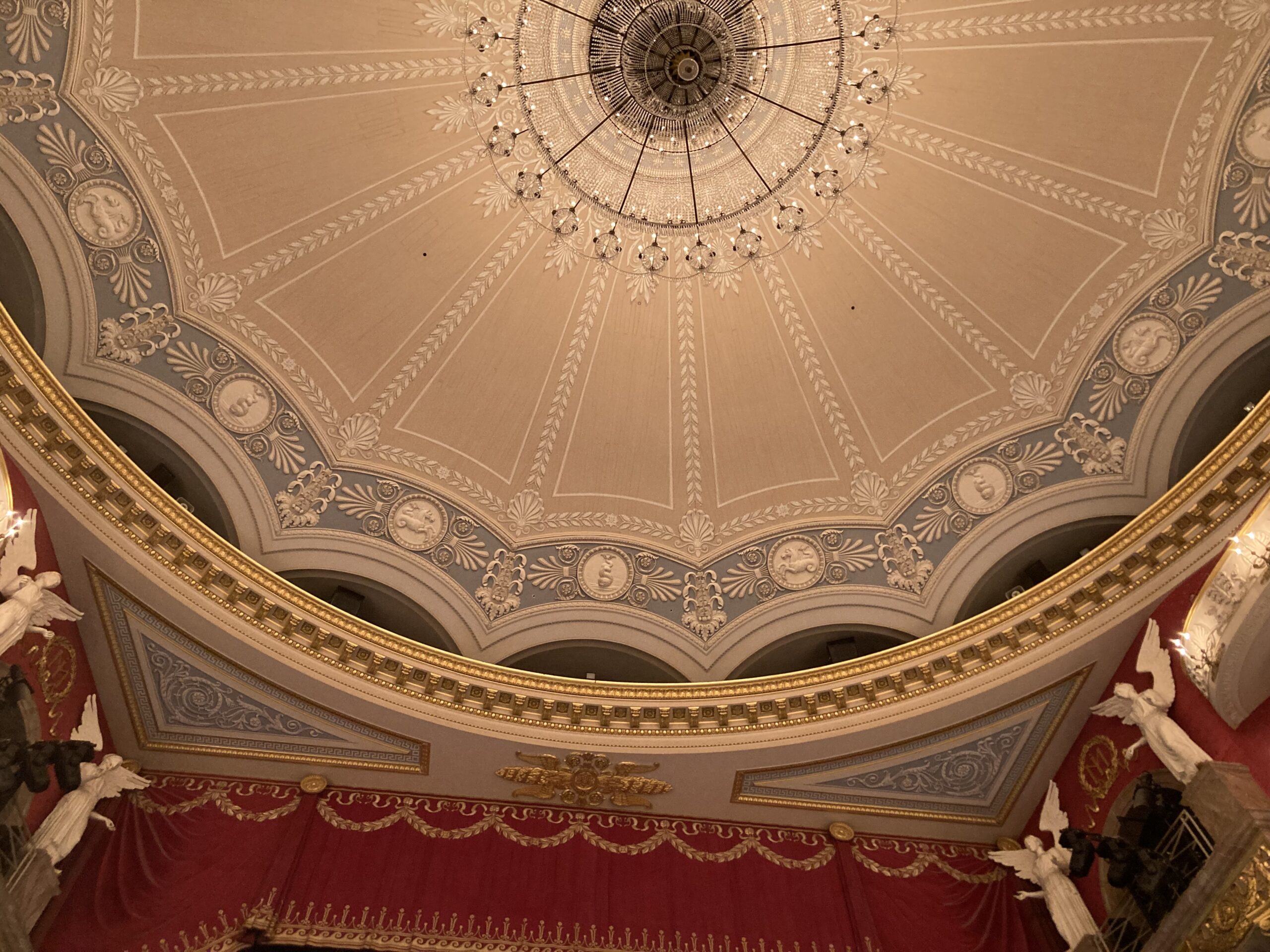
Nationaltheater, Munich, Bayerische Staatsoper, opera, culture

Looking up inside the Nationaltheater. (Photo: mine. Please do not reproduce without express written permission.)

The second half of the production, with high-flying rock-god style designs (thanks to Michael Levine), added particular emotional weight to Strauss’s oft-soaring score, with the orchestra now sensitively responsive, attenuating itself to every fine point of voice and stage equally. Stirring video design (by Graz-based media company rocafilm) juxtaposed scenes of post-war Munich with an elderly Strauss at his house in Garmisch-Partenkirchen in 1945. His gentle smile contrasted with grimaces; his waves of hand morphed to a myriad of hands-over-faces; his garden became rubble. Such imagery possessed an immediacy that became bracingly confrontational; amidst the splendor of the Nationaltheater, we silently observed the building’s blackened shell eighty years prior, with the sounds of Strauss (Nazi collaborator to some; compromised if unquestionable genius to others) enveloping its red-velvet corners. Is ruination really so distant? Are we, in our comfort and elegance and click-clack shoes, somehow complicit? Not unlike Der Rosenkavalier (1911) before it, Die Liebe der Danäe is just as concerned with the passing of time, and what we choose to do with that time, especially in relation to others. Does time teach? Erase? Ease? Heal? Should it… can it? Thoughts of Strauss attending what would be the only presentation of Danäe in his lifetime flooded the brain; that sole presentation was a private rehearsal in 1944 in Salzburg, permitted by the Nazis, who had closed all other theatres in accordance with Goebbels’ declaration of “total war” following the attempted assassination of Hitler months before. The composer walked to the front of the auditorium during the finale of Act 3, listening carefully. At the music’s close, according to producer Rudolf Hartmann, held up his hands and said, teary-eyed, “Perhaps we shall meet again in a better world.” Even before the curtain descended in the opera house that night, I bit my lip and tried to hold back tears. It didn’t work.

Nicholas Brownlee, portrait, profile, opera, bass-baritone, singer

Nicholas Brownlee: On Opera, Emotions, & Being “A Whole And Total Person”

Nicholas Brownlee smiles when asked if he has any summer plans.

“Not really,” comes the response, “but I think I know every inch of track between Munich and Bayreuth.”

The American bass-baritone has been singing non-stop, or so it seems, for over a decade. This past season has been especially focused on the work of Richard Wagner, starting last autumn at Bayerische Staatsoper in Munich with a highly acclaimed production of Das Rheingold directed by Tobias Kratzer, with Brownlee singing the role of Wotan, King of the Gods. The production was revived this past July for the company’s annual summer opera festival. This summer he returned to the Bayreuth Festival, following his debut there last summer, as Donner in a revival of Das Rheingold, directed by Valentin Schwartz and conducted by Simone Young. Between rehearsals for the two revivals, Brownlee clocked up a lot of mileage with Deutsche Bahn.

The journey for a “classic-American boy” from Alabama, as you’ll read, has been longer, if also deeply rewarding. Winner of the 2025 Richard Tucker prize, Brownlee’s journey has been characterized by a nose-to-the-grindstone approach, one that has never been at the expense of intelligent singing and a colourful, rich sound. The bass-baritone, who was awarded first-prize in the Hans Gabor Belvedere Singing Competition (2016), the Zarzuela prize at Operalia (2016), and was a winner in the Metropolitan Opera National Council Auditions (2015), got his start studying at the University of South Alabama before getting his Master of Music degree from Rice University. From the 2014-2015 to 2016-2017 seasons, Brownlee was a member of the LA Opera Young Artist program; he also appeared with the International Vocal Arts Institute in Tel Aviv, was part of the inaugural Young Artist Vocal Academy with Houston Grand Opera; spent a summer in Beijing with I Sing Beijing, and was part of the ensemble of Badisches Staatstheater Karlsruhe, where he performed a range of works by Handel, Massenet, Gounod, Offenbach, Mozart, and Verdi, and others. The 2020-2021 season saw him join the ensemble of Oper Frankfurt, where he has been based ever since. There, Brownlee has added the music of Verdi, Mozart, Strauss, Szymanowski, Bizet, Bartók, Giordano, Stravinsky, and a great many more to his repertoire.

He has since performed with Wiener Staatsoper, Opernhaus Zürich , Irish National Opera, Teatro dell’Opera di Roma, Teatro de São Carlos (Lisbon), The Metropolitan Opera, LA Opera, The Dallas Opera, Santa Fe Opera, Atlanta Opera, and Bard SummerScape,  expanding his musical palette to include the work of Erich Korngold (Das Wunder der Heliane, 2019) as well as contemporary composers like Jake Heggie (Moby Dick, 2015) and Unsuk Chin, whose Alice in Wonderland was presented in 2015 in concert with the Los Angeles Philharmonic and conductor Susanna Mälkki. He has also performed with the Houston Symphony Orchestra, Orchestre Symphonique de Montréal, the Prague Philharmonia Orchestra, and Orchestra Sinfonica Siciliana; next season sees him give concert performances with the Houston Symphony (Tristan und Isolde) and the orchestra of the Gran Teatre del Liceu (Mahler’s Eighth Symphony).

Whether in-concert or onstage in opera, Brownlee is never less than fascinating. In 2024 he gave a particularly zesty portrayal of Don Pizarro in a unique production (by Andriy Zholdak) of Beethoven’s Fidelio at Dutch National Opera, in which he was made to resemble high fashion honcho Karl Lagerfeld. One definitely isn’t supposed to root for the bad guy in Beethoven’s paean to freedom and fidelity… and yet. Something similar could be said for his Wotan in the Bayerische Staatsoper production of Das Rheingold – though Wotan is less villainous, as Wagner fans will know, than he is ruthlessly ambitious. Brownlee placed emphasis on the “ruthless” part, offering a multifaceted portrayal of the Valhalla god, by turns playful, brutal, seductive, highly selfish and deeply driven – human.

We discussed that and more last month, at the almost-end of what had been a very busy, Wagner-heavy season. Along with Wotan in Munich in October (and again in July), early February saw Brownlee sing the same role for his house debut with Opéra national de Paris (directed by Calixto Bieito) and Oper Leipzig, in a revival of  Rosamunde Gilmore’s 2013 staging. From there, Brownlee performed as the doomed title character in Der fliegende Holländer (The Flying Dutchman) at Palau de les Arts Reina Sofía (Valencia), Teatro Regio di Torino, and Bayerische Staatsoper. He sang the role of Amfortas (Parsifal) with Oper Frankfurt and in a concert presentation with Cēsis Art Festival and the Latvian National Symphony Orchestra. Recently in Bayreuth, Brownlee stepped in at the last minute for the singing role of Hans Sachs in Die Meistersinger von Nürnberg. His 2025-2026 season opens with a role debut as Balstrode in Peter Grimes in Frankfurt (opposite tenor Allan Clayton in the lead) before travelling to Hong Kong to sing Amonasro in Aida; his hectic future also includes a performance of Jochanaan in Salome with Lyric Opera Chicago, a turn as the Dutchman opposite Asmik Grigorian’s Senta in Bayreuth, and of course, a return to Wotan with Die Walküre with Bayerische Staatsoper, both next summer. One suspects the Munich-Bayreuth line is going to be especially well-used.

Brownlee’s impressive vocalism, with its oaken shades and bronzed ringing top, joins seamlessly with an effortlessly magnetic stage presence and thoughtful artistry – and comes minus any divo attitude. The “charismatic and charming” description by The New York Times (from a review in 2015) is not inaccurate; offstage however, the bass-baritone’s charisma is powered by a refreshing lack of pretension or putting-on of any artiste-style airs. He is a star, make no mistake, but he wants to make sure audiences don’t just hear him, but feel him, and his musicality especially, with all the earth of sonic experience viscerally moving between fingers and toes. This isn’t singing from the heavens so much as from rolling around in that very earth, while, to borrow from Wilde, gazing at the stars. That’s the magic of Nicholas Brownlee as person and performer, onstage and off.

Over a lunch of salad and mineral water, and on the very day of the Munich Rheingold revival, Brownlee spent a good hour-plus musing on singers of all genres (he is a big Roy Orbison fan), the realities of German ensemble life, the importance of embracing his background (including creature comforts), living with (and as) Wotan, and why all opera essentially revolves around four basic human emotions.

Nicholas Brownlee, opera, stage, bass-baritone, Der fliegende Holländer, Wagner, Bayerische Staatsoper, performance

Nicholas Brownlee in the title role of Der fliegende Holländer, Bayerische Staatsoper, 25 March 2025. Photo ©Geoffroy Schied

Early Inspirations

Some singers have a clear idea of what they want to do – “When I first heard Aida, I knew I had to be Aida,” or “When I first heard Traviata, I knew I had to be Violetta” – was it the case for you with the music of Wagner, or was it a more circuitous route?

For me opera was, and continues to be, a very interesting journey. I have no classical music in my family at all, although I originally wanted to be a conductor; that’s how I fell in love with music. I had a high school teacher who introduced me to big symphonies and gave me a full music education in a public high school in Alabama, which was and is rare. And so I went to school to be a conductor and pianist. And it wasn’t until I was in the first opera I ever saw that I really thought about singing.

Which opera were you in at the beginning?

I was in the chorus of La traviata with the Mobile Opera. They still exist and I’m on the board there now. I then fell head over heels in love with opera through them.

Was there a big “a-ha!” moment – “Wow, I can sing this stuff!” – or was it more gradual?

I was always singing and performing in my household – Elvis Presley; Conway Twitty; old-school country music. I think it makes you a balanced performer to know that work. And I think when you look at singers like Tom Jones and Elvis and Roy Orbison, all those guys, they’re just beautiful, I mean… wow, they are just really good singers! They sing in tune; they sing unfixed post; they project – it’s all really good stuff. So with all that music at home, I would also sing and perform. In college I had a professor who was already sort of pushing me to sing; when I would have my exams, he would say, “You have a voice, and it’s operatic; I can hear it in your speaking voice.” I was 19 years old. So then I changed my focus to include voice in my major, and I started taking voice lessons. That was 16 or 17 years ago or so now, and there have been a lot of steps, but it’s been incredible.

Opera for me was the first thing I ever truly felt comfortable in, really. I grew up your very classic-American boy; I played American football and baseball and golf. I didn’t really know I felt uncomfortable then – I felt perfectly comfortable, in a way – but then I got around opera singers and various other artists in rehearsal rooms, and all my dark jokes were met with smiles. It was like, “Ah, welcome to the craziness!” That was when I felt the most comfortable, and I knew that I’d found a home.

Honest Friends = Good Friends

How does that sense of community translate to your experiences now? Doing opera productions, one forms this little club, and then when the run ends, so does the club – I would imagine that’s tough.

Well, it’s gotten easier. It is tough when you’re beginning because you’re young, you’re right out of school, and school is such an insular community. Then you go into your young artist program, and you’re all together like we were in LA for two years, having every meal together; in a way there are very frat-like vibes in a young artist program, because we’re all in it together… but then, all of a sudden, you are a freelance artist.

And those first few years, you’re working, sometimes with people in similar age ranges, and you realize people may take different paths: teaching, coaching, management. So you learn that every gig is different people, but each time you’re creating a bond. Maybe you have a show romance with someone or you think you’re best friends and you trade numbers. You’re like, “I found it! I found my best friend!” – and then it’s just gone. And then you go away and you don’t have time to figure it all out and real life kicks in. It’s so hard to get to this level – the amount of, not just talent, but luck it takes, the stress, the energy, the training, everything… it’s a lot. There are so many things you are forced to deal with. You end up working with some of the same people also, so there are little mini-reunions twice or sometimes three times a year, and that’s really important. From that, you start to forge actual friendships with roots and depth – and that, for me, has been a huge change.

Has that depth affected your performance practices?

I’ve been in the ensemble for five years in Frankfurt. The way we use our ensemble is so special. For instance, we’ll do a full Salome, and it’s everybody in the ensemble. We do a full Ring Cycle; it’s everybody from the ensemble. So you’re singing with some of your real best friends – like, all of our kids play together in real life. We have a lot of life there together and you get to do opera with them also, and so there’s a real safety, but more than that; there’s this ability to like feel like you can take chances that you wouldn’t normally take when you’re a guest in a place – because that trust is already there, it’s established. And, to be quite frank with you, it’s good to have friends who are close enough to sometimes say, “Well, that didn’t work, that thing you were trying to do.”

It works the other way also. Right before we went out and did a twelve-show run of Macbeth, I saw a friend of mine and they said, “I’m going to do it this way tonight” – and later it was like, “Bro, you gotta do that every night!”. There’s a beautiful, natural camaraderie amongst the singers, something that can be really hard to find.

Camaraderie, Comforts, & Life Between Plans

How do you negotiate life as an American in Europe?

It’s hard. I think you know I’ve lived here for nine years now. I was first in Karlsruhe for four years, then in Frankfurt now for five years. I think, like anywhere, you just have to find your people – you have to find your way of living. For instance, in the first four years my wife (mezzo-soprano Jennifer Feinstein) and I were here we went full-European: no car; lived in the heart of the city; walked everywhere – rain, snow, didn’t matter. It was really difficult. And then when we moved to Frankfurt, my wife and I were both like, “Look, if we’re going to really lean into here, why don’t we at least have some of the comforts from home?”

So we still live centrally, but further out. We bought a car we go grocery shopping with; we buy in bulk. We bought a big, American-style refrigerator with ice on the door. We bought screens for the windows. You have to find your creature comforts, these little things that, for better or worse, we grew up with, culturally. You cannot help where you’re born; you cannot help or change what is your homeland. And so, you adjust and you acclimate as much as you can – and then enjoy your creature comforts.

I would imagine that actually helps you on stage, knowing you have that kind of predictability at home.

Yes, and understanding that decision fatigue is a real thing also. It’s really hard to know, as a person living in a foreign place, exactly what you want initially, and how you want your life to look on a literal day-to-day basis – especially as an artist. I mean, as artists we are always looking at the big picture in this zoomed-out way, but the details matter, like “Wow, this person is probably a little dehydrated; he needs a coffee” – it’s just that simple sometimes.

Nicholas Brownlee, Sean Panikkar, Lucie Thies, Bayerische Staatsoper, Das Rheingold, Wotan, Valhalla, Tobias Kratzer, opera, Wagner

Film still from Tobias Kratzer’s production of Das Rheingold for Bayerische Staatsoper. (L-R) Sean Panikkar as Loge, Nicholas Brownlee as Wotan, Lucie Thies (Bavarian State Opera extras). Photo © Manuel Braun, Jonas Dahl, Janic Bebi

Does Wotan want a coffee, then?

Yes! I mean, the question as to whether Wotan’s actually a human or a god or whatever… sometimes people are just people, and the answer is very simple. And I think that that’s the thing that gets us through day-to-day life. I think that it’s taken me a long time to come back around to this idea; I was raised very blue-collar, and then I got to college and I met a variety of different people, and I wound up getting a little too lofty for my britches, I would say, a little too heady and a little too looking-down-at-my-past culture and how I was raised – and now, I’ve come right back around. I think that that’s being a whole and total person. I think that’s what people mean by being worldly.

The ability to sit in a cafe in Paris and argue about philosophy until 2am is really nice, and really fun, and boy do I love that kind of thing, but I also love when I get invited by a nonna for an incredible meal that involves four ingredients – that is life; that is experience. It’s easy to fall into thinking opera’s this big, flowery thing, but, I say this all the time, I really am just screaming into a black void…

… with great precision and beauty.

That’s true, but I’m also doing it because I want to display the four base emotions of human life and try to shed a little bit of light on them. In order to do that, I say some of the most lofty things, especially singing Wagner – it’s the most poetic German you’ve ever heard in your life. Yes, we can break down the chords and we can talk about how gorgeous the music is and all of it, yes – but really, for me, what there highlights the four most basic human emotions: love; anger; sadness; the fourth one is complicated, maybe something like saudade, longing, sehnsucht. And I think that that’s what opera is. It’s trying to capture those four base emotions. Of course we can discuss its incredible power at various levels: the scary power of the church in Tosca; the power of economic hardship in Bohéme; Wotan’s testing and exercising his own divine power in The Ring. These stories aren’t distant; they’re very real.

With this Wotan I’m singing in Munich, I think of it like Elon Musk when he was 31 years old and had just sold PayPal; you can listen to interviews from that time and hear that he was walking along that line of power and how to use it. Wotan in Rheingold feels like somebody I might know, somebody who was young and made it big and is walking this line now. I mean, imagine you have the keys to the city, to every single city, the secrets of many, infinite knowledge, any male or female wants to be next to you – or more – all the time; how is that shit not going to corrupt you? Of course it will. Having that kind of a life is not the way life is really meant to be – it’s weird. The way this production ends really underlines that.

So what do you think has this experience taught you overall?

Some of my colleagues will say to me after a performance, “Look, you have this life, it’s a good life; whatever you do, Nick, hold onto it.” As much as Wagner is great, Bayreuth is great, Munich is great, it’s all very great – it’s important to have a life outside of opera. I think it’s really imperative. You can easily forget that life happens outside the opera house each and every day; you zoom in, and then you zone out. My wife is a big planner and I’m very spontaneous, and we’ll talk about meeting in the middle, but we always say in the end: life is really between the plans. Life is now.

Top photo: Fay Fox
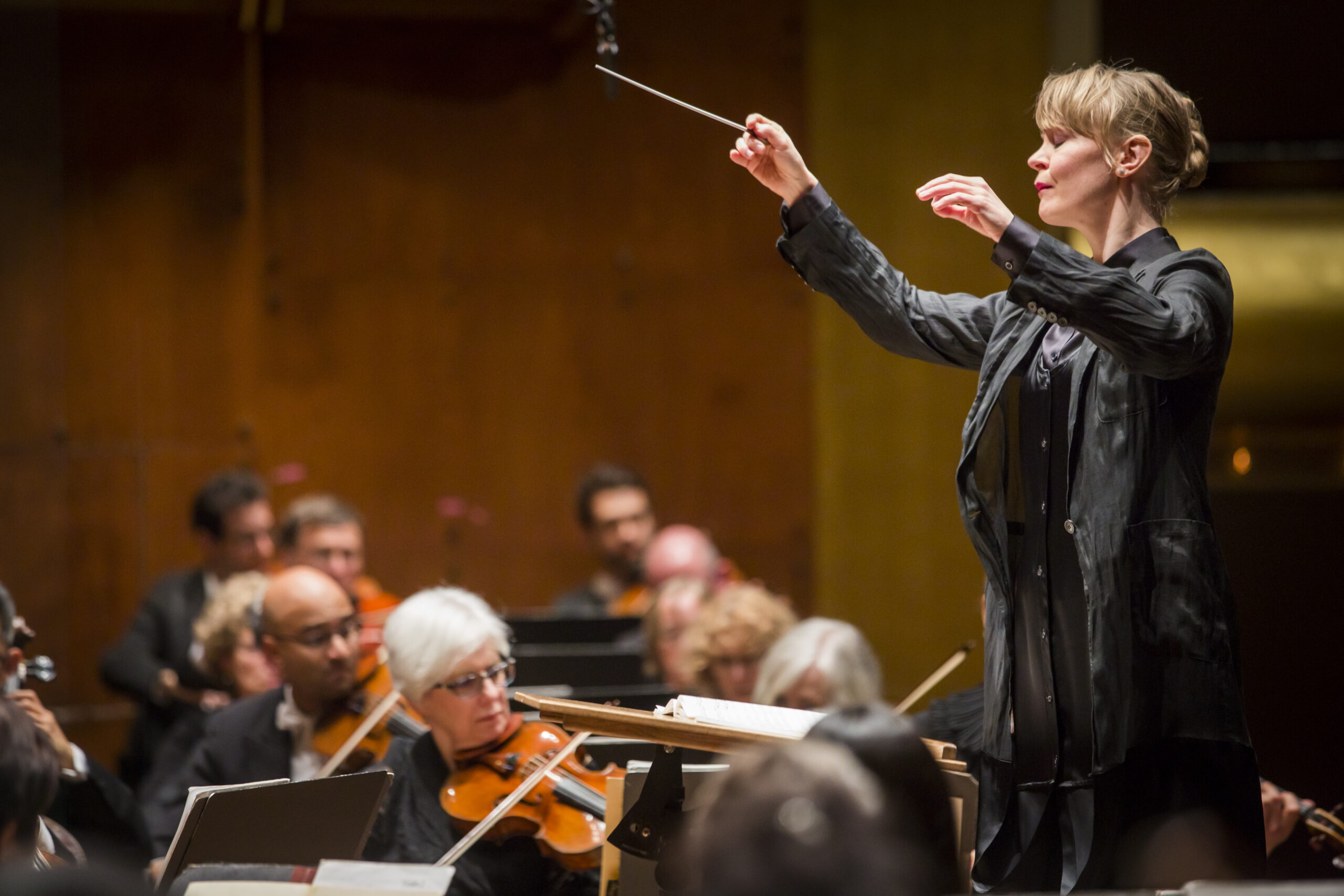
Susanna Mälkki, conductor, classical music, opera

Susanna Mälkki: “Allowing The Ear And The Eye To Understand”

Mythology has a way of making its presence felt across generations and into contemporary life, whether in film, television, or music. Gabriel Fauré (1845-1924) found inspiration in Homer’s Odyssey, separating himself from other influential, mythologically-inclined composers of the era (chiefly Richard Wagner and his Ring tetralogy) while simultaneously tipping chapeau, in his own way, to the epoch’s sonic landscape and the endurability of Homeric storytelling. In creating Pénélope, Fauré carved a creative path that was, and remains, entirely his own.

Opera composing came relatively late to the French composer, who is arguably best-known for his art songs, chamber music, the Pavane in F-sharp Minor (1887), Op. 50, his Pelléas et Mélisande Suite, Op. 80 (1898), and his Requiem in D-minor, Op. 48 (premiered in three versions: 1890; 1893; 1900). He began Pénélope, when he was 62 years old. Composed between 1907 and 1912 in the summers away from his duties as head of the Paris Conservatoire, the work is (as it is formally noted) a “poème lyrique” in three acts. Its libretto, by playwright and actor René Fauchois, is based on the story of the return of hero Ulysses to his home of Ithaca, finding his wife Penelope and a gang of wily suitors, detailed near the end of Homer’s Odyssey.

Premiered in Monte Carlo in March 1913, the opera went on to be produced at the Théâtre des Champs-Elysées in May of that year; it became part of the repertoire of the Opéra-Comique in 1919 before being presented by the Opera de Paris (1943), and subsequently premiered in the U.S. (1945), Argentina (1962), the U.K. (1970), the Wexford Festival Opera (2005), and more recently Oper Frankfurt (2019). Singers Suzanne Danco, Jessye Norman and Régine Crespin were among the many who sang (and/or recorded) the title role. Gramophone‘s Lionel Salter noted (in a review of the Norman recording) that the opera is “essentially a lyrical work, though there are almost no arias as such; it employs Wagner’s leitmotif technique (although in an individual way) but is not at all Wagnerian in idiom; it is basically intimate and restrained, though there are also powerful emotional scenes…”. MusicWeb International‘s Ralph Moore (in a review of the same 1980 recording) noted sounds of not only Wagner but Bartók, “not perhaps so strange after all, as Fauré himself said he was pushing the boundaries of tonality without leaving them behind.”

The unique soundscape Fauré created for Pénélope demands an approach infused with utmost attention to detail and care; given this reality, together with the opera’s unique dramatic demands, the work has not found a regular foothold in contemporary opera programing. Music writer Jessica Duchen muses in her excellent biography of the composer (2000, Phaidon Press) that the reason might be because “it does not fulfil operatic audiences’ expectations of spectacle and rapidly paced action, or because of a general neglect of French operas of this period, with the exception of Debussy’s Pelléas.” Duchen goes on to quote pianist Edouard Risler (1873-1929), who said at the opera’s rehearsal, just prior to its Monte Carlo opening, that Fauré’s opera “will last, but it will take a long time to establish itself.”

An arguable re-establishment has been underway for a little while, what with the Frankfurt production six years ago, and more recently, a presentation  as part of the Bayerische Staatsoper summer festival in Munich last month. Led by the formidable team of Andrea Breth (director) and Susanna Mälkki (conductor), the production featured mezzo-soprano Viktoria Karkacheva in the lead and tenor Brandon Jovanovich as Ulysse. As well as being a first for the company, Pénélope also marked the house debuts of Breth and Mälkki. In his review for BR Klassik, reviewer Bernard Neuhoff praised both artists, writing that the conductor led the vaunted Bayerisches Staatsorchester with “inspiration and precision” (“inspiriert und präzise). That comes as no surprise to anyone who’s been following Mälkki’s work over the last decade or so. Mälkki’s style is a fascinating mix of such precision as well as buckets of poetry, often employing wide, rhythmic gestures and open body language; for Pénélope these elements were put to careful use. There was astute attention paid to the pacing of Fauré’s score and its orchestration (her signalling to various sections was gentle but firm; her attentiveness to singers absolutely clear) – and to director Andrea Breth’s highly stylized vision. The result was a marvellously moving portrait: here was an old tale that felt remarkably fresh, with a deeply thoughtfulness applied equally to musical and theatrical realms.

Susanna Mälkki, conductor, classical music, opera

Photo: Chris Lee

Beginning her career as a cellist, Mälkki was Chief Conductor of the Helsinki Philharmonic from 2016 until 2023, and is its Chief Conductor Emeritus. From 2017 to 2022 Mälkki also led the Los Angeles Philharmonic as Principal Guest Conductor She has conducted a number of other eminent orchestras including the Berliner Philharmoniker, Staatskapelle Berlin, Staatskapelle Dresden, Gewandhausorchester Leipzig, Symphonieorchester des Bayerischen Rundfunks (Munich), the London Symphony Orchestra, the Chicago Symphony Orchestra, the New York Philharmonic, the Philadelphia Orchestra, the Cleveland Orchestra, and the Orchestre Symphonique de Montréal. From 2006 until 2013 Mälkki was the Music Director of the Ensemble Intercontemporain, having been directly invited to the position by founder Pierre Boulez.

In the opera world, she has conducted productions at a range of acclaimed houses including Teatro alla Scala, Wiener Staatsoper, The Royal Opera House Covent Garden, Opéra national de Paris, The Metropolitan Opera, Gran Teatre del Liceu, as well as the Festival d’Aix-en-Provence, leading works by Stravinsky, Mozart, Verdi, Wagner, Beethoven, and Kaija Saariaho. The recipient of numerous awards and honours – including the Pro Finlandia Medal of the Order of the Lion of Finland and Commandeur de l’Ordre des Arts et des Lettres of France – Mälkki is a Fellow of the Royal Academy of Music in London and a member of the Kungliga Musikaliska Akademien in Stockholm. The 2025-2026 season sees her leading the Danish National Symphony Orchestra, the Tokyo Symphony Orchestra, and the Boston Symphony Orchestra. In opera, she will lead productions of Tristan und Isolde at the Gran Teatre del Liceu (Barcelona) in January, and Innocence (by Kaija Saariaho) at The Met in April.

When we spoke last month at the Prinzregententheater in Munich, Mälkki was effusive in her praise of Fauré’s score, and clearly happy to have worked (or be working with) director Andrea Breth and the whole Bayerische Staatsoper team. In a quiet room with a green view over the course of roughly thirty minutes, Mälkki enthusiastically shared her thoughts on Pénélope, its place within the world of both composer and epoch, working with director Andrea Breth, and how “maps” in music can (do, must) change.

Bayerische Staatsoper, Pénélope, Fauré, performance, opera, French, stage, Andrea Breth, Susanna Mälkki, Viktoria Karkecheva, Thomas Mole, Brandon Jovanovich, theater, live

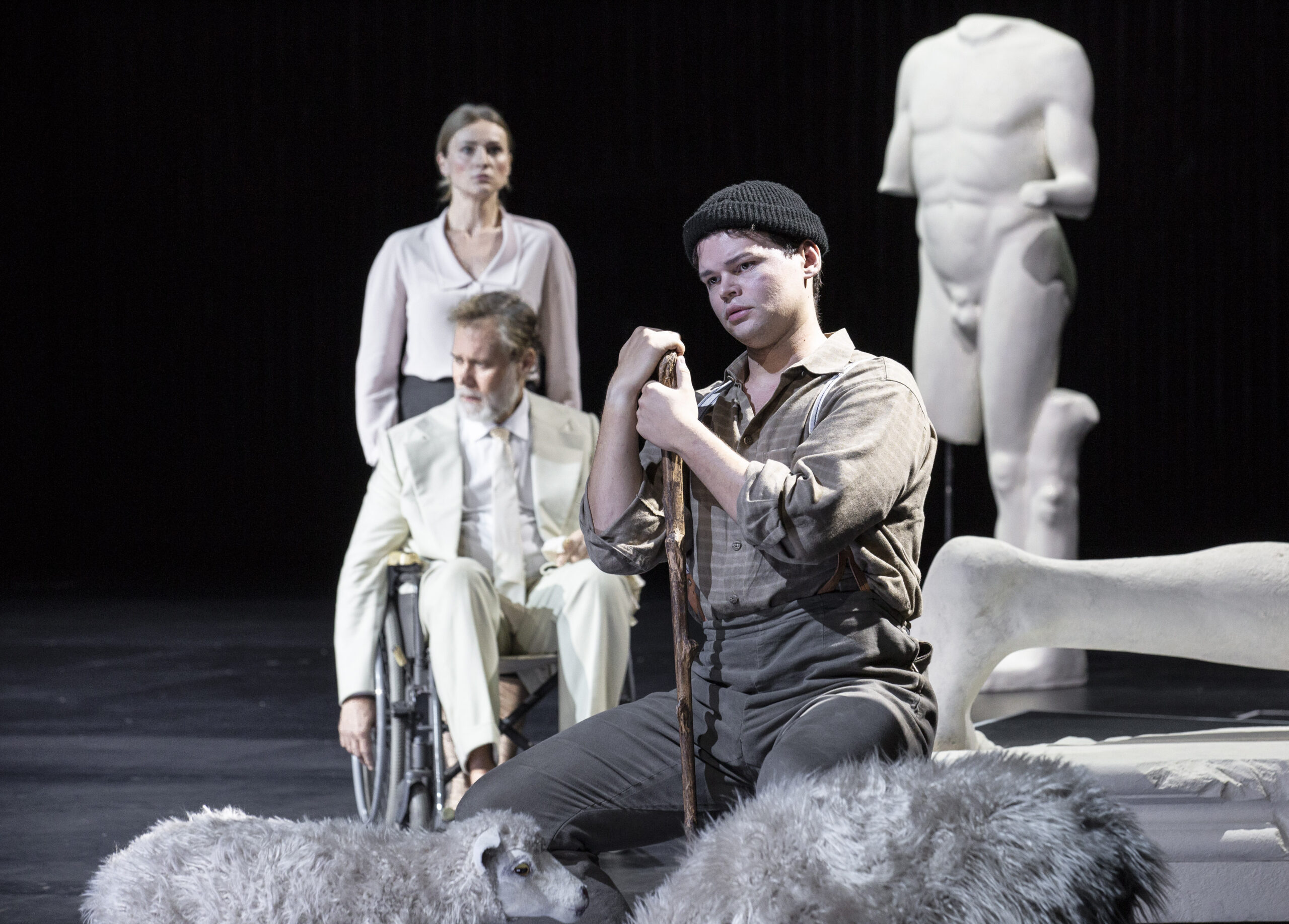
L-R Viktoria Karkacheva (standing) as Pénélope, Brandon Jovanovich as Ulysse, Thomas Mole as Eumée. Photo © Bernd Uhlig

“This Incredible Drama”

What was your experience of Fauré before Pénélope?

I knew Fauré as a cellist, actually – there are arrangements of his songs for cello and piano and then also some pieces. I knew his chamber music, and I know some of the famous orchestral pieces, like the Pavane and things like this. But actually, I confess, I did not know the opera. I’m not even sure I knew of it, but when the question came from here, from the house, I was intrigued immediately, because I’ve always liked and admired Fauré. I think Fauré has a greater importance in the history of music than what he’s given credit for – he’s not a mainstream composer, but he is very important in the family tree of how music and harmony evolved, because his music is very original.

Where do you think Pénélope fits within his overall oeuvre?

It’s a late piece, which is wonderful because I think it’s much more dramatic and radical than any of the music that came before, especially in terms of how he uses the orchestra. In the chamber music you can have pretty wild harmonics, you know – it’s always very expressive – but I would never have imagined that he had this side, or that he would just unleash this incredible drama.

Some have said of this work that it’s a rip-off of Wagner and/or Debussy – but this opera really has a language all its own.

Absolutely, and it’s very theatrical if you really listen. Its singularity is something that I could sense studying and then rehearsing it. The musicians of this orchestra of course picked up the Wagner things immediately. And already in Wagner’s time and after, every composer was influenced by Wagner, even those who did not want to be. So in a sense it’s unfair to just say that Fauré had this or that sound or tried to be Wagner, because Wagner himself was such such a great influence on the entire epoch. In fact, if you listen to the music of Franz Liszt and then you listen to Wagner, you see that Wagner in turn was actually influenced by Liszt also, much more than anyone gives Liszt credit for. So it’s all always a long chain of evolution. There is a kind of compositional exuberance, or however you call it, the romantic Schoenberg and all of that – everything is there.

On the other hand, what I find “French” in the piece is that the text is driving the music and not vice-versa. So yes, he took this and that, and then he absolutely composed something of his own. It’s very original. There’s no filler. And if you actually really study it, you can see that there’s an incredible steel structure within it also; the way Fauré uses his motives in Pénélope is very original. It’s not the Wagnerian way of using motives, even if there are sounds that may remind us of him.

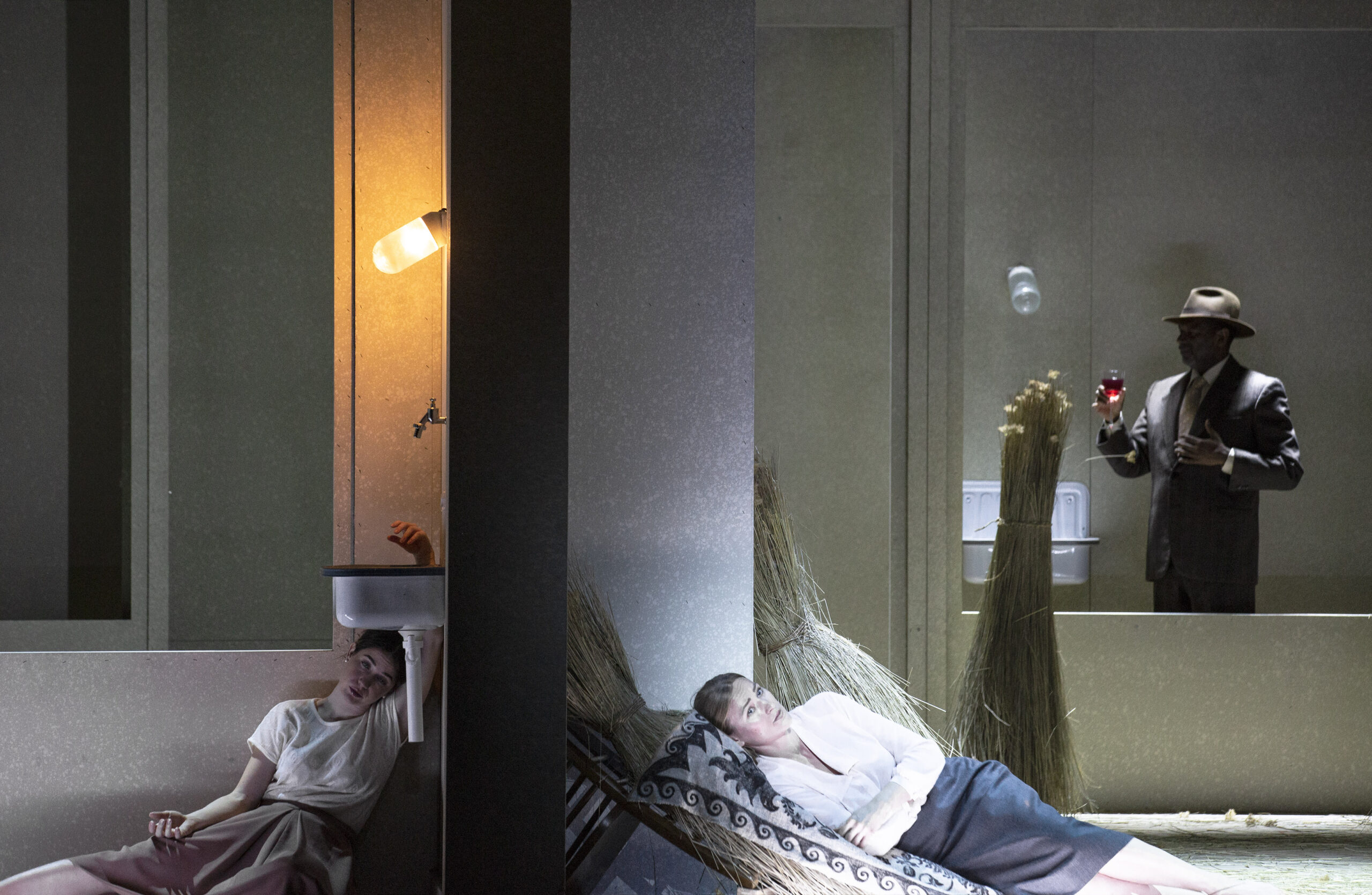
Pénélope, Fauré, Bayerische Staatsoper, Pénélope, Fauré, performance, opera, French, stage, Andrea Breth, Susanna Mälkki, Viktoria Karkecheva, theater, live, Loïc Felix

Pénélope at Bayerische Staatsoper, July 2025. Photo © Bernd Uhlig

Text, Music, Synergy

How much work did you do with Andrea Breth in terms of paying attention to those motives and having them manifest onstage, and more broadly, about the music and theatre?

I think Andrea’s approach is well-structured and analytically thought out, but fundamentally very instinctive. I very much appreciated the fact that she wanted to be in all the music rehearsals; she came to listen to everything. She had, of course, listened to recordings, but I think I sensed that there were things in my interpretation that triggered her imagination in various directions. So the kind of vibe certain scenes took, I wouldn’t say that it took another way, but I could see that something new – or something more – came out of it. I think that makes a good opera director. We spoke about the dream-like atmosphere of the piece, and she said at one point that she’s not really interested in the text, which I thought was very surprising, but I think what she meant was nothing in it was literal to her. Whereas with singing you always have to think about the words, because the music is written, especially with a composer like Fauré, for the voice. So it’s written to be sung with words you know. Musically-speaking we always need to think of the words; we can’t ignore them.

What kind of discussions did you have leading up to rehearsals?

We met in Aix last summer and she presented some ideas – some were there already, other things changed, and I thought it was fascinating. I understood very early on that she didn’t want to do some kind of historical presentation – she jokingly said, “They’re not going to be wearing togas” – but I think any serious modern director wouldn’t do opera in togas anyway.

Unless it was meant to be ironic!

Yes, of course, but then I think her idea of this kind of museum, with the statues everywhere, is fantastic, because you have the reference of the history and all the antiquity and its culture. It’s rare that directors come to music rehearsals, but I was also present at every director’s rehearsal – because I think that those are the moments when we build the connection with the whole team. In case there is something that is difficult, then I make suggestions: “Can we do these movements two bars earlier or two bars later?” or “Maybe have this gesture with this word so that musically it works and is not contradicting the singers.” And I love that kind of work – it’s not suggesting altering things, but to make them work even better at all levels.

There was an extremely palpable connection between you all, especially when you did your bows and embraced at curtain…

I think synergy is important in opera – you have to have it. Between her work, my work and then the singers, it has to be there, otherwise it’s not believable.

Staying Alert

Conductors look at things years in advance and their relationship with the score will change: it’s one thing to study and have ideas about the piece; it’s another to go and engage with people. How did your ideas – of the theater of this especially –change, or did they?

Well, in a way, it’s all kind of built into my work task, to bring the ideas, to have a vision and to be coherent. And of course you always develop them together with the singers. But also I think, with this score, there’s about two hours of music, and there was less than one minute of that music where I had to think, “Well, what should I do with this?” – so most everything was clear to me from the start. Maybe sometimes in the process you find that something is not quite clicking, so then you adapt the tempi a little bit; you might also give more time to certain spots because of basic theatre demands.

For example, there is one moment where I actually deliberately slowed things down a lot because of one very sequence in the staging ; it just wasn’t working because of too quick a set change , so I said, “I can give you a few seconds here and there?” – and then they managed to do it just in time. But then of course I have to have the judgment as to whether or not the music allows it, but in this case, yes, it did; I knew, there’s just one line sung by somebody alone, so just before and after that we could make room for it. And it works; it’s not contradicting anything. So I think what I need to bring to the table is that I’m consistent in my musical gestures in the sense of allowing the ear and the eye to understand, and also for singers to know that they can rely on me in every situation. You have to lead the music … and of course the audience doesn’t need to be aware of any of this, but we need to think about it.

There’s a tiny moment in the score – a reference to Wagner’s Siegfried – which felt quite theatrical too…

Oh, the little quote at the end – yes, isn’t that amazing? It’s wonderful. And you have to find the gravity for those moments. It’s almost like a little chapeau to Wagner, but it also works with the story. The choice of key, the choice of the instrumentation, the tempo and the context, for those who know – we immediately recognize it. Fauré called this opera a “poème lyrique” – it’s a song play, so we have to be very alert. Ulysses and Penelope is a story everybody knows, but maybe people don’t know the details; when we think of the suitors, it’s interesting how we can hear that they have their own distinct personalities. And how Fauré’s music changes in the third act, which is when Ulysse comes back, it’s this muscular sound, a totally different thing.

What was it like to work with the singers for this?

Fauré gives great importance to the singers, and the music they sing is very distinct; Pénélope has, of course, the most dramatic stuff, Ulysse has, quite surprisingly, this very lyrical stuff, but also the hero stuff as I said, he has that dualism, and then the suitors have different kinds of music, as well as the shepherd, the nurse, and the servants. As we rehearsed it occasionally felt like we were preparing for a world premiere, because there wasn’t really a convention. But that was also something that I found wonderful, because I could then just say, “This is what I think should be.” A good score is, or a partitur, is self-explanatory – you have to see how it’s all laid out, then it’s like a map. But sometimes the map changes, or the things you notice on the map change once you’ve been on the actual terrain: “Oh, there’s that” and “I didn’t see that before.” And then you do it more and more, and those connections become clearer.

How did your own conducting change because of this experience – or is it too soon to tell?

You always learn from every production. And I think one of the beautiful things about working in opera is that you’re working with the resonance of other human beings. I’m extremely happy to have discovered this side of Fauré – it was a revelation to me – and when you get to conduct an orchestra like this, it’s unbelievable, truly. I hope that I can integrate this experience and bring it to whatever I do next.

Top photo: Jiyang Chen
trees, nature, path

Reading List: Summer 2025

Voila, a varied list of meaty music morsels, here for your weekend heatwave reading perusal:

Money, Honey

Arts organizations everywhere are facing funding shortfalls, with American outlets especially feeling the pinch. The New Yorker published an article in late April outlining the realities particularly related to funding drops from philanthropic organizations; writer Helen Shaw quotes various members of said philanthropic outlets who state that funding should not be forever, for anyone. Niegel Smith, artistic director of The Flea Theater in New York, is blunt: “Since the nonprofit theatre movement solidified in the nineteen-fifties, we have faced government shifting, but not this kind of foundation retrenchment. When I entered the field, the sense was that you could work and prove yourself and then your company would win enduring support from the pool of foundations. That’s no longer the case.” (“The Show Can’t Go On”, The New Yorker, April 24, 2025)

A new article by The Globe & Mail‘s Josh O’Kane sheds light on a pay-for-play situation within the Canadian classical world. The Toronto Symphony Orchestra is allowing a wealthy amateur conductor to lead a performance of Mahler’s Second Symphony this coming week. The amount the individual paid the orchestra for the opportunity was not disclosed, but some TSO musicians (all of whom asked to remain anonymous) are unhappy. Interestingly, it was only last September that the orchestra received a $15 Million gift from the Barrett Family Foundation, the largest in the orchestra’s 102-year history. (“Amateur conductor pays Toronto Symphony Orchestra to lead Mahler performance, shocking some musicians“, The Globe and Mail, June 20, 2025)

What’s the relationship between location and innovation? A short rundown in Concerti explores various German opera companies who, facing needed renovations at their home bases, have moved to alternate locales, and found new methods and modes of both presentation and programming. The report is a little dismissive of Komische Oper Berlin — moving from Behrenstraße to “polite bourgeois Charlottenburg” (specifically the Schiller Theatre) has hardly dampened the company’s embrace of innovation. Large-scale presentations like Henze’s The Raft of Medusa (staged at an old hangar at Templehof Airport in 2023) and the upcoming Jesus Christ Superstar (at the same venue this autumn) might never been done so ambitiously, nay programmed at all, were it not for the renovations that forced the company from their longtime home. Still, this is good food for thought, especially at a time when dwindling resources may necessitate more creative approaches. (“Ungeahnte Impulse“, Concerti, June 13, 2025)

Humans First

Sir Simon Rattle received the 2025 Ernst von Siemens Prize in mid-May in Munich. The conductor is using the €250,000 prize to form a new period ensemble within the Bavarian Radio Symphony Orchestra (BRSO).  In a comprehensive interview with BR Klassik’s Bernhard Neuhoff done earlier this month, the conductor (who is also the subject of a new documentary) reflects on his career and its changes and challenges. One quote (translated) particularly stood out: “You will need all experiences, because if there is only music, what’s the point? We have to be human beings first, and musicians second.” (This nicely echoes something Lucas Debargue said to me in early 2020.) The conductor is set to lead the BRSO in a new production of Don Giovanni at Festival D’Aix, and he’ll also be on the podium for a concert with the orchestra in mid-July (still in France), one featuring the music of Ligeti, Wagner, and Bruckner. (“So Hat Musik Sein Leben Verändert“, BR Klassik, June 6th, 2025)

A new column by Lynn Gardner in The Stage explores survey results of British theatregoers, and makes an obvious if important observation: “For those of us for whom theatregoing is a habit, we often forget that for many people a night at the theatre is a special night out.” (“Matching expectation to experience in theatre is getting harder“, The Stage, June 16, 2025) Gardner’s musings on the intersection of expectations and artistry brought to mind an interview in Van Musik between music writer Arno Lücker and author, film critic, and podcast host Wolfgang M. Schmitt, in which Schmitt shares how his classical passion came about, and what he thinks of companies targeting young audiences. (The title of the piece – which translates to “Classical music institutions are on the wrong track if they declare their older audiences to be a problem”–  should be a tip-off.) Schmitt’s insights are fascinating: “Fewer and fewer people – and this is my cultural pessimism, which I feel is completely justified – are prepared to break away from social media in order to concentrate on something for an hour or two. If you are not willing to muster this ability to concentrate, then you will never be able to open yourself up to the realm of classical music.” (“Die Klassik-Institutionen sind auf einem ganz falschen Weg, wenn sie ihr altes Publikum zum Problem erklären“, Van Muzik, February 19, 2025)

The Devil Inside

Earlier this month BBC Music published an interesting little survey of the so-called “devil in music”, the tritone – known better (to some of us anyway) as the augmented fourth or diminished fifth, depending on the musical context. Creepy and essentially unresolved in sound, the chord was avoided throughout much Medieval and early Baroque writing. Steve Wright references a number of famous examples where the easily-identifiable chord is used: the writing for Don Pizarro in Fidelio; Debussy’s Prélude à l’après-midi d’un faune and La Damoiselle élue; Camille Saint-Saëns’ Danse Macabre; Sibelius’s Fourth Symphony; Bernstein’s West Side Story. Of course my personal favourite is its use as part of the famous Tristan chord. (“The ‘devil in music’: the musical trick once thought so dangerous that it was banned outright“, BBC Music, June 3, 2025.)

Demons (or more traditionally, daimons) are part-and-parcel of many folk legends and stories, though as a symbol they are heavily linked with Christianity and its concepts of sin, temptation, possession, and damnation. Aeon takes a fascinating look at their history, wisely (refreshingly) noting that “(t)he demons of the Christian Bible were none other than the daimons of paganism demoted, that is, the lesser divinities of the Greco-Roman religion superseded by Christianity after Rome’s conversion to Christianity in the 4th century CE.” (This brings to mind Waldemar Januszczak‘s excellent series on the (so-called) Dark Ages, in which he carefully links various Christian rituals, symbols, and depictions to ancient counterparts.) Writer and professor David Gordon White does something similar here, noting that “(f)or the monks of medieval Catholicism, the organisation of the demonic host replicated its own hierarchy” – an idea strongly reflected in the opera world. As well as being a reflection of repressive regimes, though, their influence is also often code for unleashed sexuality (The Devils of Loudun) or overheated fantasy (The Fiery Angel) or even simply awful people (Don Giovanni, and not only the main character, who indeed exits the work surrounded by said figures). White also examines Buddhist and Hindu traditions as well as the connection between language and myth. (“Demonology“, Aeon, May 12, 2025)

Is singing a crime? (I can hear some of you tittering.) It once was, at least in 16th century Geneva, when Protestant reformers led by John Calvin attempted to stamp out what they termed “illicit singing.” JSTOR‘s Livia Gershon quotes a 2015 paper by musicologist Melinda Latour examining song (and singing) in the town during that period – the role of Calvinism in shaping (dampening?) cultural life. Between 1542 and 1552, over one hundred people were tried in the civic-religious court for singing and/or performing works perceived by authorities as dance music – songs with sexy content, or anything dance-related (which, in turn, might lead to sex, which was a big no-no). As Gershon notes, “singing was considered a form of enticement to more serious offenses.” (“When Singing Was A Crime“, JSTOR Daily, May 9, 2025)

Reality As It Is

Dutch National Opera’s new staging of Boris Godunov (by Kirill Serebrennikov) will be broadcast on Mezzo TV on July 13th. Tomasz Konieczny sings the lead and Vasily Petrenko is in the pit. The production takes a very plus-ça-change approach to its subject matter, perhaps reflecting the house arrest experience of its director less than a decade ago, but more directly his attitude toward the current state of things in his homeland. “I believe in taking conscious, thought-through decisions, in trying to grasp and understand the reality as it is,” he recently told The Guardian’s Shaun Walker. Boris Godunov runs at Dutch National Opera (DNO) through the end of June; the run is sold out. (“‘It’s about self-destruction’: director Serebrennikov on his bleak operatic vision of Russia“, The Guardian, June 16, 2025)

Relatedly: the DNO Academy (DNOA) teamed up with Masters students at Leiden University for an Honours practicum called “Politics, Opera, & Philosophy”. Over the past few months, 25 students from a variety of programmes studied various aspects of the opera world; they attended a dress rehearsal, examined music and texts, and heard lectures from a variety of figures working directly in the industry, including conductors, directors, and dramaturgs, and *gasp* critics. (I like this.) Tim Meijers, who lectures in philosophy at Leiden University, worked with Paul McNamara, the artistic director of DNOA, to create a class that dove straight into issues (including outdated racial depictions) that clash with contemporary sensibilities and awareness: “Sometimes it’s super problematic, but then you go and listen to the music and think: wow! Do you just throw the whole thing in the trash?” The class concluded with a final concert of arias, duets, and scenes from well-known works. (“This course brings opera into the classroom: ‘Many themes are still relevant today’“, Leiden University, June 13, 2025)

Still with politics (and theatre): Globe Theater Berlin has partnered with Eastern European troupe Urban Theater for Krieg. Macht. Frieden (?) (War. Power.  Peace (?) ) , a contemporary take on Shakespeare’s Henry V and complemented by texts from both Machiavelli and Hannah Arendt. (Urban Theater’s repertoire itself includes the intriguing-sounding Richter’s Fairytale, a meditation on the life and work of pianist Sviatoslav Richter.) Krieg. Macht. Frieden (?) opened Globe Theater Berlin’s summer season recently and runs through mid-September.

RIP Pierre Audi

Michael Quinn wrote an excellent obituary of Pierre Audi in The Stage following the director’s untimely passing in May. Rupert Goold, current artistic director of the influential Almeida Theatre, called Audi’s tenure “the purest expression of values that remain central to the Almeida to this day – experimentalism, internationalism, integrity, playfulness and, above all, a celebration of new artists.” In opera, Audi’s many accomplishments included the first Ring Cycle ever to be staged in the Netherlands; it was led by Hartmut Haenchen, with whom he worked extensively – and intensively. The conductor penned a thoughtful tribute on his Facebook page: “Es ging immer um die Sache und nicht die Person.” (“It was always about the cause and not the person.”)

The Ring Cycle one of many feathers in Audi’s cap over his three decades with Netherlands Opera, a company that went on to be renamed Dutch National Opera (DNO) during his tenure. Audi also helmed the British premiere of Verdi’s Jerusalem (for Opera North) in 1990. His artistic passion fully embrace new works as much as old, and he premiered a number of ambitious pieces including Thebans (by Julian Anderson and Frank McGuinness) in 2014 for English National Opera, and Innocence (by Kaija Saariaho) in 2021 and Picture a Day Like This (by George Benjamin and Martin Crimp) in 2023, both for Festival D’Aix, where he had served as director since 2018; three years earlier he had been named artistic director of New York’s Park Armoury. Pierre Audi passed away suddenly in Beijing in early May at the age of 67. (Pierre Audi Obituary, The Stage, May 12, 2025)

Thank you Mr. Burrell and Mr. Brendel

Colorado Public Radio published a very good obituary of legendary American bassist Charles (“Charlie”) Burrell. Profiled in a segment on Denver television news last year, Burrell said of classical music that “I didn’t pick it up; it picked me up.” Burrell became entranced with classical via a performance of Tchaikovsky’s Fourth Symphony, led by Pierre Monteux. Long considered “the Jackie Robinson of the classical world”, Burrell’s many accomplishments included working with the Denver and San Francisco Symphony Orchestras, as well as being a professor at San Francisco Conservatory of Music. (Sidenote: Burrell would eventually be taken for lunch by Monteux himself.) A recipient of the Martin Luther King Jr. Humanitarian Award and member of the Colorado Music Hall of Fame, the musician also has an arts school named after him in the Denver area. Charles Burrell passed away earlier this week at the age of 104. (“Classical bass legend Charlie Burrell dies at 104“, Colorado Public Radio (CPR), June 17, 2025)

News of Alfred Brendel’s passing this week has led to a waterfall of touching tributes and remembrances. Martin Kettle writes in his obituary for The Guardian that “(i)n performance, he eschewed glitz.[…] That was the deal. It was the music, not his personality, that the audiences came to hear.” Brendel gave his first concert at the age of 17 in Graz, Austria; through the next six decades he focused on Austro-German repertoire, recording the Beethoven concertos and sonatas (twice);  all of Mozart’s piano concertos, and numerous works by Schumann, Brahms, Liszt, and Schubert. He accompanied singers in recital too, notably Dietrich Fischer-Dieskau with Winterreise. Brendel was also a poet, painter, and a teacher, and very supportive of other musicians (which is precisely how I encountered the pianist in Berlin years ago – at a performance by Martin Helmchen). Another pianist, Canadian Bruce Liu, wrote a simple, elegant post on his Facebook page: “You taught me how to find meaning between the notes.” Brendel passed away at his home in London; he was 94. (“A man of sense and wide sensibilities, Alfred Brendel was simply the pianist of pianists“, The Guardian, June 20, 2025)

Stay cool, readers – my heartfelt thanks for your continued support. More music and culture writing is coming soon (perhaps, maybe, I hope).

In the meantime: Remember the c-word.

Top photo: mine. Please do not reproduce without express written permission.
John Daszak, tenor, opera, Robert Workman, portrait, artist, classical

John Daszak: “I Was Always A Bit Of A Showman”

Anyone who has ever seen John Daszak live in performance isn’t likely to forget the experience. The British tenor brings to mind Goethe’s quote that “(g)reat passions are diseases without hope (Große Leidenschaften sind Krankheiten ohne Hoffnung)” (Maxims and Reflections, No. 23). Opera – its artists, its practitioners, its scholars and its fans – are all thusly afflicted, willingly and repeatedly, by the “disease” of opera, that most magical of art forms – one which Daszak so excels in, and indeed largely, boldly embodies.

Earlier this year the busy singer performed on the stage of the Bayerische Staatsoper (Bavarian State Opera) in Munich, in a colourful new production of Janáček’s Kat’a Kabanová by Krzysztof Warlikowski with musical direction by Marc Albrecht. Daszak was the hapless husband Tichon, opposite Corinne Winters in the title role and Pavel Černoch as lover Boris; he imbued the character with an unmissable pathos, betraying his own deep and longstanding love of theatre – and then there’s that voice, one capable of both great lyricism and great authority in equal measure. His Tichon, performed with a crystalline Czech diction and agile vocality, had a ringing top and a texture colourful and glowing one moment, despairing and plaintive the next. It was a dramatic if controlled approach, one perfectly befitting the singer’s approach (largely sympathetic, as you’ll read) while also attuned to the composer’s percussive writing. Showman? Definitely, but never just for the sake of it.

Getting his start at the Guildhall School of Music and Drama and then the Royal Northern College of Music, Daszak made his debut at the Royal Opera Covent Garden in 1996 and has since gone on to perform at the some of the world’s most acclaimed houses including The Metropolitan Opera, Teatro Alla Scala, Berliner Staatsoper, Komische Oper Berlin, Opéra national de Paris, the aforementioned Royal Opera, The Bolshoi, Dutch National Opera, Teatro di San Carlo, Staatsoper Hamburg, Grand Théâtre de Genève, and Teatro Real; he has also appeared at a variety of annual events including Glyndebourne, Bayreuther Festspiele, Ruhr Triennale, and the Salzburg Festival – where, in 2017,  Daszak sang the role of Tambour Major in a critically acclaimed presentation of Wozzeck directed by South African artist William Kentridge. Together with these appearances, he has worked with a range of famed directors (Tcherniakov, Bieito, McVicar, Kosky), and conductors too (Daniel Barenboim, Tugan Sokhiev, Kirill Petrenko, Simone Young) – as he explained in a recent conversation, what’s most important for any and every opera team is an innate appreciation of the art form as both theatre and music, together.

Complementing that appreciation is a broad and largely demanding repertoire, one that reflects both an artistic curiosity and a love of, and for, drama. Throughout his career he has often embodying tormented, slippery, and/or unsavoury characters; Daszak’s characterizations run the gamut from touching to sympathetic to heroic to outright sleazy – but they are always recognizably human. That human quality is especially noticeable in the voice; one is tempted to offer comparisons here (Kollo, Beirer, Vickers especially) – but Daszak is Daszak; the diction is impeccable; the tone, alternatingly sweet and acid, depending on the work; the delivery, keenly aware, attenuated, careful, dazzling. Works by Shostakovich, (Richard) Strauss, Hindemith, Mussorgsky, Britten, Rimsky-Korsakov, Schreker, Pfitzner, Prokofiev, Wagner, Weill, and of course, Janáček pepper his bio; the role of Herodes in Strauss’s Salome, which he’ll be doing again in Zürich shortly, is one could claim to have put his signature on, albeit in wildly different productions, including a memorable presentation by Lydia Steier for Opera national de Paris in 2022.

His turn as Tichon in Kat’a Kabanová last month in Munich marks the latest in a long line of appearances at the storied Bayerische Staatsoper, where he has appeared in a dizzying array of roles. Those include the titular Der Zwerg (Zemlinsky); Le Lépreux in Messiaen’s epic Saint François d’Assise; Bernardo Novagerio in Pfitzner’s Palestrina; Die Knusperhexe in Humperdinck’s Hänsel und Gretel; Prince Vasily Golitsïn in Mussorgsky’s Khovanshchina; Tambour Major in Wozzeck; Aegisth in Elektra; and Alviano Salvago in Schreker’s Die Gezeichneten. The latter role was one he also performed at Opernhaus Zürich in 2018, in a very memorable (and rather muddy) production directed by Barrie Kosky and led by Vladimir Jurowski. In 2020, he appeared again at the Zürich house as Prince Shuisky in a pandemic-era presentation of Boris Godunov alongside bass Brindley Sherratt.

Passion for the stage and for music connect with passion for his own culture; as much as being an ambassador for opera, Daszak, who has Ukrainian heritage, has also been a vocal supporter of the country and its people, particularly since Russia’s invasion in 2022. That doesn’t mean, however, he won’t appear in Russian-language/penned operas; it does mean no more trips to Moscow. As he explains, it’s a personal decision, one that, in his case, has direct connection to those at the front. Currently in Italy, Daszak is preparing for dual roles (as Il carceriere and Il grande Inquisitore) in Dallapiccola’s Il prigioniero with Teatro dell’Opera di Roma opening 23 April. From Rome, he heads to Zürich for a revival of Salome opening the end of May. He returns to Munich as part of Bayerische Staatsoper’s summer festival presentation of Kat’a Kabanová on 7 July.

Speaking in a rhythmic, rapid-fire blend of memories, musings, and lines from favourite works (operas, novels, poems and pop songs), Daszak is an intense – and intensely likeable – presence: unpretentious, earthy, funny, and roaringly intelligent. Perhaps he is a symbol of Goethe’s “disease”  – or rather, quite simply, an embodiment of the art form itself. Either way, if conversation was a song, our recent exchange was an entire cycle, and then some.

Káťa Kabanová: “The whole opera is really about dysfunctional relationships”
Katja Kabanova, Janacek, Bavarian State Opera,

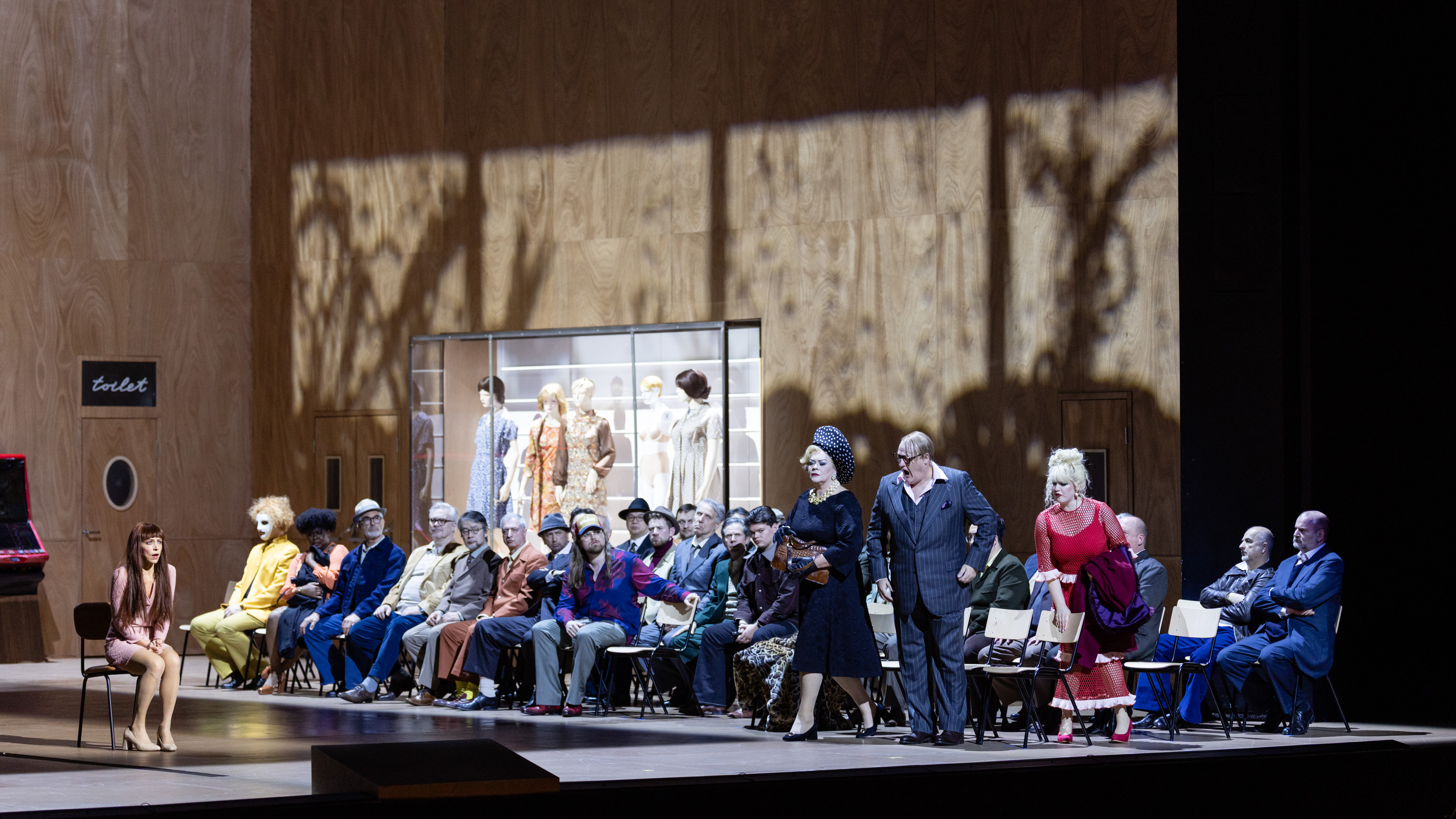
L-R (foreground) Corinne Winters as Káťa, Violeta Urmana as Marfa, and John Daszak as Tichon in Bayerische Staatsoper’s new production of Káťa Kabanová, premiered in March 2025. Photo © Geoffroy Schied

Tell me about your first time singing this opera…

It was in 2000, in Paris – I was 32 years old. It’s funny because I work with singers now. I like coaching and online teaching. I’ve got quite a few students now since COVID, because people were locked up and they couldn’t go anywhere and they said, “Do you want to give me a lesson?” I said, “Yeah, sure, because I’m at home, I’ve got time, you’ve got time, why not?” So I worked with these singers, some of them are quite young – 30, 31, 32 – and I thought, good lord, I sang Peter Grimes at La Scala and Boris in Káťa Kabanová at Paris Opera at that age… wow. Before that, I did it when I was at Glyndebourne on tour – I was singing in the chorus and covering Tichon. So I knew the role at that point, but I’d not sung it.

What’s it like coming back to the same opera after two decades, but in a different role?

It’s fun but it’s also strange, because of course I’m no longer the “young lover“; people might not now cast me as Boris, or even Sergei in Lady Macbeth of Mtsensk, which I’ve sung quite a bit. Maybe you could get away with that one, actually – Sergei doesn’t have to be that young – but Boris is supposed to be roughly 20 years old, I think, he even says his uncle’s in charge of his inheritance until he comes of age. But when you’re playing someone who’s not so different in age from you, you see things differently.
John Daszak, opera, Janacek, Tichon, Katja Kabanova, Bayerische Staatsoper, Warlikowski, singing, theatre, live, art

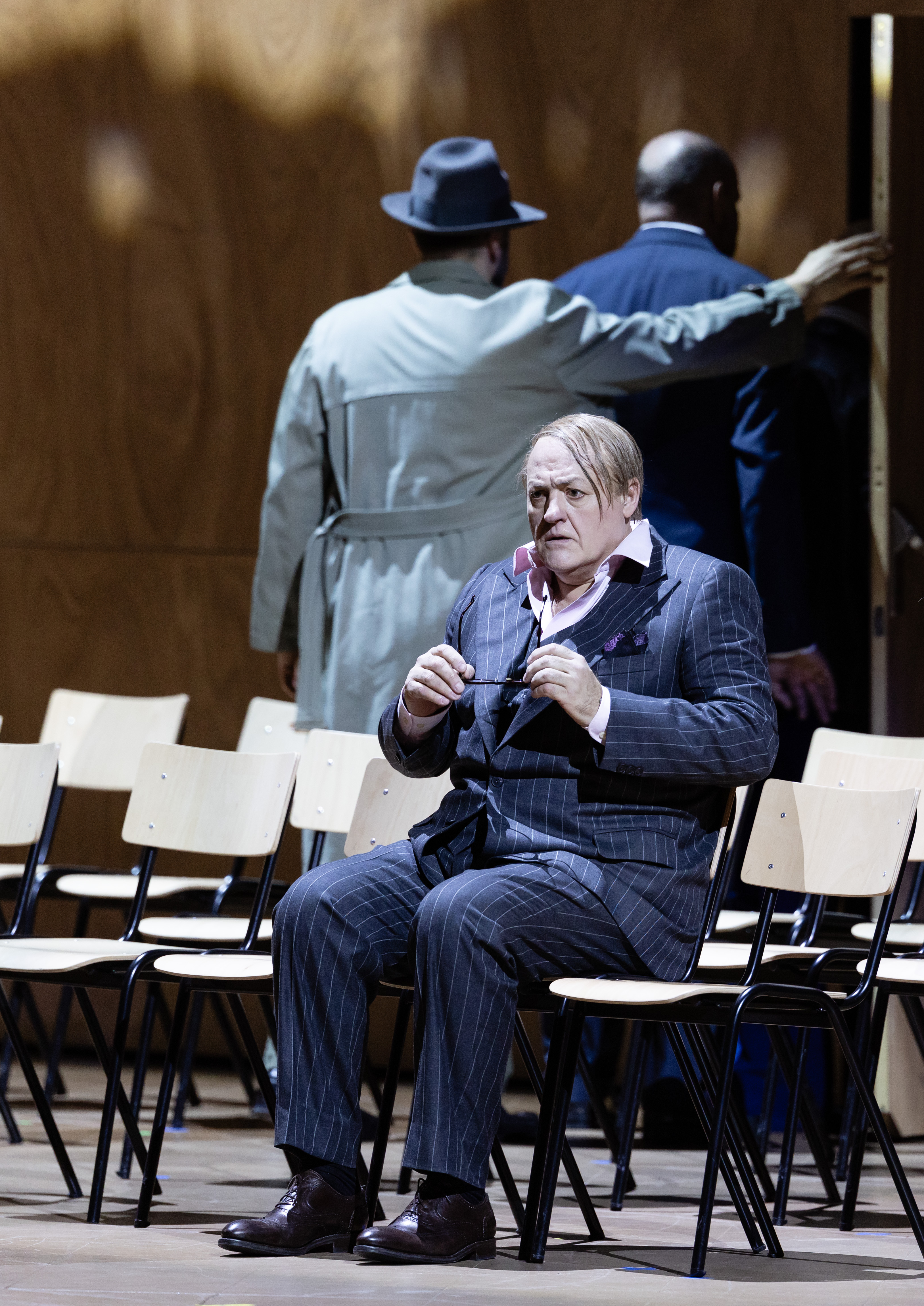
John Daszak as Tichon in Kat’a Kabanova at Bayerische Staatsoper. Photo © Geoffroy Schied

And how do you see Tichon?

I feel for him. When I first came into the production, I knew I wanted to play him as a sympathetic character. I think he should be in love with Káťa; people say, “Oh, he’s not in love with her” – I play him as if he is in love with her but he can’t function as a normal human being because of the damage done by his mother. I play it like he’s living under this big shadow of his mother that he can’t really get himself out of or away from – he loves Káťa but he can’t function in a relationship because of the dysfunction within his own upbringing. The whole opera is really about dysfunctional relationships.

Language, Sound, Meaning

To what extent does the language complement that dysfunction?

The language is so percussive and rhythmic; so specific, and very evocative of the people. Janáček’s music reflects the Czech language itself, probably more than any other Czech composer. I think all of the rhythms are in the writing – in the percussion; in the strings; in the woodwinds. You can hear this stress on the first syllable and then there might be a long syllable after. You hear the language right in the music.

You’ve been in Russian, Czech, German operas; what’s your process for learning them?

My operatic career can be likened to this: there are people who like skiing down a beautiful piste and having lunch at a restaurant and a glass of wine and then skiing on, and the people who like to go in a helicopter to the top of a mountain, get dropped off and ski down the mountain. The latter is the kind of opera experience that I am used to. I’m a helicopter skier, not in real life – but in opera, yes. So yes, I have sung Russian in Moscow; Spanish in Madrid; Italian in Italy; of course French in France. And German in Germany, though I still haven’t mastered spoken German. But I don’t think I’m really a natural linguist, and I don’t believe that you have to speak a language fluently to be able to perform an opera in that language – I mean, I don’t speak Russian; I don’t speak Spanish. But what you do have to do is study – and you have to have a thorough process of learning.

My process is, first of all, if someone offers me a new role, I look through all the music and think, “Yep, I could probably manage that.” Then, if I accept it and have to learn it, I go through the whole of the text, and, if it’s tricky music, I mark up different beats here and there – where the stress is in the bar, so I know my way around it to navigate musically.

Then I go through the text, and I work with someone who’s a native speaker in that language. You’ve got to find someone who speaks that language, who’s also preferably got an artistic side, but not necessarily. I work with them for a few hours. It takes at least, I would say two or three sessions, each one consisting of two or three hours, so it’s at least six to nine hours in total to go through all the text and learn how to pronounce it; you need to know the pronunciation of everything. Then comes a literal translation – every single word, what it literally means; it might not make sense in English, but at least you know exactly what you’re singing at what point. For instance, at one point in Jenufa, Steva sings what literally translates as “I, I, I, I drunk?” – it doesn’t make much sense in English, but he’s really saying, “What do you mean I’m drunk? Me? Me drunk?” So you have to do pronunciation, literal translation, and then a kind of cultural translation. But it’s interesting that it’s almost impossible to do justice to Czech in an English translation, because all the stresses are wrong.

“I didn’t think of it as being any different from any other music”
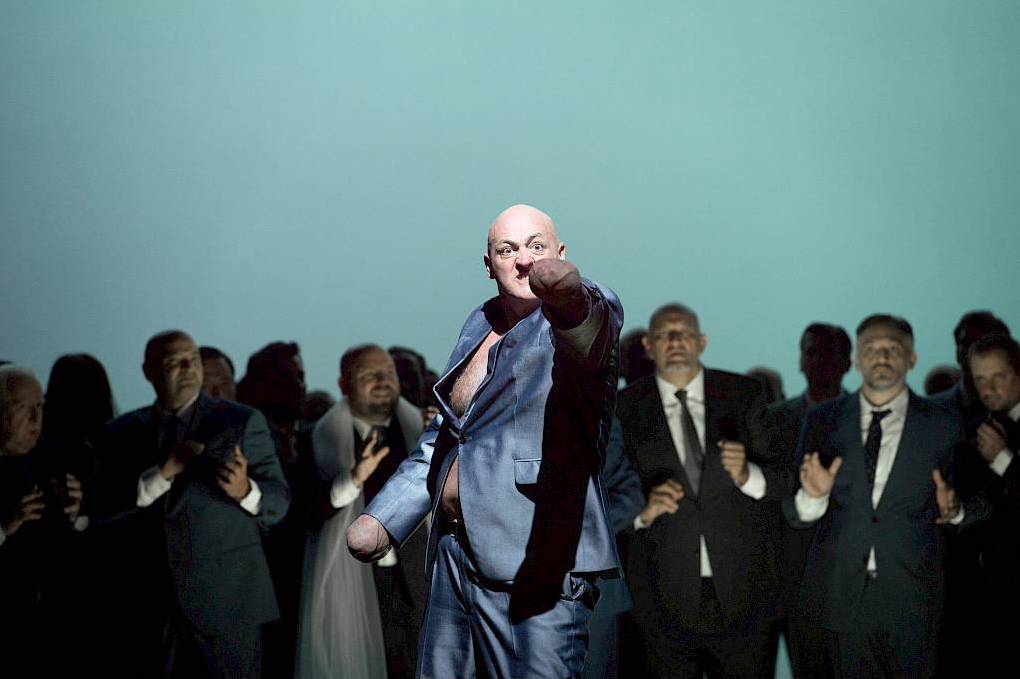
Die Gezeichneten, Opernhaus Zürich, Barrie Kosky, John Daszak, opera, stage, music, theatre, tenor, singer, production, 2018

John Daszak as Alviano Salvago in Oper Zürich’s 2018 production of Die Gezeichneten. Photo © Monika Rittershaus

Did you set out to actually do these kinds of roles?

I built my audition repertoire from singing in Glyndebourne Chorus – it was a great place to get a bit of training; if you’re in the chorus they try to find decent covers from the chorus. So if someone gets sick you go on and do rehearsals, or you go on and do a show. I’d been studying there and learning Tichon and Steva.

So you already knew that this Czech music was in your voice…

… because I’d been asked to cover them. I auditioned and they immediately said, “Oh wow, you can cover some of the Janáček pieces.” It was the then-casting director, Sarah Playfair, who picked up on it at the time.

Had you ever considered Janáček before that?

Funnily enough, one of the operas we did at the Royal Northern College of Music was From The House of the Dead. I sang Skuratov, which is quite a big role, and it was great fun. I didn’t think of it as being any different from any other music that I sang at the time, but I was probably 22 years old. I think the music was somehow in my heart and blood, maybe because my dad is from Ukraine. I feel like I know these Janáček characters, because I’ve grown up with my father around the house, and around his friends. Even though there weren’t that many Ukrainians in the UK, there was actually a Ukrainian club in our local town outside Manchester and there were quite a lot of expats at that club who’d left during the war.

Do you have any problem with performing Russian works now?

I talked with a Ukrainian lady who’s a journalist just the other day and she asked the same thing. My cousin’s son is a viola player and he’s now in the army at the front. People might well say, “Well, then how can you appear in Russian works knowing that this is happening?” I can understand it, but also, if it’s not a contemporary work, then what did Tchaikovsky have to do with what’s happening now? Also most Russian historical composers were anti- establishment – think of Shostakovich: in Lady Macbeth he’s taking the mickey out of the whole government, he’s making them look foolish. That’s why Stalin, when he saw it, said “Nyet”. I think it’s a mistake to cancel everything. Certain performers who haven’t clearly said “I’m against this” I have more of a difficulty with.

I had a contract in Russia myself – I was supposed to go back and do a Salome there that we’d done in Aix-en-Provence but thank God it was cancelled. I don’t want to go there. I can’t imagine that I will ever go to Russia again – it would take a long time and there would have to be a lot of positive things done towards Ukraine before I would do it. As it is, I haven’t even been to Ukraine during the war. I was asked if I would go to adjudicate a competition; I spoke to my family about it, and they said, are you insane? I wanted to show solidarity with my family and Ukrainians at this terrible time, but my cousin’s son said “No, you’re better staying out of Ukraine; you can do more for Ukraine in what you’re doing right now than you could by coming here.”
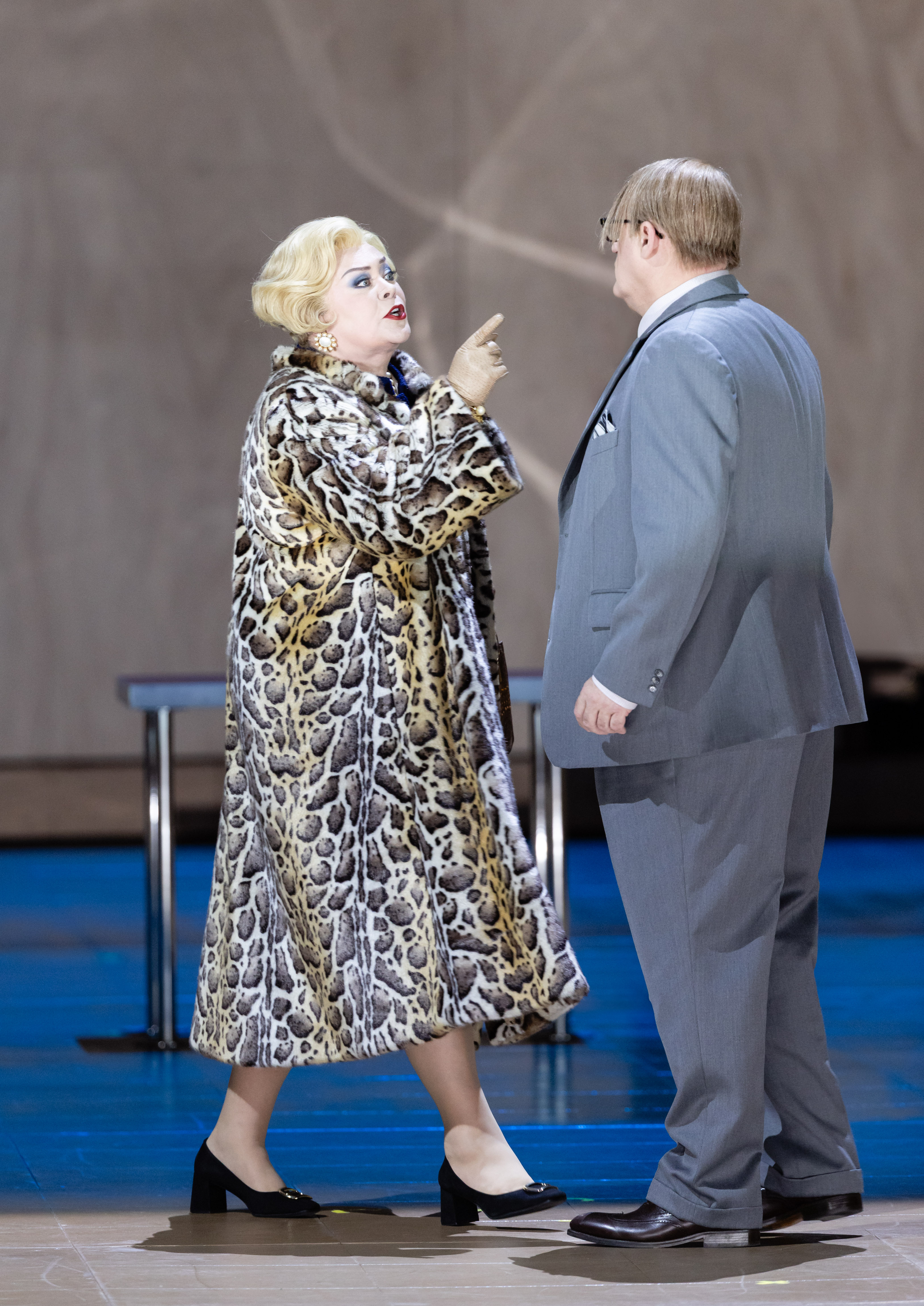
Katja Kabanova, Janacek, Bavarian State Opera, Janacek, Violeta Urmana, John Daszak, Warlikowski, Bayerische Staatsoper, stage, live, opera, singing, art

Violeta Urmana as Marfa and John Daszak as Tichon in Kat’a Kabanova at Bayerische Staatsoper. Photo © Geoffroy Schied

Blending Singing and Theatre

How do you balance music and theatrical elements?

From as far as I can remember from being a child I was always a bit of a showman. If I saw an advert on TV, I’d reenact it for my parents and my two older brothers – I think it’s to do with being the youngest: you’re always striving for attention. I’ve always been kind of theatrical. I started singing very young and I used to sing a lot and was in choirs, though I did play violin and then switched to double bass. I had a theatrical side to me, but I didn’t have the technique of acting; I knew nothing about it. At the RNCM (Royal Northern College of Music) I remember being around the Head of Vocal Studies, the singing department of the Opera School, Joseph Ward, who had a great voice, very English. He was a tenor and he had this heady, warm sound; equally important was how he made you respect what you were doing, including most especially the acting side of things.

If I did a lieder recital now, I’d have to almost stage it – I’ve always been busy with opera and that is my favorite thing, to have the costume, set, rehearsals, the theater side of it, because for me it’s kind of escapist – but if you’re doing a lieder recital in front of an audience, you can really see the faces of the audience, all looking at you; that’s one of the scariest things in the world. I have worked with Julius Drake for many years, and I remember over 20 years ago he wanted to do The Diary of One Who Disappeared at the Chichester Festival, and of course, I’d sung in Czech already. I memorized it and made it into a bit of a show. I used a chair and some props – everybody loved it. It was very successful.
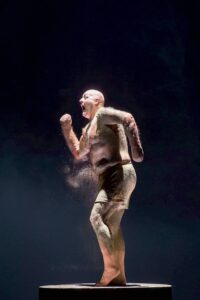
Die Gezeichneten, Opernhaus Zürich, Barrie Kosky, John Daszak, opera, stage, music, theatre, tenor, singer, production, 2018

John Daszak as Alviano Salvago in Oper Zürich’s 2018 production of Die Gezeichneten. Photo © Monika Rittershaus

What’s your relationship with directors?

I’ve worked with a lot of great directors, including a lot of cutting-edge ones like Bieito, Tcherniakov, Kosky, Warlikowski. They’ve repeatedly asked me to do things with them because they like the way I work. I always see it as my responsibility: to try and do the best job for the music and the text. That means I try and do what the conductor wants, and try and do what the director wants. I don’t think I’ve ever had such a big issue with a director that I’ve said, “I can’t do that because I’ve got to sing” or “I’m not going to do that because that will make me look ridiculous.”

Die Gezeichneten in Zürich was incredibly daring. Can you imagine the conversation at the beginning with Barrie? “You’re gonna strip off and have mud and blood thrown at you.” We actually had a rehearsal just for the mud and blood part! I came in one day and there was plastic all over the floor, and I thought, “Yep, here we go!” Kosky is great because he enjoys working and you always have fun with him in rehearsals, but also he’s got a brilliant mind; he remembers everything, and if you mess something up or don’t remember what you did gesture-wise, he’s on you straight away: “Ah, no, you’re supposed to do that.”

Tcherniakov is also fantastic – he wants things to be very specific; he’s almost got a kind of cinematographic idea of exactly what he wants but he does say, “No, don’t do that, do it more like this” or “Great, I love what you did; do it again.” There’s a framework. Warlikowski is less structured, but he is fascinating to work with; we sit down and talk through the text. There is an overall concept, but it’s much more like, ‘We’re going to discover things on this journey together.” There’s a lot of experimentation.

And conductors?

They tend to have a very specific idea of what they want – sometimes it does become a problem if they’re not so interested in the dramatic side. Zubin Mehta is, for me, still one of the best opera conductors, because he’s so with you on stage. He was always controlling the orchestra, and looking at you; if you held a note a bit longer, then he would wait. He has the technique to do that, and he also has an interest in what’s going on on stage. He understands it’s about the singers and about the drama, about the theater. So the best opera conductors understand and like both things: the music, and the theatre.

Top photo: Robert Workman
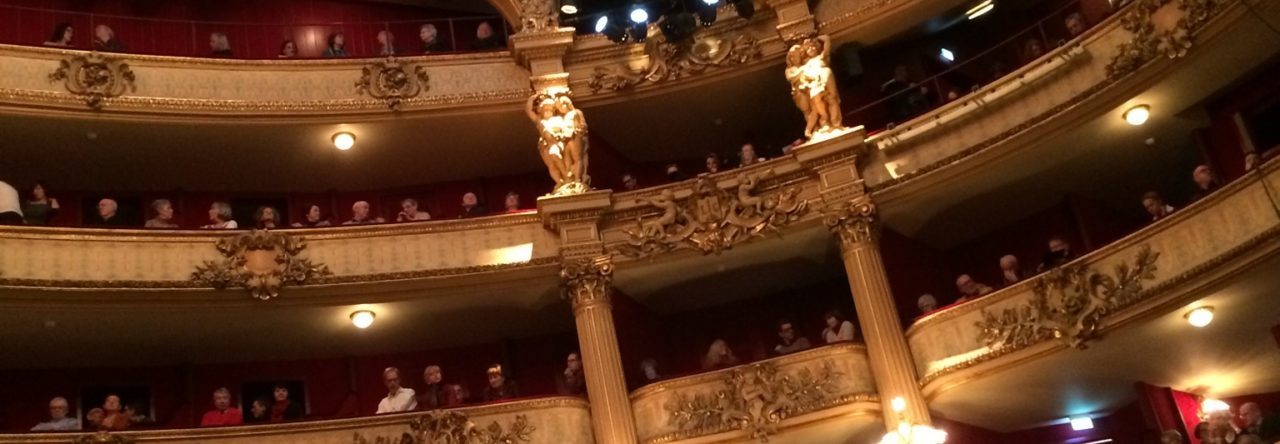
Helmut Deutsch, Christian Immler, album, music, classical, lieder, Grosz, Gund, Outthere Music, Alpha Classics

Be Still My Heart: A Lieder Album “Meant For Us To Do”

Schubert, Mahler, Brahms, Schumann, and Liszt are names known and celebrated within the world of lieder; Christian Immler and Helmut Deutsch are hoping to add a few more to the list. The celebrated bass baritone and collaborative pianist are set to release Be Still My Heart (Alpha Classics) featuring the music of Robert Gund (1865-1927) and Wilhelm Grosz (1894-1939), two composers whose oeuvres have been largely overlooked. This isn’t the first time Immler and Deutsch have highlighted the work of unknown composers. The pair released Hidden Treasure (BIS Records) in 2021, which shone a light on the work of composer Hans Gál. At the time of its release Immler wrote in Gramophone that “(r)eading through and rehearsing music which hasn’t ‘become sound’ for more than a century is for me a powerful combination of curiosity, pioneer spirit and obligation. One is indeed living history!” That spirit of exploration continues with Be Still My Heart, which, amidst its thirty-three tracks, hosts several world-premiere recordings – not a small achievement given the sheer volume and consistently high quality of its respective composers’ output.

Robert Gund, Ludwig Michalek, portrait, composer, lieder, Be Still My Heart, classical

Portrait of Robert Gund by Ludwig Michalek, around 1921. Private collection.

Swiss-born Gund (who used the more French “Gound” for a time before changing it in 1916) enjoyed an illustrious career in Vienna, where, over the course of three decades as a singing and harmony teacher, he built a considerable reputation as both an educator (Alma Mahler was among his students) and composer. He created many works (especially songs) – but also destroyed many, including a symphony, a piano concerto, and an original opera. German writer/musicologist Ernst-Jürgen Dreyer contributed album notes to a 1986 Jubilate vinyl release of songs featuring soprano Franziska Hirzel and pianist Ilona Sándor, and noted that “(f)ew people … suspected that the modest and amiable man known in all salons, father of a family rich in sons, pianist in countless chamber music pieces, sought-after song accompanist and organiser of ‘music jours’ and ‘student productions’, not only had something to add to the songs of the moderns as a composer, but that he surpassed them with genuine song talent.”

In his opening for the liner notes to Be Still My Heart, multi-award-winning producer Michael Haas (who is also the co-founder of Vienna-based exil.arte) quotes a 1905 essay by critic Julius Korngold that savages the contemporaneous state of Viennese lieder while notably singling out Gund for praise; Haas goes on to weigh the reasons behind Gund’s gradual disappearance in music, noting his unique position in Vienna at that time:

… his compositions, as confirmed by Julius Korngold, presented a reliable oasis of stability, offering beauty and inventiveness within the bounds of received convention. Unfortunately, “received convention” was not a priority in the early days Viennese Modernism.
(Michael Haas, Be Still My Heart, 2025)

Wilhelm Grosz, composer, music, Vienna, classical, lieder, music

Wilhelm Grosz, 1927 © Georg Fayer; ÖNB, Bildarchiv Austria

Wilhelm Grosz, twenty-nine years Gund’s junior, was born in Vienna and schooled by a wide range of composers, Franz Schreker among them. Grosz would go on to become the artistic manager of the Ultraphone Gramophone company in Berlin before leading the Kammerspiele Theater in Vienna, though he was forced to flee Austria in 1934. After a short stay in the UK, the composer (who used a number of pseudonyms) moved to New York with plans to continue on to Hollywood, joining other exiled European artists – but he died of a massive heart attack in 1939. His considerable output includes orchestral works, chamber music, film scores, music for two ballets, and three operas; his work would go on to be covered by a range of artists including Frank Sinatra and The Beatles. Haas contextualizes the presence of Grosz within a Viennese progressivism that is more wide than it may first appear, observing the composer’s “metamorphosis from Viennese fin de siècle, to songs for German cinema before teaming up with Billy Kennedy in London under the pseudonyms Will Gross, André Milos, Hugh Williams or Hugh Grant for hits still popular today such as “Isle of Capri” or “Harbour Lights.””

Be Still My Heart celebrates this range by offering a wide array of sounds and experiences. The album, recorded in early 2023 at Munich’s BR-Funkhaus, conveys a deep respect for history alongside a passionate embrace of innovation. With texts by a wide range of writers (including Hesse, Brentano, Morgenstern, Lenau, and Rilke) the album skillfully explores aspects of love, loss, longing, memory, and identity, with a keen sensitivity belying its academic roots. Be Still My Heart is three-dimensional, textured, real, raw, cutting – rooted in a near-forgotten history indeed, but utterly, unmistakably alive with a palpable and timeless passion.

The album is also a showcase for Immler’s intense timbral shading and Deutsch’s intuitive, poetic playing; their interplay, so clear in works like Gund’s “Julinacht” and “Nachts”, or Grosz’s “Helle, sommerliche Nacht” and “Schicksal”, serve to highlight the pair’s clear creative chemistry and near-psychic musical connection. My recent exchange with Christian Immler and Helmut Deutsch touched on forgotten and found histories, the challenges of unknown work (not least in playing it), the joys of long-term collaboration, and what it means to be on the same page in terms of artistic curiosity.

Helmut Deutsch, Christian Immler, album, music, classical, lieder, Grosz, Gund, Outthere Music, Alpha Classics“A Distinct Musical Language”

Why do you think Robert Gund’s work is so largely unknown now?

HD It’s quite unbelievable that his work is so completely forgotten. Here is a man who had performed his own symphony in the Vienna Musikverein, who was close to Mahler and before that to Brahms; he was really in the music world of Vienna in those years. But we don’t know what happened.

CI We are baffled by his music being so unknown, but there are a few theories. Helmut and I have been like detectives through the years, finding and recording unusual repertoire alongside well-known works; in those instances we were usually lucky if we got ten good songs from our investigations – but Gund wrote hundreds of songs, many of them in absolute top quality, so we really had a hard time choosing what to feature on this album – I think that’s the best compliment we can give him.

Halls will often skew their programming toward box office, especially now – “We know we can sell tickets to star names and/or Schumann/Schubert/Mahler” – and everyone else is ignored – maybe that thinking played a role also?

HD Well that’s right, and it’s worth noting that amidst those names Gund really cultivated his own language – a distinct musical language – from them; some parts of his work remind me of Brahms a little bit, but there are things in his writing which you cannot compare easily to any other composer of his time.

Yet he destroyed some of his early works, didn’t he?

HD Yes, in his very young years, he had written a symphony and a piano concerto – which he burned.

CI I wrote to the library of the Gesellschaft der Musikfreunde (Society of Friends of Music) in Vienna, and I really tried to learn more. I mean, for that kind of a destruction, you don’t have to only destroy your piano part, you have to destroy all the orchestral parts – and absolutely everything seems to be really, really gone. So he really meant it when he burned his own work – but it cannot have been bad if it was premiered at the same time as Zemlinsky’s symphony, right?

Zemlinsky was just one of his many music contacts, is that right?

CI Yes – along with composing, Gund had been the archivist of the Tonkünstlerverein association founded by Schoenberg in Vienna, and he had been Alma Mahler’s counterpoint teacher; he had also played four-hand piano with Brahms! He had all these people on what you might call speed-dial now. Along with these connections Gund was one of the first musicians to promote and actually present lecture-recitals in which he would discuss his research on the complexities of thematic connections in music – and he was twice married to a singer, so he had easy access to interpreters. But I think at heart he was a private person, and he just didn’t like the craziness of what an international career would demand. I met Gund’s grandson, and the more we spoke, the more it seemed as if this was true. Gund, as a composer, seems to have been extremely private.

Natural, Elegant, Evocative

So how would you characterize Gund’s writing then?

CI The quality of his writing is phenomenal! And – I don’t say this lightly – I am hopeful, if not convinced, that more people will be performing his songs now. I have had so many young students already say, “I love this, where can I get the music?” and I tell them: it’s printed. The majority of his lieder were printed in his lifetime, and they are available now; you don’t have to go to any society and get the manuscripts. It’s all printed, everything is out there. And this album with Helmut feels like it was something which was meant for us to do.

What were the unique challenges of not only choosing which pieces to play, but then perfecting and recording them?

HD We had difficulties making selections because there are only so many minutes you can have on a CD. When we first selected the songs we liked, we went far over the running time – so we had to edit, and it was really very hard for us to say goodbye to so many wonderful works. There is much more to discover of Gund than is even on this record.

CI The main thing we wanted was to have a nice mix; some of the songs make use of unique metres, like 5/4, but Gund uses the time in such a refined way that it just lulls you in. And I think Helmut can confirm that some composers try to get the piano accompaniment right, but Gund comes from a more pianistic side already – he was lucky to be married to singers who probably also had their influence on his writing – but the piano parts are incredibly interesting. So whenever, as a singer, I had the feeling that I needed a little injection of energy, it was right there. Gund uses very simple things, things that, in my opinion, only a master composer can apply in such a way. His writing feels very natural, very right, simple but elegant, and very evocative and realistically idiomatic for the actual instrument, whether voice or piano.

“A Rollercoaster of Musical Styles”

So why Gund and Grosz, together?

CI To start at the beginning: Helmut actually found a book about Robert Gund. That was the initiative. I think; you stumbled across it by chance – correct me if that’s not right, Helmut?

HD It was in Bonn, in a bookshop; there were two books there for five marks – so it was a long time ago indeed – they had Gund’s musical life only, and an appendix with 40 songs. I tried to encourage my former students in Munich with them, and some of them performed a few of the works – but It needed a person like Christian to conduct more research and to find all his other songs. We found out that there is much, much, much more. They both have the connection to Vienna, of course…

CI Yes, the combination with Gund and Grosz was done with reference to very different eras for Vienna composers; I also wrote part of my doctorate about Wilhelm Grosz and the recital scene in Vienna between the two wars. Gund and Grosz meet kind of right in the middle of an era in flux; one person is kind of tapering off and the other person is just emerging. Obviously the style of each is different, but having them both on one recording gives you a little rollercoaster of musical styles, and also a choice of poems; then it ends on Grosz’s English-language songs, which are much lighter.

What makes Grosz’s writing unique?

CI He had an incredible gift for melody, in my opinion, his sense of melody is just so sticky. We mention it in the booklet also, that his work has been covered by the likes of Frank Sinatra, Nat King Cole, The Beatles.

HD Initially with the early Grosz songs, I wondered: could I, maybe for a few minutes, be 30 years old again, just to find out whether it’s just my current age making these works difficult, or if they are really so complicated? A lot of parts in these early songs he wrote are on three systems, or, not only three systems – Debussy used this kind of writing also – but most of the chords Grosz writes for both hands have ten voices. And there are a lot of really complicated things in terms of where to put this middle line – in your right hand and in your left hand. Despite my age, I would consider myself not bad at sight-reading…

CI You are the best!

HD … but you could read one chord at one point, and you needed three or four seconds there to figure out the next chord; then the next and the next. In the end, it should be a more or less flowing tempo. After ten days, I was really very close to saying, “Christian, I’m very sorry, I give up.” But I didn’t give up. Now, after a while away from Grosz’s songs for a bit, I look at one of them and that feeling starts again – this can also be extremely difficult. So while Gund was certainly a very good pianist and did write very effective things on the piano, they are not difficult by comparison with Grosz.

CI The feeling of finding music like this… I mean you have an idea of its sound if you look at the music of the time, but there is really no comparison either. You don’t feel any influence by Brahms – maybe there’s a little bit in some songs – but there is no influence by Mahler. There are also no comparisons with recordings as with these other composers, like “This is the best recording of this and that” – when you are making the 250th recording of Winterreise, for example, you can scan generations, but here, you have to find out together, with a musical partner, and this was a fascination.

Discovering Together (With Wine)

Helmut Deutsch, Christian Immler, album, music, classical, lieder, Grosz, Gund, Outthere Music, Alpha Classics

Helmut Deutsch (L) and Christian Immler (R). Photo: Andrej Grilc

How has the working chemistry between you changed through the years? And do you, together, feel like ambassadors for these little-known lieder composers?

HD It’s thanks to these composers that the quality is, very much, in the music. And we have, if I may say so, Christian, the same taste.

CI This is very true!

HD It’s always a bad signal if you have to have a lot of discussions about a tempo, about a rubato or the like: “Why do you do this? I would like to go straight forward and you are hesitating.” I can’t remember any discussion of this kind working with Christian. One has to be very thankful to have a partner who feels the same.

CI Yes. I mean, it evolves from rehearsal to rehearsal, but talking about tempo is for me, very annoying. A purely music-making and non-verbal rehearsal is often more effective! The only thing we discussed, really, was which white wine to put into the fridge for dinner – that was important! But the prolongation of our curiosity is something I’m very fortunate to share with Helmut; it’s been a long collaboration already. And I don’t know any other pianist with whom one can have so much fun, just sitting at the piano and trying things out. It is incredible to examine repertoire like this.

Be Still My Heart (Alpha Classics) is released on 28 February 2025.
Top photo: Andrej Grilc
footsteps, snow, winter, nature, forest, scene

January 2025: Sounds, Remembrances, Reminders

“Die Zeit, die ist ein sonderbar Ding,” ponders Die Marschallin early in Strauss’s Der Rosenkavalier; indeed time and its passage are phenomena keenly felt by a great many these first four weeks of 2025. Time can sometimes pass too quickly, a cause for alarm (“Manchmal hör’ ich sie fliessen – unaufhaltsam”); time can also slow to a snail’s pace, a water’s drop, a faucet that only pours tepid. “Welcome to the 87th day of January!” one contact wryly wrote in a recent note. The experience of live art and music –opera – underlines the feeling of time speeding up, slowing down, or stopping altogether, whether through thoughtful engagement or immediacy, via sheer beauty and wonder, the use of escapism, or sometimes, rarely, all of these elements combined.

Few artists excelled that integration so clearly the way Otto Schenk did. The famed theatre artist passed away on January 9th at the age of 94. Schenk led and acted in numerous opera presentations throughout Europe and North America throughout the 1960s, 70s, 80s, and 90s, appearing in the annual “Jedermann” presentations in Salzburg and staging Wagner’s Ring Cycle with a literalist approach (including Viking-style regalia), a presentation remembered and revered by a great many. As writer Ed Pilkington noted in a 2009 article in The Guardian, “Met regulars have come to adore the production almost as much as the opera.” For many, that Ring Cycle was the absolute embodiment of Wagnerian Gesamtkunstwerk, and provided a memorable introduction to  – and resultant lifelong immersion in – Valhalla.

My mother, a diehard devotee of Italian opera, was one of those entranced fans, and she saw this production at The Met in 1990. (I was off seeing a very unusual off-Broadway production of Hamlet, natch.)

Schenk’s overall directorial oeuvre captured an epoch in opera that still largely colours mainstream perceptions of the art form, and I find it striking and quite profound that his passing came on the same day as what would have been opera impresario Rudolf Bing’s birthday (9 January). Bayerische Staatsoper in Munich hosted ten different Schenk productions, including his much-vaunted Das Rosenkavalier, last performed there in 2021. Dramaturg Malte Krasting has written a lovely tribute, describing Shenk as having “lived the theatre like no other.” (Zum Tod von Otto Schenk, Bayerische Staatsoper 10 January 2025) Wiener Staatsoper opened its online archive to the many productions Schenk did with them (L’elisir d’amore; Fidelio; Das Rosenkavalier; Andrea Chenier; Die Meistersinger von Nürnberg; Das Schlaue Füchslein; Die Fledermaus) – enjoy free access now until Friday (31 January).

A divisive new production of Die frau ohne Schatten opened at Deutsche Oper Berlin earlier this week. Featuring Clay Hilley and David Butt Philip sharing the role of The Emperor, Daniela Köhler as The Empress, Jordan Shanahan as Barak, Catherine Foster as Barak’s wife, and Marina Prudenskaya as The Nurse, Strauss’s heavily symbolic work (with libretto by Hugo von Hofmannsthal) feels, more and more through the passage of that old bugbear time, like some Rorschach Test of conscious and/or unconscious notions of sexual politics and the privilege therein (not unlike Don Giovanni) – though I wonder if that’s also what Strauss/Hofmannsthal might have actually intended.  FT‘s Shirley Apthorp criticized the lack of political stance and specifically the lack of feminist approach by director Tobias Kratzer, while Radio3‘s Andreas Göbel says Kratzer’s ignoring the fairytale elements renders his approach insufficient for the opera’s considerable (four-hour-plus) running time; Concerti‘s Roland H. Dippel writes that Kratzer’s direction smartly highlights “emotional details of characters caught up in their walls of conflict.” (Backstage Classical has a good collection of other reviews, complete with quotes and links.) Albrecht Selge offers a poetic analysis in VAN Musik, cleverly tying Berlin’s recent budget cuts (specifically to its opera houses) with thoughtful observations on the respective presentations of humour , hurt, and human warmth used in Kratzer’s presentation. (“Stofftier, aus dem die Träume sind“, VAN Musik, 28 January 2025) FroSch is conducted by outgoing General Music Director Donald Runnicles and runs through 11 February.

Morgiane, ou, Le Sultan d’Ispahan by 19th century composer Edmond Dédé is finally (finally!) receiving its world premiere early next month, courtesy of Opera Lafayette in partnership with OperaCréole . The work, considered to be the earliest surviving opera by a Black American composer, is based on the story of Ali Baba and the Forty Thieves; it will make its world premiere on Monday (3 February) at Lincoln Theatre in Washington before moving on to presentations in New York on Wednesday (at Rose Theater, Lincoln Center), and Maryland on Friday. Patrick Dupre Quigley, artistic director designate of the Washington-based Opera Lafayette (who is leading the work on its tour) commented earlier this week to San Francisco Classical Voice that the opera is “the most important piece of American music that no one has ever heard.” (“Bringing Morgiane, the first African American opera, back to life“, Katelyn Simone, San Francisco Classical Voice, 27 January 2025)

Still with streaming: Opera Vision recently hosted a broadcast of the 2000 opera Judith by Frano Parać from Croatian National Theatre. Based on the biblical tale of Judith and her murder of the general Holofernes in order to save her people, the new, recent Judith presentation marked the 500th anniversary of the death of Marko Marulić, considered the father of Croatian literature and author of Judita, the first literary epic in Croatian language published in 1521. The production was helmed by Snježana Banović with musical direction by Opera choirmaster Ivan Josip Skender; it can be streamed now through 17 July 2025.

Rundfunk Sinfonieorchester Berlin presented a programme of moving works to mark International Holocaust Remembrance Day on Monday (27 January); it included the premiere of a work by composer Berthold Tuercke. “Aus Geigen Stimmen” incorporated instruments from Violins of Hope, an historic collection comprised of stringed instruments whose owners were murdered in the Holocaust. The piece itself interweaves solos for the instruments with choral writing (performed by RIAS Kammerchor) and spoken texts that mix Yiddish songs, poetry, and first-person accounts from the time. Monday’s concert at the Philharmonie also featured Gideon Klein’s Partita for string orchestra, created in the Theresienstadt ghetto by Klein just nine days before his deportation to Auschwitz in the mid 1940s, and an orchestral arrangement of String Quartet No. 5 by Mieczysław Weinberg, who, at the time of the work’s composition in 1945, had no idea his family had been murdered at Treblinka. Amidst the darkness of this programme there is a ferocious and very palpable will to live laced deeply within each work. (“Violins of Hope: Konzert zum 80. Jahrestag der Befreiung des KZ Auschwitz“, Deutschlandfunk Kultur, 27 January 2025)

That sense of “Lebenswille” is also woven in Exile (Alpha Classics), a new album of works by (mostly) exiled composers released earlier this week. Featuring violinist Patricia Kopatchinskaja and cellist Thomas Kaufmann together with Camerata Bern, the thirteen-track album deftly mixes various sounds and cultures through stellar interpretations of works by Schnittke, Schubert, Ysaÿe, Andrzej Panufnik, and Ivan Wyschnegradsky that explore notions of distance, separation, identity, and isolation. Its opening track, “Kugikly for Violin and Ukrainian and Russian Panpipe” is both a dance (complete with zesty shouts) and a kind of a manic dirge, and, like the entire album, a needed symbol of hope.


What’s the connection between video games and opera?  The ties run deeper than one might assume; they were examined with fascinating clarity recently by writer/translator Angelica Frey at JSTOR. Using quotes from music writer Tim Summers’ intriguing “Opera Scenes in Video Games: Hitmen, Divas and Wagner’s Werewolves” (published in Cambridge Opera Journal in 2017) Frey traces the ties between the two forms back to 1994, when the game Final Fantasy VI revolved around a would-be abduction of an opera star (“Maria” – who could it be?). Using contemporary references, Frey writes that “In a way, both Assassin’s Creed and Hitman challenge the assumed highbrow status of opera and the assumed lowbrow status of gaming, suggesting a more complex and compatible negotiated relationship through their fusion in the game worlds.”  (“Why Are Video Games So Fond of Opera?”, Angelica Frey, JSTOR Daily 21 January 2025)

Still with JSTOR, a timely little bit of history examining the relationship between humour and fascism in mid-20th-century Italy. Wait, there’s a relationship at all? Why yes – and sometimes it isn’t very funny, or maybe it is, but not in that funny-haha way. As Livia Gershon notes, “Journalist Leo Longanesi is said to have invented the slogan “Mussolini is always right” as a joke only to have it adopted by the regime while Longanesi moved into creating Fascist propaganda.” Hmmm… plus ça change? (“Laughing With the Fascists“, Livia Gershon, JSTOR Daily, 3 January 2025).

Relatedly, and finally: the fascinating history of Carl von Ossietzky, an influential German journalist especially active in the early 1930s. He received the 1935 Nobel Peace Prize for reports that exposed the clandestine operations of the German government in violating the Treaty of Versailles with rearmament. Those exposes landed him in a concentration camp more than once and he endured torture – as well as carefully orchestrated tours for American press. Writer Kate McQueen traces the prison meeting between Ossietzsky and Hearst Press Group correspondent Hubert Renfro Knickerbocker in detail; she also outlines the related histories of his family and colleagues, the questions that surrounded his receiving the Nobel (the ceremony for which the Norwegian royal family chose not to attend), and his tragic death from tuberculosis after five years of imprisonment, in 1938. As McQueen notes, “Ossietzsky’s articles were those of an advocate for a fledgling democracy stretched to the breaking point by increasingly radical political factions. He didn’t want the young republic to die on his watch.” (“The Good Traitor: The Journalist Who The Nazis Could Not Silence“, Kate McQueen, The Atavist November 2024).

Until next month: take deep breaths in cold air, drink hot tea in silence, read poetry, and say the word “hoffnung” – out loud, to yourself; often.

trees, nature, winter, landscape, rural

… And To All A Good Night (2024) !

This year in classical music and opera saw a lot of hype, a bit of hope, dribbles of desperation and ample ambition. With snow melting out the window and the world both quiet and loud in the post-Christmas, pre-New-Year rush, now seems as good a time as ever to remember, reflect, and of course, to read.

Some of you know this website formally began in 2017 to platform long-form conversations, the kind of thing I felt was missing (and still feel is missing) from mainstream classical music coverage. Fast forward seven years and many conversations later, and there seems to be even more reason for The Opera Queen‘s continued existence than ever. No, I am not x-y-z mainstream outlet; there’s value in being an outsider and to the readership that attracts. This site does not do album reviews, sometimes does live reviews, occasionally offers essays and features on non-classical things – those elements will continue – but mostly it specializes in talking. (Those of you who have met me in real life might not be surprised.) As author Catherine Blyth wrote in her 2009 book The Art of Conversation, “More than words, conversation is music: Its harmony, rhythm and flow transcend communication, flexing mind and heart, tuning us for companionship” – and hopefully a bit of inspiration too.

The paucity of those conversations at The Opera Queen over the last little while is owed chiefly to demands of my day job teaching in a Media and Communications department at a Canadian university, a position that tends to hoover up time, energy, resources. Most Friday nights over past four months found me unable to do little more than Netflix-and-chill (or in my case, 20/20-and-sushi). Rest assured, there are more interviews in store – and more music/theatre/media writing too; some interview chases have been in the works for several months now, and I hope to share the fruits of those efforts soon, and see far more live work, when and if resources allow for such experiences. Let us hope. Nothing brings me alive quite the way live opera does, or can, or ever will – except of course talking with the people who actually do it.

For now, I am staying put and thinking back on the many excellent exchanges published at this website over this past year – conversations with people like Brad Cohen, the General Director of New Zealand Opera; conductors Hannu Lintu and Louis Langree; director Renaud Doucet and designer André Barbe. I also spoke with Cambridge Professor David Trippett about editing Wagner In Context (the c-word!), bass Brindley Sherratt about his (overdue, brilliant) album of songs; baritone Ludovic Tézier backstage at Opera Bastille. For these, and for all the others, I am wholly grateful. I am equally filled with thanks for my readership, and their enthusiasm, passion, and continuing commitment, both to my work here, and to the art forms we all cherish. From my heart: merci beaucoup, vielen dank, mille grazie!

A late-December reading list amidst the snow and cold of the Northern hemisphere seems like a good thing, along with two recipes. Enjoy, and may we all find a little bit of quiet, and a little bit of peace, this holiday season.

Berlin Woes

Recent cuts to the budgets of Berlin’s arts institutions have polarized opinions; while cultural leaders repeatedly underlined (in public and before performances) the centrality of arts institutions to both the economy and a broader national identity, Berlin’s Mayor, Kai Wegner, stated that prices for classical events should be raised and that it isn’t right how, in his view, ‘the shop assistant in the supermarket, who probably rarely goes to the State Opera, uses her tax money to subsidise all these tickets.” / „dass die Verkäuferin im Supermarkt, die wahrscheinlich eher selten in die Staatsoper geht, mit ihrem Steuergeld diese Eintrittskarten allesamt mitsubventioniert.” (“Kai Wegner gibt Mentalitätstipps“, TAZ, Rainer Rutz, 1 December 2024) Wegner also implied support for a more North American-style system with far less government dependency by arts organizations and far more in terms of commercial programming.

German daily TAZ took Wegner at his word and asked cashiers in Berlin about opera and ticket prices. What did they say? Well, you’ll never guess. (“Gehen Kassiererinnen in die Oper?“, TAZ, Katja Kollman, 6 December 2024)

Scores & Violins

Just what do orchestra librarians do, and how does their work differ from that of other librarians? San Francisco Classical Voice has a wonderful feature on the under-appreciated position which hosts insights from San Francisco Opera Orchestra librarian Carrie Weick, Oakland Symphony / Marin Symphony / Monterey Symphony / California Symphony librarian and musician Drew Ford, and San Francisco Symphony’s principal orchestra librarian Margo Kieser, who says her past work as a musician, especially transposing scores for singers, was definitely helpful. The feature also explores the ins and outs of critical editions, how the job has changed, working with concertmasters, and interactions with various music figures past and present, including Jesús López Cobos, Sir Mark Elder and John Adams. (“The Scorekeepers: Orchestra Librarians and Their Work“, San Francisco Classical Voice, Lisa Hirsch, 4 December 2024)

Keeping in the realm of education: various residents of the rural Scottish island of Great Cumbrae have been learning how to play the violin and viola for free on instruments loaned by local organizations. The adult learning initiative is part of a PhD project on community music led by violist/educator Arianna Ranieri, who says participants have been “turning up every week with a hunger to learn– and have even begun have jam and practice sessions outside of the Saturday classes– it is a teacher and researcher’s dream, and shows how important it is to have these opportunities for adults in rural areas.”  (“Free violin lessons enrich adult learners’ lives in rural Scotland”, The Strad, 5 December 2024)

Still with strings: Following the sudden passing of György Pauk in mid-November, music writer Ariane Todes published pieces of her two conversations with the acclaimed violinist and teacher. Among the many nuggets therein are Pauk’s insights into technique (“The thumb should always be a little bent”), the role of singing  (“Timing comes from breathing, which is why the best way to understand a phrase is to sing it.”), the importance of playing Bartók (“it’s helpful to be Hungarian but you don’t have to be”), teaching approach, practice habits, what the operas of Mozart offer, and much more. Pauk’s reminiscences on the “once-famous Hungarian violin school” and its approach are particularly touching. (“Interview with György Pauk“, Elbow Music, Ariane Todes, 19 November 2024).

Viennese Delights

January anywhere can be dreary, but January in Vienna seems a bit less daunting thanks to the city’s multiple cultural offerings, including some sunny-sounding operettas. Johann Strauss II’s Das Spitzentuch der Königin (The Queen’s Lace Handkerchief) will be presented at Theater An Der Wien, the very spot the work premiered in 1880, under the baton of its composer. The piece is a political parody with a thinly-disguised monarchy engaging in misadventures with the poet Cervantes, who derives inspiration for his real-life Don Quixote along the way. The work includes the famous “Rosen aus dem Suden” (Roses from the South) waltz. Königin previews on 5 January before its formal opening on 18 January, and runs through the end of the month.

Over at the Volksoper, Offenbach’s “science-fiction operetta” Die Reise zum Mond (A Trip To The Moon) is on now through 31 January. The work premiered in Paris at the Théâtre de la Gaîté in 1875 (as Le voyage dans la lune) and has its basis in Jules Verne’s 1865 novel From the Earth to the Moon. The Volksoper’s eye-catching production (by director Laurent Pelly) explores themes of climate change and youth empowerment; it opened in October 2023 to raves, and features members of the company’s children and youth choirs performing in multiple roles. Also at the Volksoper is Im weißen Rössl (The White Horse Inn), by Ralph Benatzky along with multiple collaborators, both musical and text-based. Based on a highly popular play by Berlin theatre artist Oscar Blumenthal,  the work revolves around a waiter’s longing for his boss at a busy summer resort; the Volksoper’s production (by director Jan Philipp Gloger) explores the perils of tourism. Rössl opened earlier this month and runs to the end of January.

Along with operetta, uplift arrives via Philharmonix, who will be giving a concert at the Konzerthaus on 14 January mischievously titled “Guilty Pleasures“. A collective composed of members of both the Vienna and Berlin Philharmonic Orchestras, their fun, zesty mix of classical, jazz, and lyrical works that evoke the city’s illustrious coffeehouse culture, especially during the Belle Époque. The January date is the second in a series of three Vienna appearances the group are making throughout the season; their next appearance in the city is set for April.

Just as fun: Prokofiev’s Peter And The Wolf is set for a series of performances, in a staging by Martin Schläpfer,  ballet director and chief choreographer of the Wiener Staatsballett, and featuring youth members of said ballet corps. The production joins a long history of Peter presentations, one that has included recordings, orchestral performances, and animation, including a clever 2023 retelling narrated by Irish artist Gavin Friday and animation by Bono released last December. The Wiener Staatsoper presentation with its young dance corps happens at Wiener Staatsoper’s new NEST facility (aimed at junior audiences), and runs from the end of January through to 9 February.

Sound Of The Season

‘Tis the season of Bach’s Christmas Oratorio, hurrah! First performed in Leipzig between Christmas Day 1734 and 6 January 1735, Bach had actually composed the gorgeous six-cantata oratorio (made up largely of much parody, or repurposed, music) a decade earlier. Among the many performances to be found online, those done by Netherlands Bach Society caught my attention; the Dutch group released a fascinating introduction to the work last year, and more recently shared videos of the first three cantatas of the oratorio, all with English subtitles. Once you know the words to the chorales, you cannot help but sing along, but just in case you need some pointers, here’s the full text (with English translations), courtesy of the Bach Cantatas website. Jauchzet, frohlocket!

Musical keys have personalities (or so goes the thinking) and Bach’s Oratorio is centered around the key of D Major (“the key of Hallelujahs“) – so what’s your personal key? What does it say about you? Find out with this fun little quiz, courtesy of Van Musik. (“Tonart-O-Mat“, Arno Lücker, 27 November 2024) Mine is apparently D-flat major, the key of Debussy’s “Claire de Lune” (and, apparently, “eine wunderbare, hochromantische Tonart!” 😀 ).

Yum

cake, baking, homemade, bundt, Christmas, festive

Nigella Lawson’s eggy vanilla cake, chez moi. Photo: mine. Please do not reproduce without written permission.

Once a prolific holiday baker, I am now a confirmed rarely-ever baker, but for pizza and the occasional loaf of hearty bread; one recent cold day I found myself hankering, not for sweets but for process, texture, aroma. The sensual aspects of baking, together with its demand for patience and respect for step-taking, made for a lovely late-afternoon pursuit and a rather nice result. (“Spruced-Up Vanilla Cake“, Nigella Christmas, 2008). I don’t have Nigella Lawson’s fancy Christmas tin, but my trusty bundt pan did nicely. Also: don’t fret if you don’t have (enough) yogurt; a bit of vinegar dropped into heavy cream (and left to sit for twenty-ish minutes) does the trick.

This year’s Chanukkah happened to fall on 25 December, but as I had the cake (above) I decided against making homemade doughnut or latkes, the latter being something I once produced in copious quantities using Lawson’s recipe from her 2004 book Feast as a guide. This recipe for Kartoffelpuffer, which uses flour in place of the more traditional matzo meal (which I would still use), is easy, and… mmm, lecker:

New Year’s Eve may well be a Fledermaus affair, enjoyed with a bit of smoked fish, some salad olivye, pickles, pelmeni, and a glass of bubbles. Until then: thank you, dear readers, for your continued support and trust, and here’s to more talks, thoughts, and life-giving performances in 2025!

branches, tree, sky, nature

November Reading List: Money, Morals, Curiosity, & Remembrance

Amidst waterfalls of bad news, a busy personal work schedule, poor health, and crushingly low moods, this autumn has often felt like a very long swim uphill, through maple syrup, in the dark. Music helps, of course, but sometimes so do people, or more specifically, the energy of meaningful exchanges. Sometimes those conversations lead to new discoveries, for one or both parties, cultural or otherwise; sometimes they can also trigger rediscoveries.

Lately I have been diving into my mother’s extensive vinyl collection, specifically the recordings of various Puccini operas. 2024 marks 100 years since the composer’s passing, and a number of organizations have been marking the occasion, including Teatro Alla Scala, Opera Australia, and the Pacific Music Festival. In a list for Gramophone in early October, music writer Mark Pullinger names ten defining moments within Puccini’s operatic presentation history and includes now-famous broadcasts and productions, some of which sit in my  vinyl collection (including the famous Maria Callas/Tosca, natch). This week, amidst grading and emails, I found myself stopping to marvel anew at Luciano Pavarotti’s “Che gelida manina”, from the famous Karajan-led recording of La bohème done at Jesus-Christus-Kirche, Berlin in 1972 and also featuring Mirella Freni as Mimi. Whew.


Puccini wonderment aside, this is woefully late list of things to read, watch, ponder. More is coming soon, including many fascinating interviews for 2025. Until then:

Nominations for the 67th annual GRAMMY® Awards were announced on November 8th; among the nominees is Deutsche Grammophon recording of Adriana Mater by Kaija Saariaho, released earlier this year. The Esa-Pekka Salonen-led recording featuring the San Francisco Symphony received two nominations, Best Opera Recording and Best Contemporary Classical Composition; I interviewed the opera’s leads (Fleur Barron, who sings the titular Adriana and Axelle Fanyo as Adriana’s sister Refka) earlier this autumn. The awards will be handed out February 2nd in Los Angeles.

Adriana Mater, San Francisco Symphony, Peter Sellars, Esa-Pekka Salonen, Kaija Saariaho, music, classical, drama, theatre, Fleur Barron

Fleur Barron in the 2023 San Francisco Symphony presentation of Adriana Mater by Kaija Saariaho. Photo: Brittany Hosea-Small

English National Opera (ENO) recently announced programming for their new locale in Manchester. Einstein on the Beach by Philip Glass and an in-concert performance of Mozart’s Cosi fan tutte are part of the lineup, which errs heavily to new(ish) work. Music writer Richard Bratby salutes the company’s ambition but still has some (rather convincing) reservations. (“English National Opera’s Manchester plan shows flair but it’s still a mess“, The Times, 21 November). He highlights a vital point amidst ENO’s many challenges and its recent move, namely “how does Opera North fit into this brave new world where ENO rules the roost in Manchester? Or does it?” Indeed.

Some of the other points Bratby raises highlight the findings of a recent report by Opera America about newcomers to opera. The study, conducted between 2020 and 2024, surveyed 11,000 attendees across 36 various-sized companies in the United States. It turns out (well well, shock shock) newcomers mostly come for the tried-and-true operas of yore (i.e. the Aidas, Carmens, Traviatas) and that, quite encouragingly, they’ve investigated what they’re about to see a little bit beforehand; what mostly prevents a return is ticket prices. (“Understanding Opera’s New Audiences“, Opera America, 21 November).

A report released earlier this month from the UK-based Sutton Trust pinpoints class as a prime reason for lack of representation in the arts. Among the many suggestions for creating greater equity within the cultural world: banning unpaid internships lasting more than four weeks. HUZZAH. (“Young working-class people being ‘blocked’ from creative industries, study finds“, Nadia Khomani, The Guardian, 13 November)

Kosky, director, Komische Oper Berlin, portrait, Intendant, Berlin

Photo: Jan Windszus Photography

Budget cuts to Berlin’s vibrant arts scene have recently been announced. Among the most dramatic: the planned renovation of Komische Oper Berlin’s historic Behrenstrasse theatre has been put on hold for two years (supposedly), after various levels of government – namely Senator for Culture Joe Chialo and Mayor Kai Wegner – had made assurances that very thing would not happen. Former Intendant Barrie Kosky wrote a passionate open letter in Tagesspiegel underlining the theatre’s significant Jewish history. Current KOB Managing Director Susanna Moser told music writer Axel Brueggemann in a podcast that she learned of the grim news in the newspaper. She added that she’s keeping her faith intact for a positive resolution. (“Ich gebe mehr nicht die Kugel“, Backstage Classical, 24 November).

Brueggemann had himself tried getting an interview with Chialo, only to be repeatedly stonewalled by assistants. The Senator for Culture did give an interview to FAZ; Brueggemann has nicely summarized his thoughts therein, which include a move toward long-needed structural changes, the development of corporate partnerships, and higher ticket prices. Eeeeek. (“Joe Chialo verteidigt Berlin-Einsparungen“, Backstage Classical, 27 November)

Opern News reporter Stephan Burianek has written a very thorough article about bass Ildar Abdrazakov’s now-cancelled appearance in the Teatro San Carlo production of Don Carlo set to open January 19th. The Russian artist and ardent Putin supporter may shriek victimhood (and receive much public/collegial sympathy) but there’s equal merit to considering that Abdrazakov was, to use a Russian saying, trying to sit on two chairs at once. The question of funding sources does remain relevant, more than ever (see above) and it’s fortifying to see those sources being more thoroughly investigated; Burianek has, thankfully, brought the receipts. (“Eine Bürde für den Anstand“, Opern News, 19 November)

Read/hear the word “reimagined” within the opera world lately and one tends to hold one’s breath (especially given the reimagining/political censoring/total remake of Schnittke’s Life With An Idiot recently in Zurich) – but La Carmencita, happening next month in New York City, intrigues. The Spanish-language translation of Bizet’s famous opera  is being recontextualized here through a Latin American lens, courtesy of soprano/producer Sasha Gutiérrez, director Rebecca Miller Kratzer, and GRAMMY®Award-winning bassist/composer Pedro Giraudo. The Opera Next Door production runs for one night only, on 6 December, at the David Rubinstein Auditorium, Lincoln Center; admission is free.

More immediately: Four Note Opera, presented by Nederlandse Opera Studio, takes place tomorrow in Groningen as part of the city’s wide-ranging Sounds Of Music Festival. The satirical 1972 work by Tom Johnson indeed uses only four notes together with five soloists and a pianist; Dutch National Opera first presented the unusual opera earlier this year in a co-production with the Nederlandse Reisopera and Opera Zuid.

Also tomorrow: a tribute to the late, great Benjamin Luxon is taking place at Wigmore Hall (London) at noon. The Cornish baritone died in July at the age of 87, having enjoyed a varied career encompassing lieder, oratorio, opera, ballads, folk songs, as well as work in television. In a remembrance published in August in The Guardian, music writer Barry Millington praised Luxon’s “burnished baritone, genial personality and seemingly effortless vocal projection”. Tomorrow’s tribute will include a host of British music luminaries including Sir Bryn Terfel, Dame Janet Baker, and Sir Thomas Allen, and the event will be livestreamed from the Hall.

In closing: composer Pavel Karmanov passed away on November 23rd; the Siberia-born composer was 54. Along with being a composer, pianist, and flutist, as well as a hugely influential teacher and music figure, Karmanov was a member of the rock band Vezhlivy Otkaz from 2000 until 2017. This performance of Karmanov’s 1993 composition “Birthday Present For Myself”, recorded in Paris in 2014, feels particularly right (not least because my own birthday happens in a little over two weeks) – the work bears traces of Debussy, Glass, and Silvestrov:

Until next time: stay warm, stay home if you’re sick, and remember the c-word.

Page 1 of 60

Powered by WordPress & Theme by Anders Norén