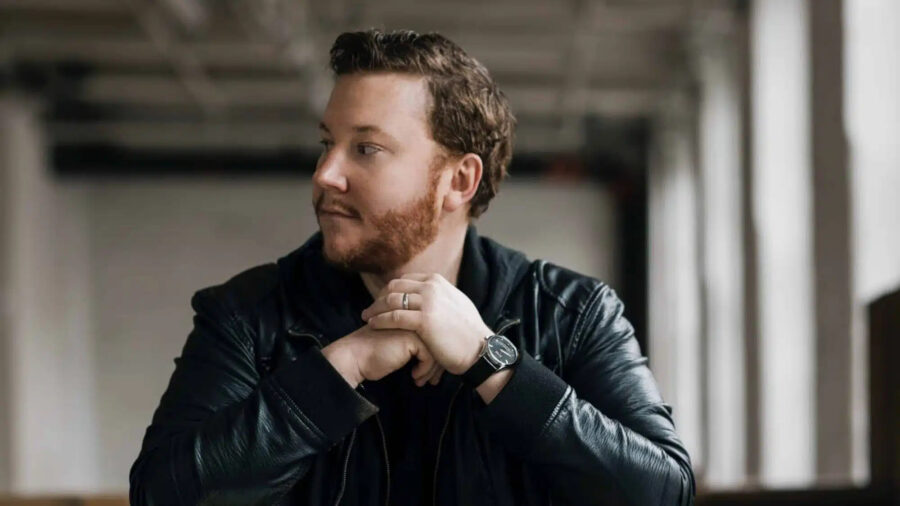
Nicholas Brownlee smiles when asked if he has any summer plans.
“Not really,” comes the response, “but I think I know every inch of track between Munich and Bayreuth.”
The American bass-baritone has been singing non-stop, or so it seems, for over a decade. This past season has been especially focused on the work of Richard Wagner, starting last autumn at Bayerische Staatsoper in Munich with a highly acclaimed production of Das Rheingold directed by Tobias Kratzer, with Brownlee singing the role of Wotan, King of the Gods. The production was revived this past July for the company’s annual summer opera festival. This summer he returned to the Bayreuth Festival, following his debut there last summer, as Donner in a revival of Das Rheingold, directed by Valentin Schwartz and conducted by Simone Young. Between rehearsals for the two revivals, Brownlee clocked up a lot of mileage with Deutsche Bahn.
The journey for a “classic-American boy” from Alabama, as you’ll read, has been longer, if also deeply rewarding. Winner of the 2025 Richard Tucker prize, Brownlee’s journey has been characterized by a nose-to-the-grindstone approach, one that has never been at the expense of intelligent singing and a colourful, rich sound. The bass-baritone, who was awarded first-prize in the Hans Gabor Belvedere Singing Competition (2016), the Zarzuela prize at Operalia (2016), and was a winner in the Metropolitan Opera National Council Auditions (2015), got his start studying at the University of South Alabama before getting his Master of Music degree from Rice University. From the 2014-2015 to 2016-2017 seasons, Brownlee was a member of the LA Opera Young Artist program; he also appeared with the International Vocal Arts Institute in Tel Aviv, was part of the inaugural Young Artist Vocal Academy with Houston Grand Opera; spent a summer in Beijing with I Sing Beijing, and was part of the ensemble of Badisches Staatstheater Karlsruhe, where he performed a range of works by Handel, Massenet, Gounod, Offenbach, Mozart, and Verdi, and others. The 2020-2021 season saw him join the ensemble of Oper Frankfurt, where he has been based ever since. There, Brownlee has added the music of Verdi, Mozart, Strauss, Szymanowski, Bizet, Bartók, Giordano, Stravinsky, and a great many more to his repertoire.
He has since performed with Wiener Staatsoper, Opernhaus Zürich , Irish National Opera, Teatro dell’Opera di Roma, Teatro de São Carlos (Lisbon), The Metropolitan Opera, LA Opera, The Dallas Opera, Santa Fe Opera, Atlanta Opera, and Bard SummerScape, expanding his musical palette to include the work of Erich Korngold (Das Wunder der Heliane, 2019) as well as contemporary composers like Jake Heggie (Moby Dick, 2015) and Unsuk Chin, whose Alice in Wonderland was presented in 2015 in concert with the Los Angeles Philharmonic and conductor Susanna Mälkki. He has also performed with the Houston Symphony Orchestra, Orchestre Symphonique de Montréal, the Prague Philharmonia Orchestra, and Orchestra Sinfonica Siciliana; next season sees him give concert performances with the Houston Symphony (Tristan und Isolde) and the orchestra of the Gran Teatre del Liceu (Mahler’s Eighth Symphony).
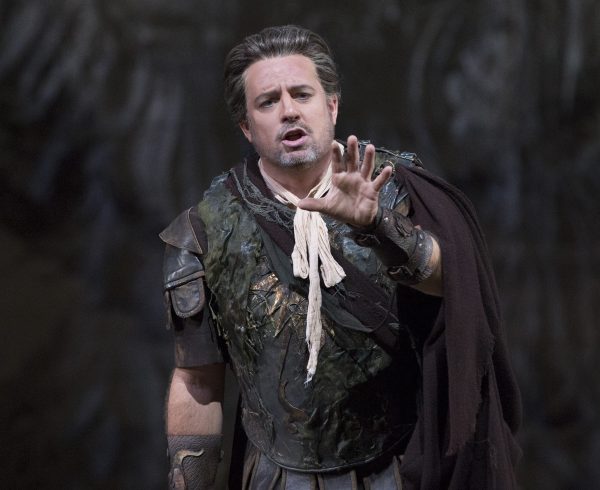
Whether in-concert or onstage in opera, Brownlee is never less than fascinating. In 2024 he gave a particularly zesty portrayal of Don Pizarro in a unique production (by Andriy Zholdak) of Beethoven’s Fidelio at Dutch National Opera, in which he was made to resemble high fashion honcho Karl Lagerfeld. One definitely isn’t supposed to root for the bad guy in Beethoven’s paean to freedom and fidelity… and yet. Something similar could be said for his Wotan in the Bayerische Staatsoper production of Das Rheingold – though Wotan is less villainous, as Wagner fans will know, than he is ruthlessly ambitious. Brownlee placed emphasis on the “ruthless” part, offering a multifaceted portrayal of the Valhalla god, by turns playful, brutal, seductive, highly selfish and deeply driven – human.
We discussed that and more last month, at the almost-end of what had been a very busy, Wagner-heavy season. Along with Wotan in Munich in October (and again in July), early February saw Brownlee sing the same role for his house debut with Opéra national de Paris (directed by Calixto Bieito) and Oper Leipzig, in a revival of Rosamunde Gilmore’s 2013 staging. From there, Brownlee performed as the doomed title character in Der fliegende Holländer (The Flying Dutchman) at Palau de les Arts Reina Sofía (Valencia), Teatro Regio di Torino, and Bayerische Staatsoper. He sang the role of Amfortas (Parsifal) with Oper Frankfurt and in a concert presentation with Cēsis Art Festival and the Latvian National Symphony Orchestra. Recently in Bayreuth, Brownlee stepped in at the last minute for the singing role of Hans Sachs in Die Meistersinger von Nürnberg. His 2025-2026 season opens with a role debut as Balstrode in Peter Grimes in Frankfurt (opposite tenor Allan Clayton in the lead) before travelling to Hong Kong to sing Amonasro in Aida; his hectic future also includes a performance of Jochanaan in Salome with Lyric Opera Chicago, a turn as the Dutchman opposite Asmik Grigorian’s Senta in Bayreuth, and of course, a return to Wotan with Die Walküre with Bayerische Staatsoper, both next summer. One suspects the Munich-Bayreuth line is going to be especially well-used.
Brownlee’s impressive vocalism, with its oaken shades and bronzed ringing top, joins seamlessly with an effortlessly magnetic stage presence and thoughtful artistry – and comes minus any divo attitude. The “charismatic and charming” description by The New York Times (from a review in 2015) is not inaccurate; offstage however, the bass-baritone’s charisma is powered by a refreshing lack of pretension or putting-on of any artiste-style airs. He is a star, make no mistake, but he wants to make sure audiences don’t just hear him, but feel him, and his musicality especially, with all the earth of sonic experience viscerally moving between fingers and toes. This isn’t singing from the heavens so much as from rolling around in that very earth, while, to borrow from Wilde, gazing at the stars. That’s the magic of Nicholas Brownlee as person and performer, onstage and off.
Over a lunch of salad and mineral water, and on the very day of the Munich Rheingold revival, Brownlee spent a good hour-plus musing on singers of all genres (he is a big Roy Orbison fan), the realities of German ensemble life, the importance of embracing his background (including creature comforts), living with (and as) Wotan, and why all opera essentially revolves around four basic human emotions.

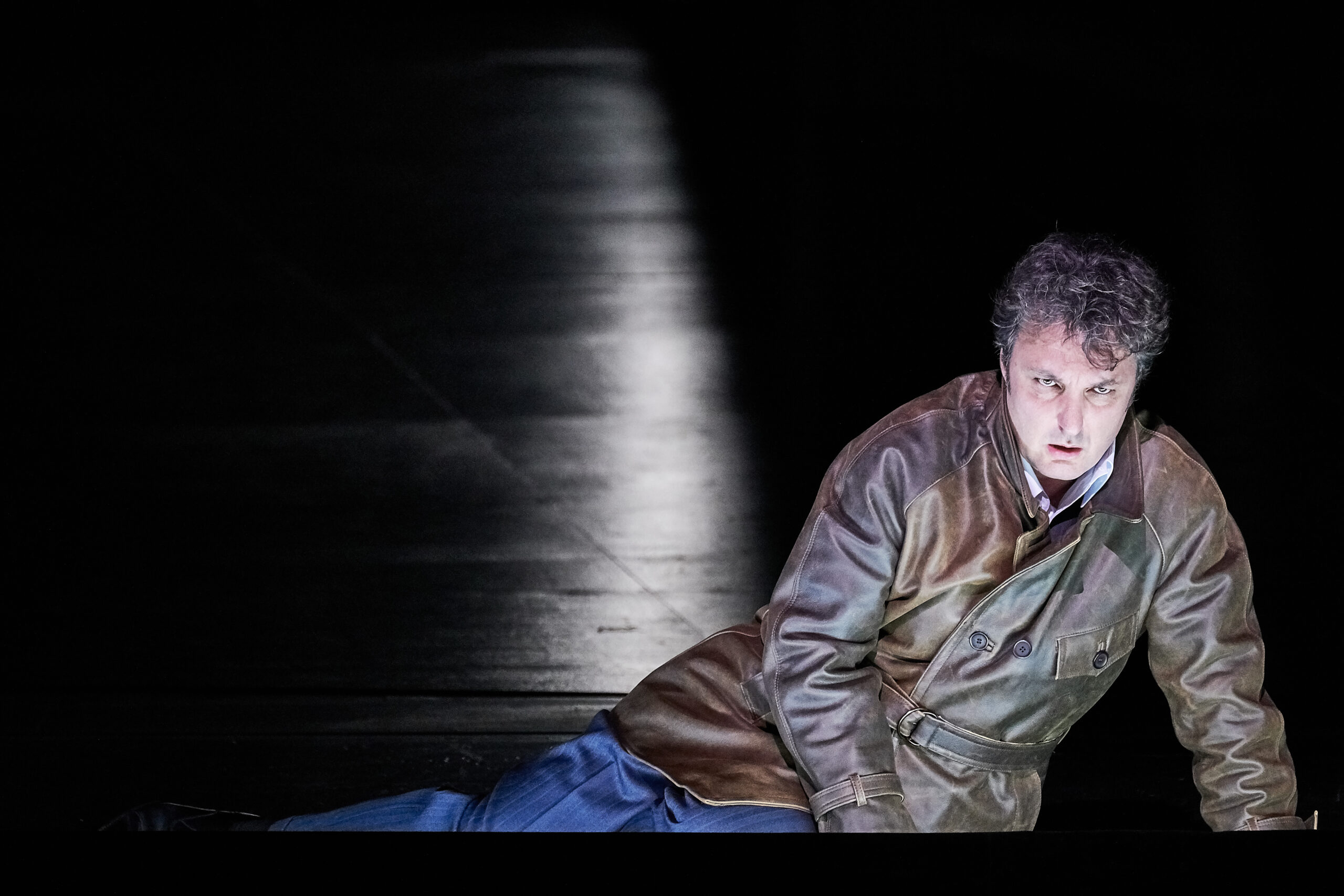
Nicholas Brownlee in the title role of Der fliegende Holländer, Bayerische Staatsoper, 25 March 2025. Photo ©Geoffroy Schied
Early Inspirations
Some singers have a clear idea of what they want to do – “When I first heard Aida, I knew I had to be Aida,” or “When I first heard Traviata, I knew I had to be Violetta” – was it the case for you with the music of Wagner, or was it a more circuitous route?
For me opera was, and continues to be, a very interesting journey. I have no classical music in my family at all, although I originally wanted to be a conductor; that’s how I fell in love with music. I had a high school teacher who introduced me to big symphonies and gave me a full music education in a public high school in Alabama, which was and is rare. And so I went to school to be a conductor and pianist. And it wasn’t until I was in the first opera I ever saw that I really thought about singing.
Which opera were you in at the beginning?
I was in the chorus of La traviata with the Mobile Opera. They still exist and I’m on the board there now. I then fell head over heels in love with opera through them.
Was there a big “a-ha!” moment – “Wow, I can sing this stuff!” – or was it more gradual?
I was always singing and performing in my household – Elvis Presley; Conway Twitty; old-school country music. I think it makes you a balanced performer to know that work. And I think when you look at singers like Tom Jones and Elvis and Roy Orbison, all those guys, they’re just beautiful, I mean… wow, they are just really good singers! They sing in tune; they sing unfixed post; they project – it’s all really good stuff. So with all that music at home, I would also sing and perform. In college I had a professor who was already sort of pushing me to sing; when I would have my exams, he would say, “You have a voice, and it’s operatic; I can hear it in your speaking voice.” I was 19 years old. So then I changed my focus to include voice in my major, and I started taking voice lessons. That was 16 or 17 years ago or so now, and there have been a lot of steps, but it’s been incredible.
Opera for me was the first thing I ever truly felt comfortable in, really. I grew up your very classic-American boy; I played American football and baseball and golf. I didn’t really know I felt uncomfortable then – I felt perfectly comfortable, in a way – but then I got around opera singers and various other artists in rehearsal rooms, and all my dark jokes were met with smiles. It was like, “Ah, welcome to the craziness!” That was when I felt the most comfortable, and I knew that I’d found a home.
Honest Friends = Good Friends
How does that sense of community translate to your experiences now? Doing opera productions, one forms this little club, and then when the run ends, so does the club – I would imagine that’s tough.
Well, it’s gotten easier. It is tough when you’re beginning because you’re young, you’re right out of school, and school is such an insular community. Then you go into your young artist program, and you’re all together like we were in LA for two years, having every meal together; in a way there are very frat-like vibes in a young artist program, because we’re all in it together… but then, all of a sudden, you are a freelance artist.
And those first few years, you’re working, sometimes with people in similar age ranges, and you realize people may take different paths: teaching, coaching, management. So you learn that every gig is different people, but each time you’re creating a bond. Maybe you have a show romance with someone or you think you’re best friends and you trade numbers. You’re like, “I found it! I found my best friend!” – and then it’s just gone. And then you go away and you don’t have time to figure it all out and real life kicks in. It’s so hard to get to this level – the amount of, not just talent, but luck it takes, the stress, the energy, the training, everything… it’s a lot. There are so many things you are forced to deal with. You end up working with some of the same people also, so there are little mini-reunions twice or sometimes three times a year, and that’s really important. From that, you start to forge actual friendships with roots and depth – and that, for me, has been a huge change.
Has that depth affected your performance practices?
I’ve been in the ensemble for five years in Frankfurt. The way we use our ensemble is so special. For instance, we’ll do a full Salome, and it’s everybody in the ensemble. We do a full Ring Cycle; it’s everybody from the ensemble. So you’re singing with some of your real best friends – like, all of our kids play together in real life. We have a lot of life there together and you get to do opera with them also, and so there’s a real safety, but more than that; there’s this ability to like feel like you can take chances that you wouldn’t normally take when you’re a guest in a place – because that trust is already there, it’s established. And, to be quite frank with you, it’s good to have friends who are close enough to sometimes say, “Well, that didn’t work, that thing you were trying to do.”
It works the other way also. Right before we went out and did a twelve-show run of Macbeth, I saw a friend of mine and they said, “I’m going to do it this way tonight” – and later it was like, “Bro, you gotta do that every night!”. There’s a beautiful, natural camaraderie amongst the singers, something that can be really hard to find.
Camaraderie, Comforts, & Life Between Plans
How do you negotiate life as an American in Europe?
It’s hard. I think you know I’ve lived here for nine years now. I was first in Karlsruhe for four years, then in Frankfurt now for five years. I think, like anywhere, you just have to find your people – you have to find your way of living. For instance, in the first four years my wife (mezzo-soprano Jennifer Feinstein) and I were here we went full-European: no car; lived in the heart of the city; walked everywhere – rain, snow, didn’t matter. It was really difficult. And then when we moved to Frankfurt, my wife and I were both like, “Look, if we’re going to really lean into here, why don’t we at least have some of the comforts from home?”
So we still live centrally, but further out. We bought a car we go grocery shopping with; we buy in bulk. We bought a big, American-style refrigerator with ice on the door. We bought screens for the windows. You have to find your creature comforts, these little things that, for better or worse, we grew up with, culturally. You cannot help where you’re born; you cannot help or change what is your homeland. And so, you adjust and you acclimate as much as you can – and then enjoy your creature comforts.
I would imagine that actually helps you on stage, knowing you have that kind of predictability at home.
Yes, and understanding that decision fatigue is a real thing also. It’s really hard to know, as a person living in a foreign place, exactly what you want initially, and how you want your life to look on a literal day-to-day basis – especially as an artist. I mean, as artists we are always looking at the big picture in this zoomed-out way, but the details matter, like “Wow, this person is probably a little dehydrated; he needs a coffee” – it’s just that simple sometimes.

Film still from Tobias Kratzer’s production of Das Rheingold for Bayerische Staatsoper. (L-R) Sean Panikkar as Loge, Nicholas Brownlee as Wotan, Lucie Thies (Bavarian State Opera extras). Photo © Manuel Braun, Jonas Dahl, Janic Bebi
Does Wotan want a coffee, then?
Yes! I mean, the question as to whether Wotan’s actually a human or a god or whatever… sometimes people are just people, and the answer is very simple. And I think that that’s the thing that gets us through day-to-day life. I think that it’s taken me a long time to come back around to this idea; I was raised very blue-collar, and then I got to college and I met a variety of different people, and I wound up getting a little too lofty for my britches, I would say, a little too heady and a little too looking-down-at-my-past culture and how I was raised – and now, I’ve come right back around. I think that that’s being a whole and total person. I think that’s what people mean by being worldly.
The ability to sit in a cafe in Paris and argue about philosophy until 2am is really nice, and really fun, and boy do I love that kind of thing, but I also love when I get invited by a nonna for an incredible meal that involves four ingredients – that is life; that is experience. It’s easy to fall into thinking opera’s this big, flowery thing, but, I say this all the time, I really am just screaming into a black void…
… with great precision and beauty.
That’s true, but I’m also doing it because I want to display the four base emotions of human life and try to shed a little bit of light on them. In order to do that, I say some of the most lofty things, especially singing Wagner – it’s the most poetic German you’ve ever heard in your life. Yes, we can break down the chords and we can talk about how gorgeous the music is and all of it, yes – but really, for me, what there highlights the four most basic human emotions: love; anger; sadness; the fourth one is complicated, maybe something like saudade, longing, sehnsucht. And I think that that’s what opera is. It’s trying to capture those four base emotions. Of course we can discuss its incredible power at various levels: the scary power of the church in Tosca; the power of economic hardship in Bohéme; Wotan’s testing and exercising his own divine power in The Ring. These stories aren’t distant; they’re very real.
With this Wotan I’m singing in Munich, I think of it like Elon Musk when he was 31 years old and had just sold PayPal; you can listen to interviews from that time and hear that he was walking along that line of power and how to use it. Wotan in Rheingold feels like somebody I might know, somebody who was young and made it big and is walking this line now. I mean, imagine you have the keys to the city, to every single city, the secrets of many, infinite knowledge, any male or female wants to be next to you – or more – all the time; how is that shit not going to corrupt you? Of course it will. Having that kind of a life is not the way life is really meant to be – it’s weird. The way this production ends really underlines that.
So what do you think has this experience taught you overall?
Some of my colleagues will say to me after a performance, “Look, you have this life, it’s a good life; whatever you do, Nick, hold onto it.” As much as Wagner is great, Bayreuth is great, Munich is great, it’s all very great – it’s important to have a life outside of opera. I think it’s really imperative. You can easily forget that life happens outside the opera house each and every day; you zoom in, and then you zone out. My wife is a big planner and I’m very spontaneous, and we’ll talk about meeting in the middle, but we always say in the end: life is really between the plans. Life is now.